

For many prospective diners, Instagram is an early inspection of the business. Before they decide to book, order or walk in, they may be trying to establish a few basic facts: what the restaurant serves, where it is, what it might cost, what the room feels like and whether there is a straightforward next step.
That makes the profile less like a gallery and more like a shopfront. Attractive food photography can create interest, but it cannot do all the work of signage, a menu board, a window display and an open door.
The useful standard is not that every visitor follows the account. It is that a suitable visitor can move from discovery to reassurance and then to action without hunting through months of posts.
Run the five-minute shopfront test
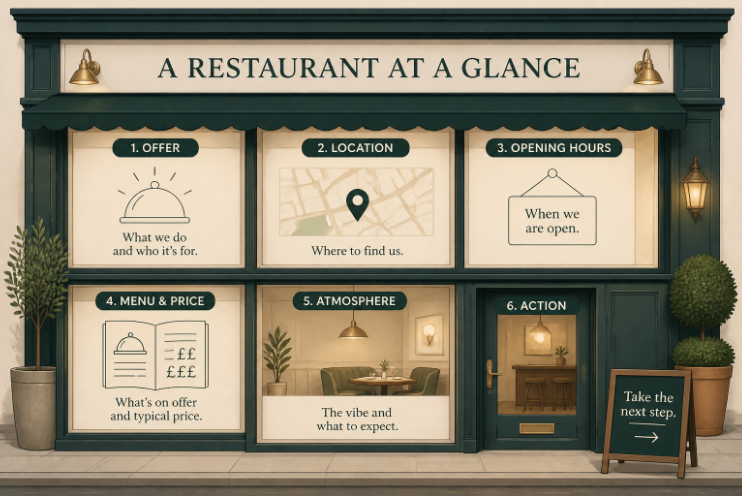
A useful restaurant profile should work like clear signage, a menu board and an open door.
Ask someone unfamiliar with the restaurant to look at its profile for five minutes. Can they tell:
what the restaurant serves and what occasion it suits;
its neighbourhood, address and contact route;
current opening times, including different takeaway or collection hours where relevant;
the likely price level and where to find a current menu;
what the dining room and service experience are actually like; and
how to book, order or make an enquiry?
If the answers are hidden in an old carousel or depend on a direct message, the profile is creating unnecessary work for a potential customer. This test is about clarity, not production values.
Fix the signage before making more content
Start with the profile name, a plain-English description of the offer, location details, contact options and one working link to the most useful destination. For a table-service restaurant, that may be a booking page; for a neighbourhood café, it might be the menu or ordering page.
Check this information before bank holidays, temporary closures, menu changes and seasonal service shifts. Test links on a phone, not just from the office. A profile advertising lunch when the kitchen is closed, or directing a diner to a broken booking page, can undo the trust created by good content.
The same essentials should match the website and Google Business Profile. Google’s guidance on managing a Business Profile explains how core information, including location, opening hours, phone number, website and photos, can appear in Search and Maps. Consistency helps diners avoid conflicting details as they move between local search and social media.
Accessibility belongs in the signage too. If guests commonly ask about step-free access, allergens, vegetarian dishes, halal options, children’s facilities or dogs, give staff a reliable and accurate answer. Do not make an accommodation sound assured unless the operation can consistently provide it.
Make the menu board easy to find
A menu buried in an old post is not a dependable menu board. Dishes, prices, dietary information, availability and service formats change too often for the grid to be the sole source of truth.
Keep a current menu reachable through the profile link, website or a clearly labelled Highlight where that feature is available to the account. If menus change daily, say so and distinguish representative dishes from guaranteed availability. Make set-menu, tasting-menu, Sunday lunch and takeaway pricing easy to locate.
This is a commercial as well as a customer-service issue. A diner who arrives to find a materially different price or unavailable dish may reasonably feel that the presentation was misleading, even if the change was unintentional.
Use the window display to show the whole occasion
Food remains central, but dishes alone do not communicate the full decision a guest is making. Show a realistic mix of:
food and drink;
the dining room at the times guests are likely to visit;
table settings, bar seats, private areas or outdoor space;
staff and service, with their agreement;
occasions such as a pre-theatre supper, business lunch or Sunday meal; and
preparation or provenance where it genuinely explains the offer.
A straightforward image of the room during service can be more helpful than a perfect close-up with no sense of place. Avoid imagery that exaggerates space, implies access to an unavailable view or repeatedly promotes dishes that have left the menu.
Customer posts can add useful perspective, but treat them carefully. Ask before repurposing a guest’s image, credit the creator where appropriate, and take particular care with identifiable diners and children. A customer’s spontaneous post is also different from content created after an invitation, payment or gift.
[Visual placeholder: restaurant-instagram-shopfront-checklist.jpg — Original editorial graphic showing signage, menu board, window display and open door as a restaurant-profile audit. Alt text: “The information and experience a restaurant Instagram profile should make clear.”]
Give each format a customer job
Do not treat formats as guaranteed reach tactics. Their practical value is in the job they do for a diner.
Short-form video can introduce movement, people and atmosphere: a chef finishing a dish, a bartender at work or the room before service. It should still be understandable without sound.
Feed posts can hold more durable context, such as a menu direction, chef introduction, refurbishment or concise explanation of the restaurant’s point of view.
Stories can handle timely updates: a same-day table, a daily special, a weather-related terrace update or an event reminder. They should not be the only place where permanent information is corrected.
Highlights, where available, are useful for answers that need a longer life: menus, directions, private dining, accessibility and frequently asked questions. Review them as closely as the bio.
Platform labels, link options and available insights can vary by account type and change over time. Before building a process around a feature, check what the restaurant’s own Instagram account currently provides.
Turn attention into an operational outcome
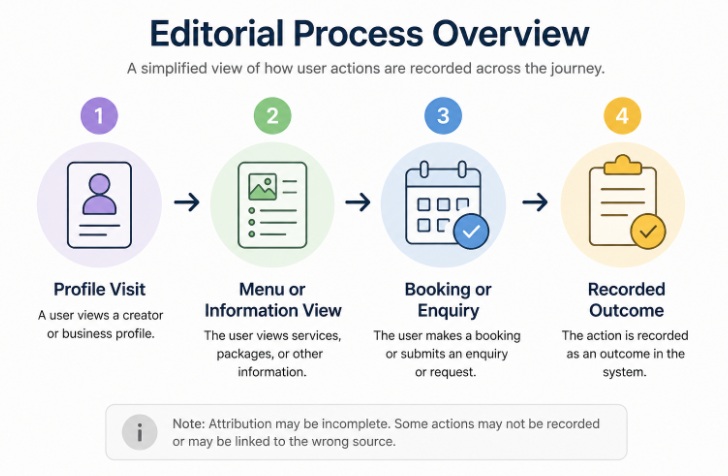
Track useful actions while recognising that a diner may discover on Instagram and convert elsewhere.
Map the route from a post to profile visit, menu view, booking page, telephone call, direct-message enquiry, takeaway order or private-dining lead. Then test each route outside service and on a mobile connection.
Be precise about what is being measured. A booking-link visit shows intent to investigate. A booking start shows that someone began the process. A completed booking is the stronger operational outcome, but only if the booking system records it and the team can reasonably connect it to the route taken. Instagram and booking-platform attribution will often be incomplete: a diner may view a post, search for the restaurant later and book through Google or the website.
Direct messages need an owner, not a vague expectation. Assign a named person or shift role to check message requests and inboxes, agree a response standard that the team can realistically meet, and provide a handover for days off. Review unanswered and slow replies weekly, particularly for private dining, group bookings and same-day availability.
Timely content can also support quieter trading periods. A Story about lunch availability or an early-week set menu may be worth testing, provided it is accurate and does not rely on artificial scarcity. The question is not simply whether a post received likes; it is whether it prompted a useful action in a service period the business wanted to improve.
That is also a better lens for assessing audience quality. Understanding what makes an Instagram audience commercially useful starts with activity beyond the follower total: local relevance, meaningful attention and actions that can be observed. Follower count and likes can provide context, but they are not a substitute for enquiries, orders, bookings and covers.
[Visual placeholder: restaurant-instagram-customer-journey.jpg — Original process diagram showing profile visit, menu view, booking or enquiry, and recorded outcome. Alt text: “A framework for tracking a diner journey from Instagram to restaurant action.”]
Connect Instagram to local discovery
Instagram can convey character; a website, search listing and reviews often answer immediate practical questions. A diner may discover a restaurant through video, check Maps for directions and opening hours, then return to the profile to judge the atmosphere.
Keep the restaurant name, address, hours, telephone number, service description and menu or booking destination aligned across those touchpoints. If the venue changes booking provider, pauses delivery or closes for refurbishment, update every relevant channel rather than hoping a pinned post will correct older information.
Build a system a small team can maintain
Consistency does not require daily polished production. It requires a routine that protects accuracy:
Set aside a short weekly check for hours, menus, prices, links, Highlights and message response.
Capture several usable assets during one service or planned shoot.
Use simple templates for specials, availability and events.
Let staff contribute material, but give one person final responsibility for accuracy and tone.
Review monthly activity: profile visits, link taps, booking starts, completed bookings where trackable, enquiries, orders, redemptions and covers by service period.
A modest account can still be effective when it gives an honest impression, answers practical questions and presents a clear route to action.
Treat creator and customer content transparently
Do not blur unsolicited customer enthusiasm with paid, gifted or incentivised content. A restaurant that pays, invites, gives a meal or offers another benefit in return for promotional content should consider the disclosure requirements that apply to that arrangement.
The Competition and Markets Authority’s guidance for brands on social-media endorsements advises that advertising should be clearly and prominently labelled, using labels such as “Ad” or “Advert” where applicable. It also reinforces the importance of not disguising commercial relationships as independent opinion.
Restaurants should not ask for a positive review in exchange for free hospitality, and should check current CMA, ASA and CAP guidance before running creator activity. This is not legal advice: the appropriate approach can depend on the incentive, relationship and content.
The weekly closing check
Before the next week begins, ask:
Information: Are hours, menus, prices, dietary details, contact options and links current?
Experience: Does recent content show what a visit genuinely feels like?
Action: Can a guest book, order or enquire in a few taps?
Responsibility: Has someone checked and answered messages, including requests?
Learning: What booking starts, completed bookings, enquiries, orders or covers can the team see, while acknowledging attribution gaps?
Instagram works best as a maintained customer-facing operation, not a louder display cabinet. The aim is a truthful, welcoming and practical front door to the restaurant.
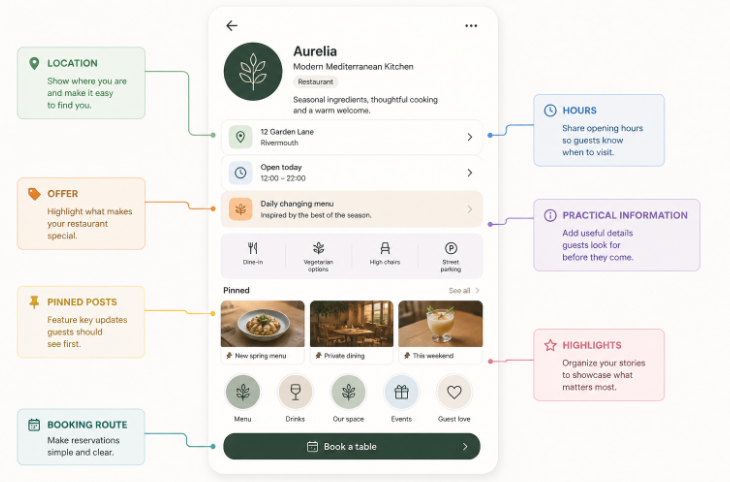
A practical shopfront test focuses on clarity, current information and an obvious next step.
Instagram can support discovery, but the customer journey also depends on accurate menus, booking details and location information.
A manageable reset prioritises accurate information, realistic content capture and review of useful signals.