
New Delhi, India – December 8, 2025 – In a landmark strategic alliance poised to redefine the global semiconductor supply chain and catapult India onto the world stage of advanced manufacturing, Intel Corporation (NASDAQ: INTC) and the Tata Group announced a monumental collaboration today. This partnership centers around Tata Electronics' ambitious $14 billion (approximately ₹1.18 lakh crore) investment to establish India's first semiconductor fabrication (fab) facility in Dholera, Gujarat, and an Outsourced Semiconductor Assembly and Test (OSAT) plant in Assam. Intel is slated to be a pivotal initial customer for these facilities, exploring local manufacturing and packaging of its products, with a significant focus on rapidly scaling tailored AI PC solutions for the burgeoning Indian market.
The agreement, formalized through a Memorandum of Understanding (MoU) on this date, marks a critical juncture for both entities. For Intel, it represents a strategic expansion of its global foundry services (IFS) and a diversification of its manufacturing footprint, particularly in a market projected to be a top-five global compute hub by 2030. For India, it’s a giant leap towards technological self-reliance and the realization of its "India Semiconductor Mission," aiming to create a robust, geo-resilient electronics and semiconductor ecosystem within the country.
Technical Deep Dive: India's New Silicon Frontier and Intel's Foundry Ambitions
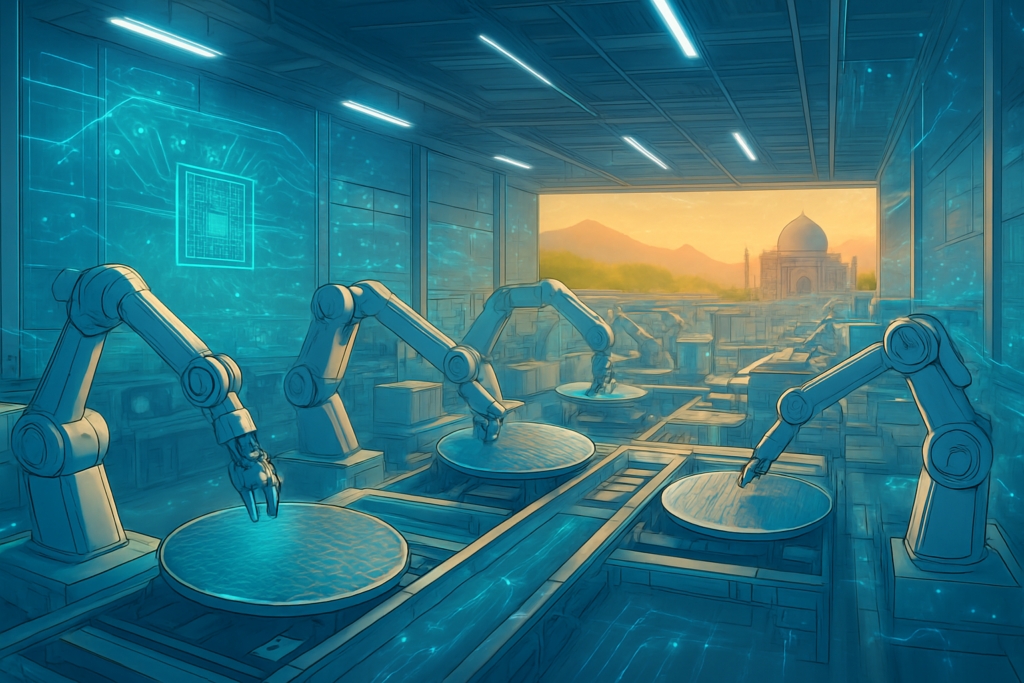
The technical underpinnings of this deal are substantial, laying the groundwork for a new era of chip manufacturing in India. Tata Electronics, in collaboration with Taiwan's Powerchip Semiconductor Manufacturing Corporation (PSMC), is spearheading the Dholera fab, which is designed to produce chips using 28nm to 110nm technologies. These mature process nodes are crucial for a vast array of essential components, including power management ICs, display drivers, and microcontrollers, serving critical sectors such as automotive, IoT, consumer electronics, and industrial applications. The Dholera facility is projected to achieve a significant monthly production capacity of up to 50,000 wafers (300mm or 12-inch wafers).
Beyond wafer fabrication, Tata is also establishing an advanced Outsourced Semiconductor Assembly and Test (OSAT) facility in Assam. This facility will be a key area of collaboration with Intel, exploring advanced packaging solutions in India. The total investment by Tata Electronics for these integrated facilities stands at approximately $14 billion. While the Dholera fab is slated for operations by mid-2027, the Assam OSAT facility could go live as early as April 2026, accelerating India's entry into the crucial backend of chip manufacturing.
This alliance is a cornerstone of Intel's broader IDM 2.0 strategy, positioning Intel Foundry Services (IFS) as a "systems foundry for the AI era." Intel aims to offer full-stack optimization, from factory networks to software, leveraging its extensive engineering expertise to provide comprehensive manufacturing, advanced packaging, and integration services. By securing Tata as a key initial customer, Intel demonstrates its commitment to diversifying its global manufacturing capabilities and tapping into the rapidly growing Indian market, particularly for AI PC solutions. While the initial focus on 28nm-110nm nodes may not be Intel's cutting-edge (like its 18A or 14A processes), it strategically allows Intel to leverage these facilities for specific regional needs, packaging innovations, and to secure a foothold in a critical emerging market.
Initial reactions from industry experts are largely positive, recognizing the strategic importance of the deal for both Intel and India. Experts laud the Indian government's strong support through initiatives like the India Semiconductor Mission, which makes such investments attractive. The appointment of former Intel Foundry Services President, Randhir Thakur, as CEO and Managing Director of Tata Electronics, underscores the seriousness of Tata's commitment and brings invaluable global expertise to India's burgeoning semiconductor ecosystem. While the focus on mature nodes is a practical starting point, it's seen as foundational for India to build robust manufacturing capabilities, which will be vital for a wide range of applications, including those at the edge of AI.
Corporate Chessboard: Shifting Dynamics for Tech Giants and Startups
The Intel-Tata alliance sends ripples across the corporate chessboard, promising to redefine competitive landscapes and open new avenues for growth, particularly in India.
Tata Group (NSE: TATA) stands as a primary beneficiary. This deal is a monumental step in its ambition to become a global force in electronics and semiconductors. It secures a foundational customer in Intel and provides critical technology transfer for manufacturing and advanced packaging, positioning Tata Electronics across Electronics Manufacturing Services (EMS), OSAT, and semiconductor foundry services. For Intel (NASDAQ: INTC), this partnership significantly strengthens its Intel Foundry business by diversifying its supply chain and providing direct access to the rapidly expanding Indian market, especially for AI PCs. It's a strategic move to re-establish Intel as a major global foundry player.
The implications for Indian AI companies and startups are profound. Local fab and OSAT facilities could dramatically reduce reliance on imports, potentially lowering costs and improving turnaround times for specialized AI chips and components. This fosters an innovation hub for indigenous AI hardware, leading to custom AI chips tailored for India's unique market needs, including multilingual processing. The anticipated creation of thousands of direct and indirect jobs will also boost the skilled workforce in semiconductor manufacturing and design, a critical asset for AI development. Even global tech giants with significant operations in India stand to benefit from a more localized and resilient supply chain for components.
For major global AI labs like Google DeepMind, OpenAI, Meta AI (NASDAQ: META), and Microsoft AI (NASDAQ: MSFT), the direct impact on sourcing cutting-edge AI accelerators (e.g., advanced GPUs) from this specific fab might be limited initially, given its focus on mature nodes. However, the deal contributes to the overall decentralization of chip manufacturing, enhancing global supply chain resilience and potentially freeing up capacity at advanced fabs for leading-edge AI chips. The emergence of a robust Indian AI hardware ecosystem could also lead to Indian startups developing specialized AI chips for edge AI, IoT, or specific Indian language processing, which major AI labs might integrate into their products for the Indian market. The growth of India's sophisticated semiconductor industry will also intensify global competition for top engineering and research talent.
Potential disruptions include a gradual shift in the geopolitical landscape of chip manufacturing, reducing over-reliance on concentrated hubs. The new capacity for mature node chips could introduce new competition for existing manufacturers, potentially leading to price adjustments. For Intel Foundry, securing Tata as a customer strengthens its position against pure-play foundries like TSMC (NYSE: TSM) and Samsung (KRX: 005930), albeit in different technology segments initially. This deal also provides massive impetus to India's "Make in India" initiatives, potentially encouraging more global companies to establish manufacturing footprints across various tech sectors in the country.
A New Era: Broader Implications for Global Tech and Geopolitics
The Intel-Tata semiconductor fab deal transcends mere corporate collaboration; it is a profound development with far-reaching implications for the broader AI landscape, global semiconductor supply chains, and international geopolitics.
This collaboration is deeply integrated into the burgeoning AI landscape. The explicit goal to rapidly scale tailored AI PC solutions for the Indian market underscores the foundational role of semiconductors in driving AI adoption. India is projected to be among the top five global markets for AI PCs by 2030, and the chips produced at Tata's new facilities will cater to this escalating demand, alongside applications in automotive, wireless communication, and general computing. Furthermore, the manufacturing facilities themselves are envisioned to incorporate advanced automation powered by AI, machine learning, and data analytics to optimize efficiency, showcasing AI's pervasive influence even in its own production. Intel's CEO has highlighted that AI is profoundly transforming the world, creating an unprecedented opportunity for its foundry business, making this deal a critical component of Intel's long-term AI strategy.
The most immediate and significant impact will be on global semiconductor supply chains. This deal is a strategic move towards creating a more resilient and diversified global supply chain, a critical objective for many nations following recent disruptions. By establishing a significant manufacturing base in India, the initiative aims to rebalance the heavy concentration of chip production in regions like China and Taiwan, positioning India as a "second base" for manufacturing. This diversification mitigates vulnerabilities to geopolitical tensions, natural disasters, or unforeseen bottlenecks, contributing to a broader "tech decoupling" effort by Western nations to reduce reliance on specific regions. India's focus on manufacturing, including legacy chips, aims to establish it as a reliable and stable supplier in the global chip value chain.
Geopolitically, the deal carries immense weight. India's Prime Minister Narendra Modi's "India Semiconductor Mission," backed by $10 billion in incentives, aims to transform India into a global chipmaker, rivaling established powerhouses. This collaboration is seen by some analysts as part of a "geopolitical game" where countries seek to diversify semiconductor sources and reduce Chinese dominance by supporting manufacturing in "like-minded countries" such as India. Domestic chip manufacturing enhances a nation's "digital sovereignty" and provides "digital leverage" on the global stage, bolstering India's self-reliance and influence. The historical concentration of advanced semiconductor production in Taiwan has been a source of significant geopolitical risk, making the diversification of manufacturing capabilities an imperative.
However, potential concerns temper the optimism. Semiconductor manufacturing is notoriously capital-intensive, with long lead times to profitability. Intel itself has faced significant challenges and delays in its manufacturing transitions, impacting its market dominance. The specific logistical challenges in India, such as the need for "elephant-proof" walls in Assam to prevent vibrations from affecting nanometer-level precision, highlight the unique hurdles. Comparing this to previous milestones, Intel's past struggles in AI and manufacturing contrast sharply with Nvidia's rise and TSMC's dominance. This current global push for diversified manufacturing, exemplified by the Intel-Tata deal, marks a significant departure from earlier periods of increased reliance on globalized supply chains. Unlike past stalled attempts by India to establish chip fabrication, the current government incentives and the substantial commitment from Tata, coupled with international partnerships, represent a more robust and potentially successful approach.
The Road Ahead: Challenges and Opportunities for India's Silicon Dream
The Intel-Tata semiconductor fab deal, while groundbreaking, sets the stage for a future fraught with both immense opportunities and significant challenges for India's burgeoning silicon dream.
In the near-term, the focus will be on the successful establishment and operationalization of Tata Electronics' facilities. The Assam OSAT plant is expected to be operational by mid-2025, followed by the Dholera fab commencing operations by 2027. Intel's role as the first major customer will be crucial, with initial efforts centered on manufacturing and packaging Intel products specifically for the Indian market and developing advanced packaging capabilities. This period will be critical for demonstrating India's capability in high-volume, high-precision manufacturing.
Long-term developments envision a comprehensive silicon and compute ecosystem in India. Beyond merely manufacturing, the partnership aims to foster innovation, attract further investment, and position India as a key player in a geo-resilient global supply chain. This will necessitate significant skill development, with projections of tens of thousands of direct and indirect jobs, addressing the current gap in specialized semiconductor fabrication and testing expertise within India's workforce. The success of this venture could catalyze further foreign investment and collaborations, solidifying India's position in the global electronics supply chain.
The potential applications for the chips produced are vast, with a strong emphasis on the future of AI. The rapid scaling of tailored AI PC solutions for India's consumer and enterprise markets is a primary objective, leveraging Intel's AI compute designs and Tata's manufacturing prowess. These chips will also fuel growth in industrial applications, general consumer electronics, and the automotive sector. India's broader "India Semiconductor Mission" targets the production of its first indigenous semiconductor chip by 2025, a significant milestone for domestic capability.
However, several challenges need to be addressed. India's semiconductor industry currently grapples with an underdeveloped supply chain, lacking critical raw materials like silicon wafers, high-purity gases, and ultrapure water. A significant shortage of specialized talent for fabrication and testing, despite a strong design workforce, remains a hurdle. As a relatively late entrant, India faces stiff competition from established global hubs with decades of experience and mature ecosystems. Keeping pace with rapidly evolving technology and continuous miniaturization in chip design will demand continuous, substantial capital investments. Past attempts by India to establish chip manufacturing have also faced setbacks, underscoring the complexities involved.
Expert predictions generally paint an optimistic picture, with India's semiconductor market projected to reach $64 billion by 2026 and approximately $103.4 billion by 2030, driven by rising PC demand and rapid AI adoption. Tata Sons Chairman N Chandrasekaran emphasizes the group's deep commitment to developing a robust semiconductor industry in India, seeing the alliance with Intel as an accelerator to capture the "large and growing AI opportunity." The strong government backing through the India Semiconductor Mission is seen as a key enabler for this transformation. The success of the Intel-Tata partnership could serve as a powerful blueprint, attracting further foreign investment and collaborations, thereby solidifying India's position in the global electronics supply chain.
Conclusion: India's Semiconductor Dawn and Intel's Strategic Rebirth
The strategic alliance between Intel Corporation (NASDAQ: INTC) and the Tata Group (NSE: TATA), centered around a $14 billion investment in India's semiconductor manufacturing capabilities, marks an inflection point for both entities and the global technology landscape. This monumental deal, announced on December 8, 2025, is a testament to India's burgeoning ambition to become a self-reliant hub for advanced technology and Intel's strategic re-commitment to its foundry business.
The key takeaways from this development are multifaceted. For India, it’s a critical step towards establishing an indigenous, geo-resilient semiconductor ecosystem, significantly reducing its reliance on global supply chains. For Intel, it represents a crucial expansion of its Intel Foundry Services, diversifying its manufacturing footprint and securing a foothold in one of the world's fastest-growing compute markets, particularly for AI PC solutions. The collaboration on mature node manufacturing (28nm-110nm) and advanced packaging will foster a comprehensive ecosystem, from design to assembly and test, creating thousands of skilled jobs and attracting further investment.
Assessing this development's significance in AI history, it underscores the fundamental importance of hardware in the age of artificial intelligence. While not directly producing cutting-edge AI accelerators, the establishment of robust, diversified manufacturing capabilities is essential for the underlying components that power AI-driven devices and infrastructure globally. This move aligns with a broader trend of "tech decoupling" and the decentralization of critical manufacturing, enhancing global supply chain resilience and mitigating geopolitical risks associated with concentrated production. It signals a new chapter for Intel's strategic rebirth and India's emergence as a formidable player in the global technology arena.
Looking ahead, the long-term impact promises to be transformative for India's economy and technological sovereignty. The successful operationalization of these fabs and OSAT facilities will not only create direct economic value but also foster an innovation ecosystem that could spur indigenous AI hardware development. However, challenges related to supply chain maturity, talent development, and intense global competition will require sustained effort and investment. What to watch for in the coming weeks and months includes further details on technology transfer, the progress of facility construction, and the initial engagement of Intel as a customer. The success of this venture will be a powerful indicator of India's capacity to deliver on its high-tech ambitions and Intel's ability to execute its revitalized foundry strategy.
This content is intended for informational purposes only and represents analysis of current AI developments.
TokenRing AI delivers enterprise-grade solutions for multi-agent AI workflow orchestration, AI-powered development tools, and seamless remote collaboration platforms.
For more information, visit https://www.tokenring.ai/.