As the calendar turns toward the final stretch of 2025, investors are anxiously looking for a seasonal miracle to reverse a month defined by volatility and economic uncertainty. Despite a healthy 16% year-to-date gain for the S&P 500, the first half of December has been characterized by a frustrating losing streak, leaving the major indices searching for a bottom. The market is currently grappling with the "data vacuum" left in the wake of the longest government shutdown in U.S. history, which has obscured key economic indicators and kept institutional buyers on the sidelines.
The immediate implications are significant: if the historical "Santa Claus Rally" fails to materialize, it could signal a bearish start to 2026. However, with the Federal Reserve recently stepping in with a much-anticipated interest rate cut, the stage is set for a potential year-end surge. Market participants are now betting that the combination of lower borrowing costs and the traditional holiday liquidity injection will be enough to snap the current downward trend and propel the markets to new highs before the ball drops in Times Square.
The December Doldrums: A Shutdown, a Pivot, and a Data Vacuum
The mid-December slump of 2025 was not a product of a single event, but rather a convergence of geopolitical and domestic hurdles. The primary catalyst for the recent losing streak was the record-breaking government shutdown that paralyzed Washington through late November and early December. This disruption halted the release of critical Gross Domestic Product (GDP) and Consumer Price Index (CPI) reports, leaving investors to trade on sentiment rather than hard data. This "data vacuum" created a vacuum of confidence, leading to a series of sell-offs as risk-averse funds moved to cash.
The tide began to shift on December 10, 2025, when the Federal Reserve, led by Chair Jerome Powell, announced a 25-basis-point cut to the federal funds rate, bringing it to a range of 3.50%–3.75%. This was the third cut of the year, framed by the Fed as "insurance" against a cooling labor market. While the initial reaction was positive, the gains were quickly erased by concerns over "sticky" inflation, which remains stubbornly anchored at 3.1% due to ongoing import tariffs and high housing costs.
Currently, the market is in a "wait-and-see" mode. The timeline leading up to today, December 18, has been a rollercoaster of hope and hesitation. Traders are now focusing on the official "Santa Claus Rally" window—the last five trading days of December and the first two of January. Historically, this period sees the S&P 500 rise 80% of the time with an average gain of 1.3%. After the volatility of the past two weeks, the psychological importance of this rally cannot be overstated; Wall Street is looking for a sign that the bull market of 2025 still has legs.
The Winners and Losers of the Year-End Push
In this environment of cooling rates and holiday spending, certain retail and tech giants are positioned to lead the charge. Walmart (NYSE: WMT) has emerged as a clear frontrunner, having successfully transformed its massive physical footprint into a high-speed e-commerce network. With global digital sales up 27% in late 2025, Walmart’s ability to capture budget-conscious consumers dealing with 3% inflation has made it a defensive favorite. Similarly, Target (NYSE: TGT) is seeing a seasonal boost from its exclusive in-store partnerships and robust "Buy Now, Pay Later" integrations, which have become essential for holiday shoppers this year.
The technology sector is also seeing a resurgence of interest, particularly in companies tied to the "AI Investment Cycle." Apple (NASDAQ: AAPL) recently hit fresh all-time highs following the successful rollout of its "Apple Intelligence" suite, which triggered a massive hardware upgrade cycle just in time for the holidays. Nvidia (NASDAQ: NVDA) and Palantir (NYSE: PLTR) continue to benefit from relentless corporate demand for AI infrastructure, serving as the backbone for the market's growth narrative. For these companies, a year-end rally would validate their premium valuations and set a high floor for 2026.
Conversely, some players are facing headwinds that could see them miss out on the holiday cheer. Amazon (NASDAQ: AMZN), while traditionally a holiday powerhouse, has faced localized labor strikes and increased regulatory scrutiny in December 2025, which has dampened its stock performance relative to its peers. Additionally, companies in the consumer discretionary space that lack strong pricing power are struggling to maintain margins against the backdrop of persistent inflation. For these firms, the "Santa Claus Rally" may be more of a brief respite than a true trend reversal.
Wider Significance: AI, Inflation, and the Ghost of Rallies Past
The potential 2025 Santa Claus Rally is more than just a seasonal quirk; it is a litmus test for the broader economic transition occurring in the mid-2020s. This event fits into a wider industry trend where "Big Tech" is no longer just about software, but about the physical infrastructure of artificial intelligence. The market’s reliance on companies like Nvidia and Apple to drive the indices higher highlights a narrowing of market breadth that has analysts concerned. If the rally is driven solely by a handful of tech names, the underlying health of the market may be more fragile than the headline numbers suggest.
Furthermore, the current situation draws historical comparisons to the late 1990s and the post-2010 recovery periods, where late-cycle interest rate cuts were used to extend bull markets. However, the "sticky inflation" of 2025 adds a modern twist. Unlike previous eras of low-inflation growth, the current market must balance the Fed's easing with the reality of higher costs for goods and services. This creates a ripple effect where financial fintechs like Shopify (NYSE: SHOP) and Affirm (NASDAQ: AFRM) become critical infrastructure, as they provide the liquidity and payment flexibility that keep the consumer engine running when cash is tight.
From a policy perspective, the outcome of this month will likely influence the Federal Reserve’s trajectory for the first half of 2026. A strong year-end finish would give the Fed more breathing room to hold rates steady, while a failed rally might pressure them into more aggressive cuts to prevent a hard landing. The "Indicator Rule"—which suggests that a failure for Santa to "call" at Broad and Wall often leads to a bearish January—is weighing heavily on the minds of institutional strategists.
Looking Ahead: The Road to 2026
As we look past the immediate holiday window, the short-term outlook will be dominated by the restoration of economic data flows. Once the government shutdown's impact is fully quantified, the market will have to reconcile its optimism with the reality of GDP growth and employment figures. Analysts expect a "strategic pivot" from many corporations in early 2026, shifting focus from pure AI experimentation to demonstrable ROI. This transition will likely create a divergence between AI "winners" who can monetize the tech and "pretenders" who are simply riding the hype.
Market opportunities are expected to emerge in the mid-cap sector, which has been largely ignored during the 2025 large-cap surge. If interest rates continue their descent toward the projected 3.0%–3.25% range by late 2026, smaller companies with higher debt sensitivity could see a massive re-rating. However, the challenge remains the "inflation floor"; if prices do not cool further, the Fed may be forced to pause its cutting cycle prematurely, creating a "stop-and-go" market environment that rewards active management over passive indexing.
Closing Thoughts for the 2025 Investor
The potential for a Santa Claus Rally in 2025 represents a critical junction for the American economy. After a month of "data-less" trading and shutdown-induced anxiety, a year-end surge would provide a much-needed psychological boost to both consumers and investors. The key takeaway is that while the historical odds favor a rally, the unique pressures of 3% inflation and a cooling labor market mean that this year’s "gift" from Wall Street may be more selective than in years past.
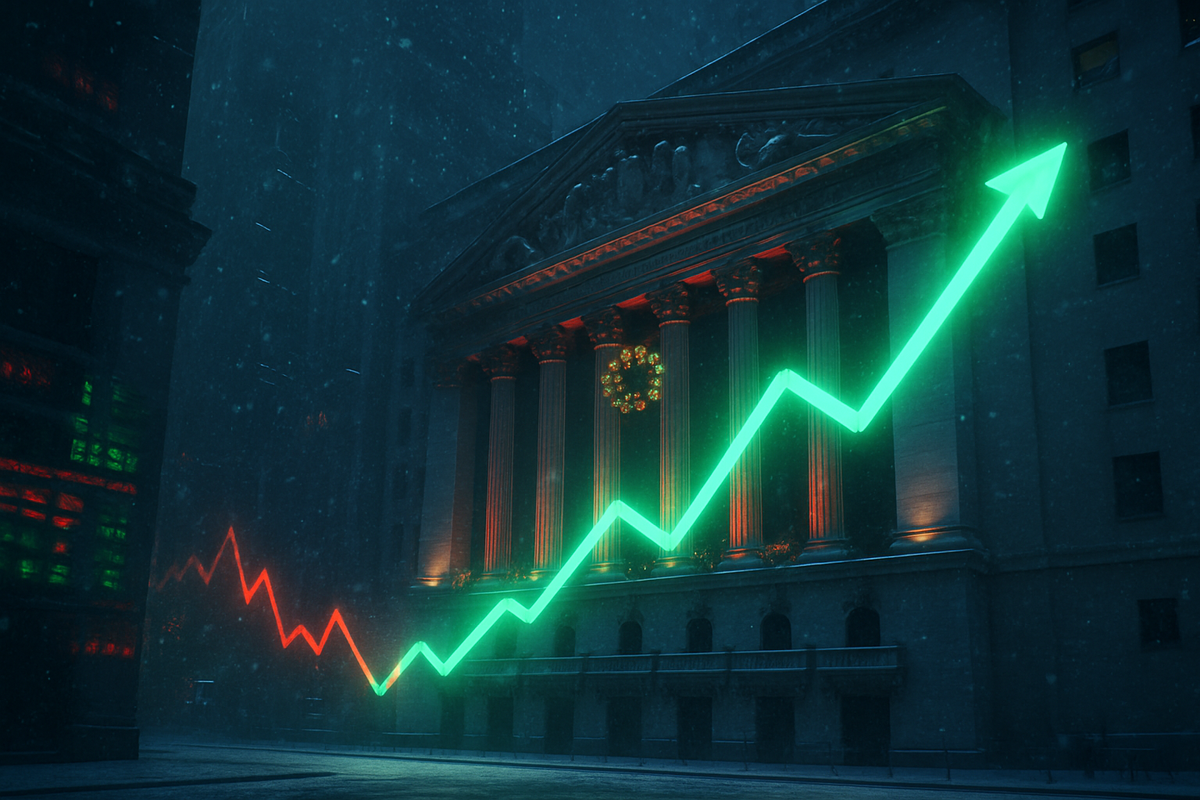
Moving forward, investors should keep a close eye on retail sales figures and the Fed’s commentary in early January. The lasting impact of this period will be determined by whether the recent rate cut can successfully stimulate growth without reigniting inflation. As we transition into 2026, the focus will shift from "surviving the shutdown" to "thriving in a lower-rate environment." For now, all eyes remain on the charts, waiting to see if Santa Claus will indeed make his scheduled stop at the New York Stock Exchange.
This content is intended for informational purposes only and is not financial advice.