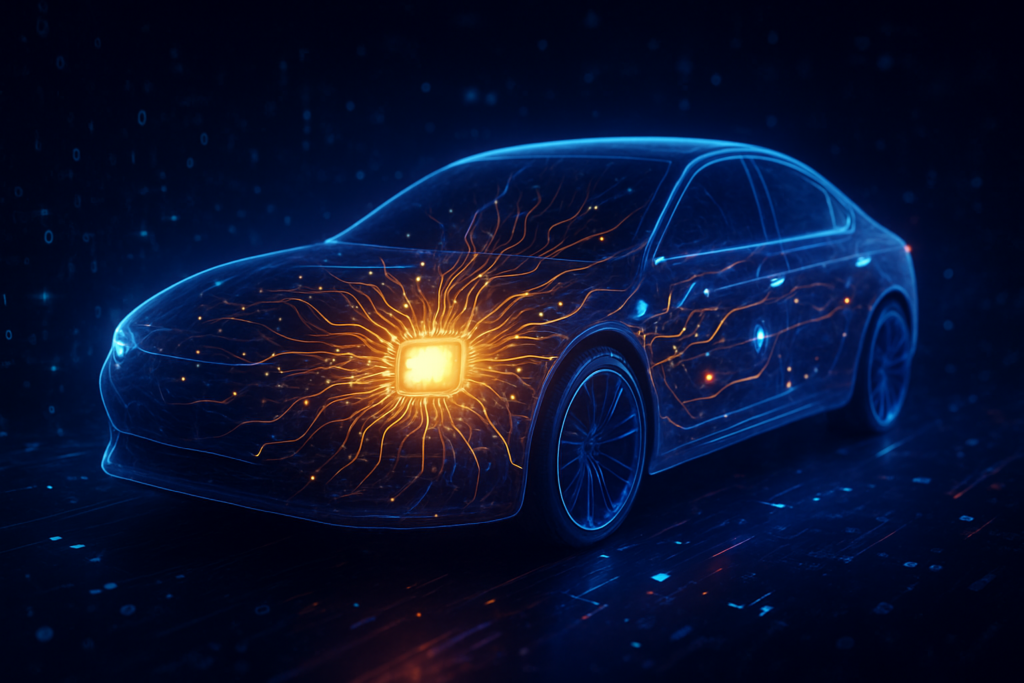
The automotive industry has reached a definitive tipping point as of late 2025. The era of the internal combustion engine’s mechanical complexity has been superseded by a new era of silicon-driven sophistication. We are no longer witnessing the evolution of the car; we are witnessing the birth of the "Software-Defined Vehicle" (SDV), where the value of a vehicle is determined more by its lines of code and its central processor than by its horsepower or torque. This shift toward centralized compute architectures is fundamentally redesigning the anatomy of the automobile, effectively turning every new vehicle into a high-performance computer on wheels.
The immediate significance of this transition cannot be overstated. By consolidating the dozens of disparate electronic control units (ECUs) that once governed individual functions—like windows, brakes, and infotainment—into a single, powerful "brain," automakers can now deliver over-the-air (OTA) updates that improve vehicle safety and performance overnight. For consumers, this means a car that gets better with age; for manufacturers, it represents a radical shift in business models, moving away from one-time hardware sales toward recurring software-driven revenue.
The Rise of the Superchip: 2,000 TOPS and the Death of the ECU
The technical backbone of this revolution is a new generation of "superchips" designed specifically for the rigors of automotive AI. Leading the charge is NVIDIA (NASDAQ: NVDA) with its DRIVE Thor platform, which entered mass production earlier this year. Built on the Blackwell GPU architecture, Thor delivers a staggering 2,000 TOPS (Trillion Operations Per Second)—an eightfold increase over its predecessor, Orin. What sets Thor apart is its ability to handle "multi-domain isolation." This allows the chip to simultaneously run the vehicle’s safety-critical autonomous driving systems, the digital instrument cluster, and the AI-powered infotainment system on a single piece of silicon without any risk of one process interfering with another.
Meanwhile, Qualcomm (NASDAQ: QCOM) has solidified its position with the Snapdragon Ride Elite and Snapdragon Cockpit Elite platforms. Utilizing the custom-built Oryon CPU and an enhanced Hexagon NPU, Qualcomm’s latest offerings have seen a 12x increase in AI performance compared to previous generations. This hardware is already being integrated into 2026 models for brands like Mercedes-Benz (OTC:MBGYY) and Li Auto (NASDAQ: LI). Unlike previous iterations that required separate chips for the dashboard and the driving assists, these new platforms enable a "zonal architecture." In this setup, regional controllers (Front, Rear, Left, Right) aggregate data and power locally before sending it to the central brain, a move that BMW (OTC:BMWYY) claims has reduced wiring weight by 30% in its new "Neue Klasse" vehicles.
This architecture differs sharply from the legacy "distributed" model. In older cars, if a sensor failed or a feature needed an update, it often required physical access to a specific, isolated ECU. Today’s centralized systems allow for "end-to-end" AI training. Instead of engineers writing thousands of "if-then" rules for every possible driving scenario, the car uses Transformer-based neural networks—similar to those powering Large Language Models (LLMs)—to "reason" through traffic by analyzing millions of hours of driving video. This leap in capability has moved the industry from basic lane-keeping to sophisticated, human-like autonomous navigation.
The New Power Players: Silicon Giants vs. Traditional Giants
The shift to SDVs has caused a massive seismic shift in the automotive supply chain. Traditional "Tier 1" suppliers like Bosch and Continental are finding themselves in a fierce battle for relevance as NVIDIA and Qualcomm emerge as the new primary partners for automakers. These silicon giants now command the most critical part of the vehicle's bill of materials, giving them unprecedented leverage over the future of transportation. For Tesla (NASDAQ: TSLA), the strategy remains one of fierce vertical integration. While Tesla’s AI5 (Hardware 5) chip has faced production delays—now expected in mid-2027—the company continues to push the limits of its existing AI4 hardware, proving that software optimization is just as critical as raw hardware power.
The competitive landscape is also forcing traditional automakers into unexpected alliances. Volkswagen (OTC:VWAGY) made headlines this year with its $5 billion investment in Rivian (NASDAQ: RIVN), a move specifically designed to license Rivian’s advanced zonal architecture and software stack. This highlights a growing divide: companies that can build software in-house, and those that must buy it to survive. Startups like Zeekr (NYSE: ZK) are taking the middle ground, leveraging NVIDIA’s Thor to leapfrog established players and deliver Level 3 autonomous features to the mass market faster than their European and American counterparts.
This disruption extends to the consumer experience. As cars become software platforms, tech giants like Google and Apple are looking to move beyond simple screen mirroring (like CarPlay) to deeper integration with the vehicle’s operating system. The strategic advantage now lies with whoever controls the "Digital Cockpit." With Qualcomm currently holding a dominant market share in cockpit silicon, they are well-positioned to dictate the future of the in-car user interface, potentially sidelining traditional infotainment developers.
The "iPhone Moment" for the Automobile
The broader significance of the SDV chip revolution is often compared to the "iPhone moment" for the mobile industry. Just as the smartphone transitioned from a communication device to a general-purpose computing platform, the car is transitioning from a transportation tool to a mobile living space. The integration of on-device LLMs means that AI assistants—powered by technologies like ChatGPT-4o or Google Gemini—can now handle complex, natural-language commands locally on the car’s chip. This ensures driver privacy and reduces latency, allowing the car to act as a proactive personal assistant that can adjust climate, suggest routes, and even manage the driver’s schedule.
However, this transition is not without its concerns. The move to centralized compute creates a "single point of failure" risk that engineers are working tirelessly to mitigate through hardware redundancy. There are also significant questions regarding data privacy; as cars collect petabytes of video and sensor data to train their AI models, the question of who owns that data becomes a legal minefield. Furthermore, the environmental impact of manufacturing these advanced 3nm and 5nm chips, and the energy required to power 2,000 TOPS processors in an EV, are challenges that the industry must address to remain truly "green."
Despite these hurdles, the milestone is clear: we have moved past the era of "assisted driving" into the era of "autonomous reasoning." The use of "Digital Twins" through platforms like NVIDIA Omniverse allows manufacturers to simulate billions of miles of driving in virtual worlds before a car ever touches asphalt. This has compressed development cycles from seven years down to less than three, fundamentally changing the pace of innovation in a century-old industry.
The Road Ahead: 2nm Silicon and Level 4 Autonomy
Looking toward the near future, the focus is shifting toward even more efficient silicon. Experts predict that by 2027, we will see the first automotive chips built on 2nm process nodes, offering even higher performance-per-watt. This will be crucial for the widespread rollout of Level 4 autonomy—where the car can handle all driving tasks in specific conditions without human intervention. While Tesla’s upcoming Cybercab is expected to launch on older hardware, the true "unsupervised" future will likely depend on the next generation of AI5 and Thor-class processors.
We are also on the horizon of "Vehicle-to-Everything" (V2X) communication becoming standard. With the compute power now available on-board, cars will not only "see" the road with their own sensors but will also "talk" to smart city infrastructure and other vehicles to coordinate traffic flow and prevent accidents before they are even visible. The challenge remains the regulatory environment, which has struggled to keep pace with the rapid advancement of AI. Experts predict that 2026 will be a "year of reckoning" for global autonomous driving standards as governments scramble to certify these software-defined brains.
A New Chapter in AI History
The rise of SDV chips represents one of the most significant chapters in the history of applied artificial intelligence. We have moved from AI as a digital curiosity to AI as a mission-critical safety system responsible for human lives at 70 miles per hour. The key takeaway is that the car is no longer a static product; it is a dynamic, evolving entity. The successful automakers of the next decade will be those who view themselves as software companies first and hardware manufacturers second.
As we look toward 2026, watch for the first production vehicles featuring NVIDIA Thor to hit the streets and for the further expansion of "End-to-End" AI models in consumer cars. The competition between the proprietary "walled gardens" of Tesla and the open merchant silicon of NVIDIA and Qualcomm will define the next era of mobility. One thing is certain: the silicon engine has officially replaced the internal combustion engine as the heart of the modern vehicle.
This content is intended for informational purposes only and represents analysis of current AI developments.
TokenRing AI delivers enterprise-grade solutions for multi-agent AI workflow orchestration, AI-powered development tools, and seamless remote collaboration platforms.
For more information, visit https://www.tokenring.ai/.