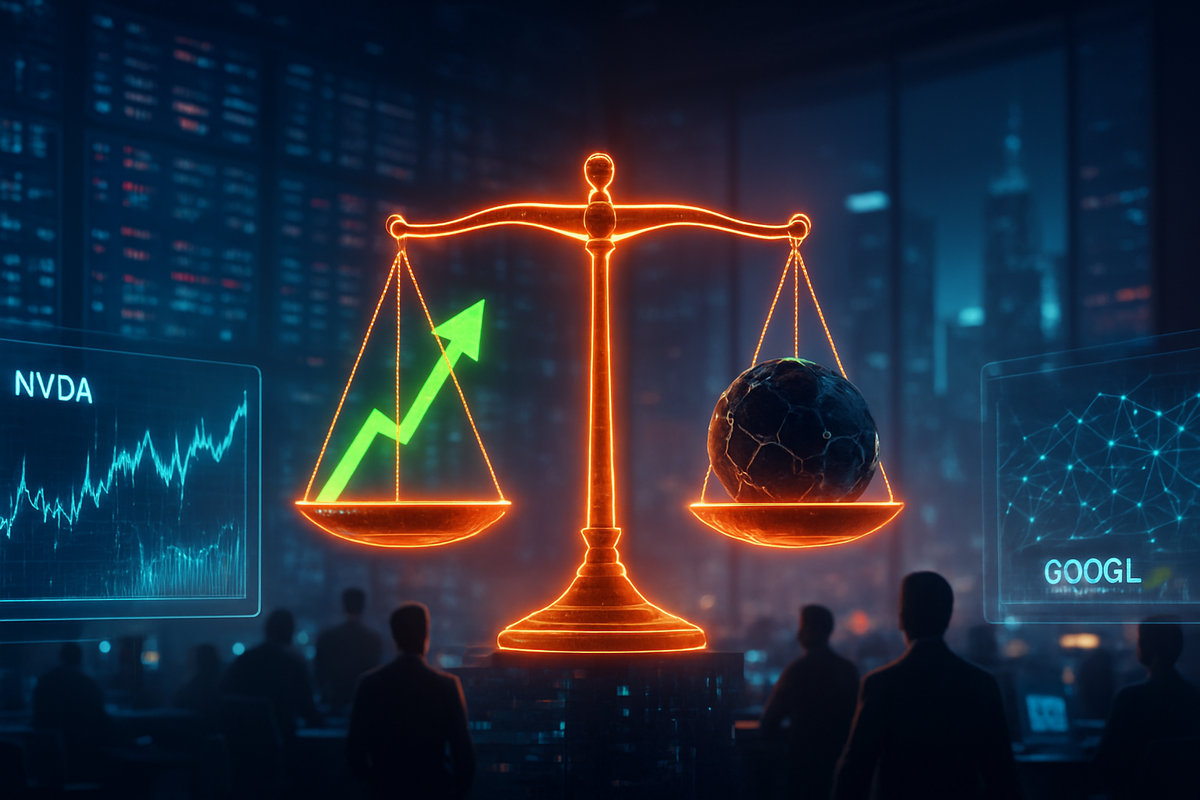
As the final trading days of 2025 approach, the financial markets find themselves suspended in a high-stakes psychological tug-of-war. On one side, a relentless "Fear of Missing Out" (FOMO) continues to drive capital into the artificial intelligence sector, fueled by a mid-December "Santa Rally" and a recent 25-basis-point rate cut by the Federal Reserve. On the other, a growing "Fear of a Bubble" has begun to fracture the once-monolithic tech leadership, leading to a "Great Divergence" where investors are no longer buying the sector wholesale but are instead demanding immediate, tangible proof of AI profitability.
This tension reached a fever pitch this week. Just one day ago, on December 18, 2025, the Dow Jones Industrial Average hit a record close of 48,416.56, propelled by a $7.1 trillion "Triple Witching" liquidity event. Yet, the atmosphere on the trading floors is far from celebratory. Today, December 19, 2025, the market is grappling with a sharp "Tech Retreat" as labor market jitters and disappointing guidance from AI infrastructure providers have sent the Nasdaq into a volatile tailspin, highlighting the fragile equilibrium between greed and systemic anxiety.
The Q4 Melt-Up and the Fracturing of the 'Magnificent Seven'
The final quarter of 2025 has been a period of extreme contrast. Following the resolution of a grueling 43-day federal government shutdown in late autumn, the markets experienced a massive "melt-up." Investors, relieved by the restoration of economic data flow and a "Goldilocks" inflation report showing CPI falling to 2.6%, poured money back into equities. However, unlike the broad-based rallies of 2023 and 2024, the 2025 year-end surge has been remarkably selective. The "Magnificent Seven" group of tech giants has effectively splintered, leaving the market in a state of nervous concentration.
Alphabet Inc. (NASDAQ: GOOGL) and NVIDIA (NASDAQ: NVDA) have emerged as the undisputed champions of this cycle, with Alphabet seeing a staggering 63% year-to-date gain as its autonomous "Agent 365" platform began replacing traditional enterprise workflows. Meanwhile, other members of the elite group have struggled to keep pace. Amazon.com, Inc. (NASDAQ: AMZN) and Apple Inc. (NASDAQ: AAPL) have lagged significantly, posting modest gains of 3% and 11% respectively, as investors grow weary of massive capital expenditures that have yet to translate into bottom-line growth. This divergence suggests that the market’s "blind faith" in AI has been replaced by a "show-me-the-money" mandate.
The timeline leading to this moment was punctuated by the November launch of advanced "Agentic AI" systems, which many analysts believe provided a temporary "valuation floor" for the sector. However, that floor was tested earlier this week when major infrastructure players reported that the timelines for new AI data centers were being pushed as far out as 2028. This news triggered a $70 billion market cap wipeout for several key firms in a single session, serving as a stark reminder that even the most revolutionary technologies are subject to the gravity of hardware cycles and margin pressure.
Winners and Losers in the AI Reckoning
In this environment of psychological extremes, the gap between the winners and losers has become a chasm. NVIDIA (NASDAQ: NVDA) continues to defy gravity, maintaining a 35% gain for the year as it transitions from a hardware provider to a full-stack AI ecosystem. Similarly, Palantir Technologies Inc. (NYSE: PLTR) has become the poster child for retail FOMO; despite a forward P/E ratio exceeding 240x, the stock remains a favorite for individual investors who fear they will miss the "next leg" of the autonomous software revolution.
Conversely, the "Fear of a Bubble" has hit the infrastructure and legacy hardware sectors hard. Oracle Corporation (NYSE: ORCL) and Broadcom Inc. (NASDAQ: AVGO) faced severe sell-offs in mid-December after their quarterly reports suggested that the astronomical costs of building AI clusters are beginning to squeeze gross margins. Investors, once willing to overlook high costs in favor of growth, are now punishing any company that hints at a delay in monetization. Microsoft Corporation (NASDAQ: MSFT), while still profitable and growing, has seen its stock price stagnate relative to the broader market as the "AI tax" on its cloud margins becomes a central concern for institutional analysts.
The "losers" in this current environment also include companies that failed to pivot their business models toward autonomous agents. Meta Platforms, Inc. (NASDAQ: META) and Tesla, Inc. (NASDAQ: TSLA) have both faced skepticism regarding their long-term AI roadmaps, with Tesla's 13.6% gain for the year underperforming the S&P 500’s 18% rise. For these firms, the challenge is no longer just proving they have the technology, but proving that the technology can generate a return on investment that justifies their current, elevated valuations.
Historical Precedents and the AI-Industrial Complex
The current tension between FOMO and bubble fears bears a striking resemblance to the late 1990s, but with a crucial difference: the "AI-Industrial Complex" is backed by trillions in actual revenue, unlike the "eyeballs-over-earnings" era of the Dot-com bubble. Nevertheless, a recent survey by Deutsche Bank revealed that 57% of investors now view a potential crash in AI valuations as the single greatest risk to market stability in 2026. This systemic anxiety is rooted in the $405 billion that big tech has collectively spent on AI infrastructure this year—a sum that some fear may never be fully recovered if the "agentic" economy doesn't scale as quickly as anticipated.
Broadly, this event fits into a larger trend of "valuation ceilings" created by Federal Reserve policy. On December 10, 2025, the Fed cut the benchmark rate to a range of 3.50%–3.75%, but signaled a "higher-for-longer" pause for the first half of 2026. This hawkish tone has capped the upside for high-multiple growth stocks, forcing a rotation into more traditional sectors like energy and financials. The market is now essentially trapped between the Fed’s restrictive stance and the tech industry’s insatiable hunger for capital.
Regulatory implications are also beginning to weigh on sentiment. As AI agents move from simple chatbots to autonomous entities capable of making financial decisions, the SEC and other global regulators have begun signaling a crackdown on data usage and algorithmic transparency. This looming policy shift has added a layer of "regulatory FOMO"—where companies are racing to establish market dominance before the window of unregulated growth slams shut.
What Lies Ahead: The 2026 Outlook
Looking toward 2026, the market is likely to face a period of forced adaptation. The short-term possibility of a "Santa Rally" continuation into January remains high, driven by the 44.6% of retail investors who remain bullish. However, the long-term outlook depends entirely on whether the "Agentic AI" revolution can deliver on its promise of massive productivity gains. If corporate earnings in Q1 2026 do not reflect the efficiencies promised by these new AI "employees," the "Fear of a Bubble" could quickly transition from a psychological state to a market reality.
Strategic pivots will be required for the laggards of 2025. We should expect to see a wave of consolidation as larger players like Microsoft (NASDAQ: MSFT) and Alphabet Inc. (NASDAQ: GOOGL) use their massive cash reserves to acquire smaller, specialized AI firms that have seen their valuations dip during the recent retreat. This "M&A winter" could provide the necessary fuel for the next market cycle, as the industry moves from infrastructure build-out to application-layer dominance.
Potential scenarios range from a "soft landing" for tech valuations to a sharp 20% correction if the Fed remains paused throughout 2026. Investors should be prepared for a "yield-driven" market, where stocks are judged not just by their AI potential, but by their ability to return capital to shareholders via dividends and buybacks—a trend already being seen in the recent resilience of the more mature tech giants.
The Investor's Wrap-Up: Navigating the Tension
The primary takeaway from the events of December 2025 is that the era of "rising tides lifting all boats" in technology is over. The "Great Divergence" has created a market where discernment is the most valuable asset an investor can possess. While the record highs of the Dow Jones suggest a healthy economy, the underlying volatility in the Nasdaq reveals a deep-seated anxiety about the sustainability of current AI multiples. The tension between FOMO and bubble fears is not just a psychological quirk; it is a fundamental feature of a market transitioning from a speculative phase to a functional one.
Moving forward, the market will likely remain in this state of "healthy tension" as long as economic data remains "Goldilocks"—not too hot to trigger inflation, and not too cold to signal a recession. However, the "labor market jitters" seen this week are a warning sign that the transition to an AI-driven economy will not be without its disruptions. Investors should watch for the Q4 earnings season in late January, which will serve as the ultimate litmus test for the "Agentic AI" narrative.
In the coming months, the key indicators to monitor will be the Federal Reserve’s commentary on the "higher-for-longer" pause and the progress of AI monetization in the enterprise software space. For those caught in the tug-of-war between greed and fear, the best strategy remains a focus on quality, margins, and the tangible delivery of value. The AI revolution is undoubtedly real, but as 2025 has shown, the path to the future is rarely a straight line.
This content is intended for informational purposes only and is not financial advice