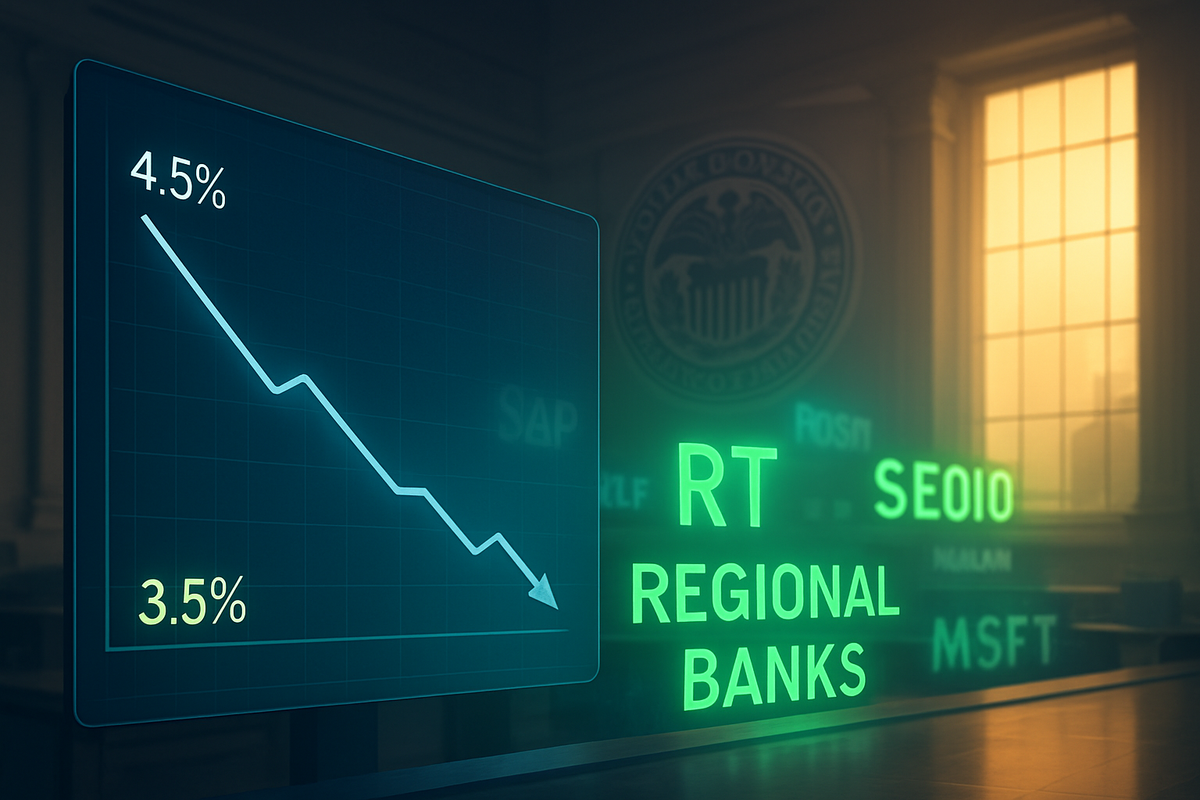
The final trading days of 2025 are approaching, and the financial landscape has been defined by a singular, persistent theme: the Federal Reserve’s pivot toward easing. Following the Federal Open Market Committee’s (FOMC) decision this week to lower the federal funds rate by another 25 basis points to a range of 3.50%–3.75%, the market is finally seeing the realization of a year-long hope. This shift has not only vindicated investors who bet on a "soft landing" but has also fundamentally rewired trading strategies that dominated the post-pandemic era.
The implications of this easing cycle are profound. For the better part of 2025, markets were locked in a tug-of-war between "sticky" inflation—exacerbated by new trade tariffs—and a cooling labor market. The Fed’s willingness to prioritize growth over the "last mile" of its 2% inflation target has sparked a massive rotation in capital. Investors are moving away from the safety of cash and mega-cap tech "fortresses" and toward interest-rate-sensitive sectors like small caps, regional banks, and software-as-a-service (SaaS) providers, signaling a new chapter for the 2026 market outlook.
The Long Road to Easing: A 2025 Timeline
The journey to the current rate environment was anything but linear. At the start of 2025, the Federal Reserve, led by Chair Jerome Powell, maintained a "higher-for-longer" stance, holding rates at 4.50% through the first half of the year. The primary concern was a persistent Consumer Price Index (CPI) that hovered between 2.7% and 3.1%, driven largely by the "Tariff Effect." Research from the St. Louis Fed suggested that newly implemented trade barriers added approximately 0.5 to 0.8 percentage points to core inflation, complicating the Fed's path to its 2% goal.
However, the narrative began to shift during the summer. By June, internal divisions within the FOMC became public, with a near-even split between officials wanting to hold steady and those advocating for immediate cuts to protect a softening labor market. The turning point arrived in the fall, following a 43-day government shutdown that disrupted economic data collection and created a "data blackout." When the numbers finally emerged in November, showing unemployment had ticked up to 4.6%, the Fed moved decisively. The central bank executed three consecutive 25-basis-point cuts in September, October, and the most recent meeting in December, bringing the total easing for the 2024-2025 cycle to 175 basis points.
Market participants, who had been pricing in these cuts with varying degrees of optimism since late 2024, reacted with a "Great Rotation." The CME FedWatch Tool, which had shown skepticism in early 2025, ended the year reflecting a market that is now closely aligned with the Fed’s "cautious easing" trajectory. This alignment has reduced the volatility seen in the Treasury markets, allowing institutional investors to extend duration in their bond portfolios and move back into the "belly" of the yield curve.
The Winners and Losers of the Rate Cut Era
The transition to a lower-rate environment has created a stark divide between companies that benefited from cheaper capital and those that were punished by shifting consumer behavior or valuation re-ratings.
The Winners: Small-cap stocks have been the primary beneficiaries of the Fed’s pivot. The Russell 2000 Index (NYSEARCA: IWM) outperformed the S&P 500 significantly in the latter half of 2025, as smaller firms are often more reliant on floating-rate debt. Applied Digital Corp. (NASDAQ: APLD) saw its shares surge as the cost of financing its massive data center expansions dropped. Similarly, Palantir Technologies Inc. (NYSE: PLTR) emerged as a "commercial powerhouse," with its stock rising over 120% this year as it successfully transitioned from government contracts to widespread corporate AI implementation. In the banking sector, Western Alliance Bancorporation (NYSE: WAL) and PNC Financial Services Group Inc. (NYSE: PNC) saw net interest margins expand as deposit costs fell faster than loan yields, a classic "U-shaped" recovery for regional lenders.
The Losers: Conversely, several high-flying names of the previous year faced a harsh reality check. The Trade Desk Inc. (NASDAQ: TTD) saw its valuation slashed by over 60% as investors moved away from high-multiple growth stocks that lacked immediate AI-driven revenue catalysts. The consumer discretionary sector also struggled; Lululemon Athletica Inc. (NASDAQ: LULU) shares fell over 50% as high interest rates for much of the year squeezed middle-class wallets, leading to a shift toward service-based spending over premium apparel. Even in the banking sector, success was not universal. Zions Bancorporation (NASDAQ: ZION) faced a sharp sell-off in late 2025 following disclosures of credit quality issues and "irregularities" in its commercial loan portfolio, highlighting the lingering risks in the Commercial Real Estate (CRE) sector.
Broader Significance and Industry Trends
The 2025 rate cycle represents more than just a change in borrowing costs; it marks a shift in the "AI trade." In 2024, the market was obsessed with the "picks and shovels"—the hardware and chipmakers. In 2025, the focus shifted to "AI Implementation." Companies that could prove AI was driving top-line revenue, like Palantir, were rewarded, while those viewed as mere infrastructure plays saw their premiums evaporate. This "AI fatigue" forced a more disciplined approach to tech investing, where cash flow and execution became more important than speculative potential.
Furthermore, the Fed's actions have highlighted a growing concern regarding the "maturity wall" in Commercial Real Estate. With approximately $1 trillion in CRE debt maturing in late 2025 and 2026, the rate cuts arrived just in time to prevent a systemic crisis, though they did not eliminate the pain. Regional banks with high CRE exposure are still under intense scrutiny, and the "neutral rate" era—where rates are neither stimulative nor restrictive—is expected to be higher than the pre-pandemic norm. This suggests that the "easy money" era of 0% rates is a relic of the past, and companies must now compete in a world where capital has a permanent and meaningful cost.
The Path Forward: What to Expect in 2026
As we look toward 2026, the market is entering a "wait-and-see" phase. The Federal Reserve has signaled a potential pause in early 2026 to assess the full impact of the 175 basis points of total easing. The primary question for the coming year is where the "neutral rate" actually lies. Most analysts project this to be around 3.0% to 3.5%, meaning the Fed may only have one or two cuts left in its arsenal before it reaches a terminal level.
For investors, the strategic pivot required in 2026 will involve moving beyond the "inflation trade." If inflation remains stable near 2.7%, the focus will shift entirely to corporate earnings growth and margin expansion. We may see an increase in Mergers and Acquisitions (M&A) and Initial Public Offerings (IPOs), as the stabilized rate environment provides the "valuation certainty" that dealmakers have craved for years. JPMorgan Chase & Co. (NYSE: JPM) is already positioned to benefit from this, having seen a significant jump in investment banking fees in the final quarter of 2025.
Closing Thoughts for the Modern Investor
The market’s journey through 2025 has been a masterclass in resilience and adaptation. The "Great Pivot" by the Federal Reserve has successfully steered the economy away from a deep recession, though the "last mile" of inflation remains a nagging concern. The most significant takeaway for investors is the return of diversification. The era of "Mega-cap or bust" has ended, replaced by a market that rewards domestic small caps, efficient software providers, and well-capitalized regional banks.
Moving forward, the key metrics to watch will be core PCE inflation and the health of the labor market. If unemployment continues to creep toward 5%, the Fed may be forced to cut below the neutral rate, potentially reigniting inflationary pressures. However, for now, the market is basking in the glow of a successful easing cycle. Investors should remain vigilant but optimistic, focusing on companies with strong balance sheets that can thrive in a "3% world."
This content is intended for informational purposes only and is not financial advice.