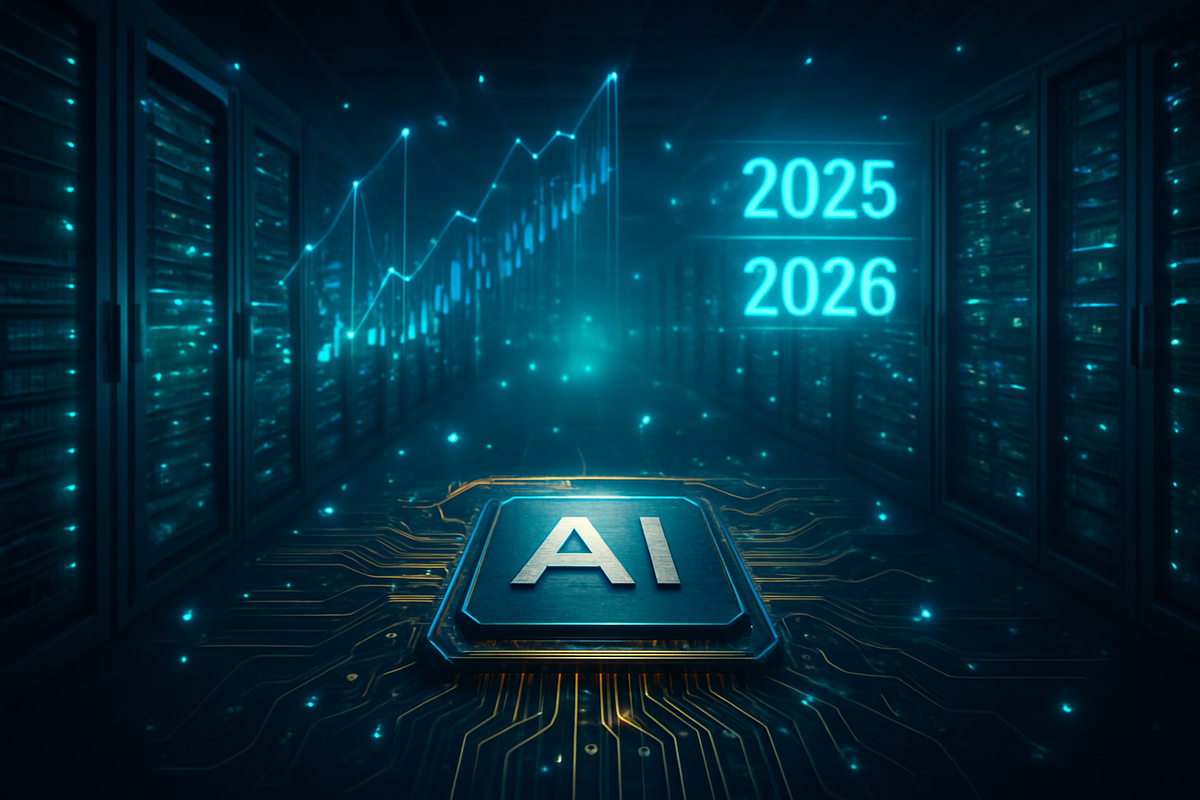
As the final weeks of 2025 unfold, the financial markets are witnessing a powerful resurgence in artificial intelligence equities, shaking off a volatile autumn to finish the year on a high note. Leading the charge are industry bellwethers Nvidia and Oracle, which have successfully navigated a mid-year "valuation reckoning" to reclaim their positions as the primary drivers of market momentum. This late-December rally is being fueled by a potent mix of stabilizing interest rates, record-breaking cloud backlogs, and a strategic pivot toward the next generation of autonomous "Agentic AI."
The immediate implications of this rebound are significant for both institutional and retail investors. After a sharp correction in November that saw several tech heavyweights lose nearly 10% of their value, the current bounce-back suggests that the appetite for AI infrastructure remains insatiable. With the Federal Reserve recently implementing a 25-basis-point rate cut on December 10, the cost of capital for massive data center expansions has eased, providing a tailwind for the high-growth tech sector as it prepares for the 2026 fiscal year.
The Road to Recovery: A Q4 Timeline of Resilience
The path to this December rebound was anything but smooth. Throughout the third and fourth quarters of 2025, the AI trade faced its most rigorous testing since the initial boom of 2023. In October 2025, Nvidia (NASDAQ: NVDA) hit a temporary ceiling as reports surfaced that hyperscalers like Alphabet (NASDAQ: GOOGL) and Meta (NASDAQ: META) were accelerating the development of their own custom silicon to reduce dependency on external hardware. This "silicon sovereignty" narrative triggered a sharp sell-off in November, leading many to wonder if the AI bubble had finally burst.
However, the narrative shifted dramatically in mid-December. The catalyst was two-fold: first, the blowout earnings from memory-partner Micron (NASDAQ: MU), which confirmed that demand for High Bandwidth Memory (HBM) continues to outstrip supply; and second, the official "bring-up" phase of Nvidia’s Blackwell Ultra architecture. By December 15, Nvidia shares had recouped their November losses, buoyed by the revelation that Blackwell systems are effectively sold out through mid-2026.
Simultaneously, Oracle (NYSE: ORCL) emerged as the dark horse of the cloud infrastructure race. After a parabolic rise in September following the announcement of a $300 billion partnership to support OpenAI’s "Stargate" supercomputer project, Oracle’s stock underwent a healthy "sell-the-news" correction. But by December 19, 2025, Oracle had stabilized, trading near its all-time highs as investors digested its Q2 FY2026 earnings report. The report highlighted a staggering $523 billion in Remaining Performance Obligations (RPO), a 359% surge from the previous year, signaling that the company has a decades-long runway of committed revenue.
Winners and Losers in the Infrastructure Arms Race
In this current environment, the clear winners are the "picks and shovels" providers who own the physical and logical layers of the AI stack. Nvidia (NASDAQ: NVDA) continues to dominate the hardware layer, with its transition to the Blackwell Ultra (B300) platform providing a bridge to the highly anticipated Rubin architecture expected in late 2026. Oracle (NYSE: ORCL) has also carved out a unique niche by offering the most flexible and cost-effective OCI (Oracle Cloud Infrastructure) for training large-scale models, effectively becoming the "neutral ground" for AI developers.
On the other side of the ledger, legacy hardware providers who have been slow to pivot away from CPU-centric architectures are facing a harsh reality. Companies like Intel (NASDAQ: INTC) continue to struggle with market share erosion as the industry's capital expenditure (CapEx) shifts almost entirely toward GPU-based accelerated computing. Additionally, smaller AI software startups that have failed to demonstrate a clear path to profitability are finding the 2025 funding environment far more restrictive than in years past. The market is no longer rewarding "AI potential"; it is rewarding "AI revenue."
Microsoft (NASDAQ: MSFT) remains a complex player in this landscape. While it benefits immensely from its partnership with OpenAI and its Azure AI services, it also faces the immense burden of massive CapEx spending. Investors are closely watching Microsoft’s margins, as the company must balance its multi-billion dollar infrastructure investments with the need to show tangible Return on Investment (ROI) from its Copilot software suite.
The Shift Toward Agentic AI and Global Policy
The broader significance of the late-2025 rebound lies in the evolution of AI technology itself. The industry is currently transitioning from "Generative AI"—which focuses on creating content and answering queries—to "Agentic AI." These are autonomous systems capable of executing complex, multi-step tasks without human intervention. This shift is driving a second wave of infrastructure investment, as Agentic AI requires even more compute power and lower latency than previous iterations.
Historically, this mirrors the transition from the early "Information Web" to the "Transactional Web" of the early 2000s. Just as the ability to conduct commerce online transformed the internet into a global economic engine, the ability for AI to perform autonomous work is expected to redefine the productivity of the global workforce. This trend is also catching the eye of regulators. In late 2025, the debate over AI safety and sovereign compute has intensified, with several nations proposing "compute sovereign" laws that require AI data to be processed within national borders, a trend that directly benefits Oracle's (NYSE: ORCL) distributed cloud strategy.
Furthermore, the Federal Reserve's pivot toward a more accommodative monetary policy in December 2025 has provided the liquidity necessary to sustain these massive industrial projects. The historical precedent of the "post-rate-hike rally" is playing out in real-time, as lower rates typically favor high-multiple growth stocks like those in the AI sector.
Looking Ahead: Is the Momentum Sustainable into 2026?
As we look toward 2026, the primary question is whether this momentum can be sustained or if a "digestion phase" is inevitable. In the short term, the outlook remains bullish. The launch of Nvidia’s (NASDAQ: NVDA) Rubin architecture in Q3 2026 is already being touted as the next major catalyst. Rubin is expected to be the first "AGI-scale" chip, featuring HBM4 memory and a three-fold increase in compute efficiency over current models.
However, 2026 is also being dubbed the "Year of Proof." The "growth-at-all-costs" mentality that defined 2024 and 2025 is expected to give way to a more disciplined focus on ROI. Enterprises that have spent millions on AI experimentation will be forced to show how these tools are improving their bottom lines. If the productivity gains from Agentic AI fail to materialize in corporate earnings by mid-2026, we could see a significant cooling of the market.
Strategically, companies will likely pivot toward "Edge AI"—bringing AI processing closer to the end-user device rather than relying solely on massive centralized data centers. This could create new opportunities for companies like Apple (NASDAQ: AAPL) and various semiconductor firms specializing in low-power, high-performance mobile chips.
Final Thoughts for the 2026 Investor
The 2025 year-end rally in AI stocks is more than just a seasonal "Santa Claus Rally"; it is a validation of the structural shift toward an AI-first global economy. Oracle (NYSE: ORCL) and Nvidia (NASDAQ: NVDA) have proven their resilience, demonstrating that even in the face of valuation concerns and competitive threats, their role in the technological infrastructure is currently indispensable.
Investors should enter 2026 with a sense of cautious optimism. While the long-term trajectory of AI remains upward, the "easy money" phase of the trade has likely concluded. The coming year will reward those who can distinguish between companies that are merely "AI-adjacent" and those that are truly "AI-essential." Key metrics to watch in the coming months include Oracle’s RPO conversion rate, Nvidia’s Rubin architecture milestones, and the broader corporate adoption of autonomous agentic systems.
As the clock ticks toward midnight on 2025, the AI revolution appears to be catching its second wind, setting the stage for a 2026 that will likely be defined by the transition from digital assistants to digital employees.
This content is intended for informational purposes only and is not financial advice.