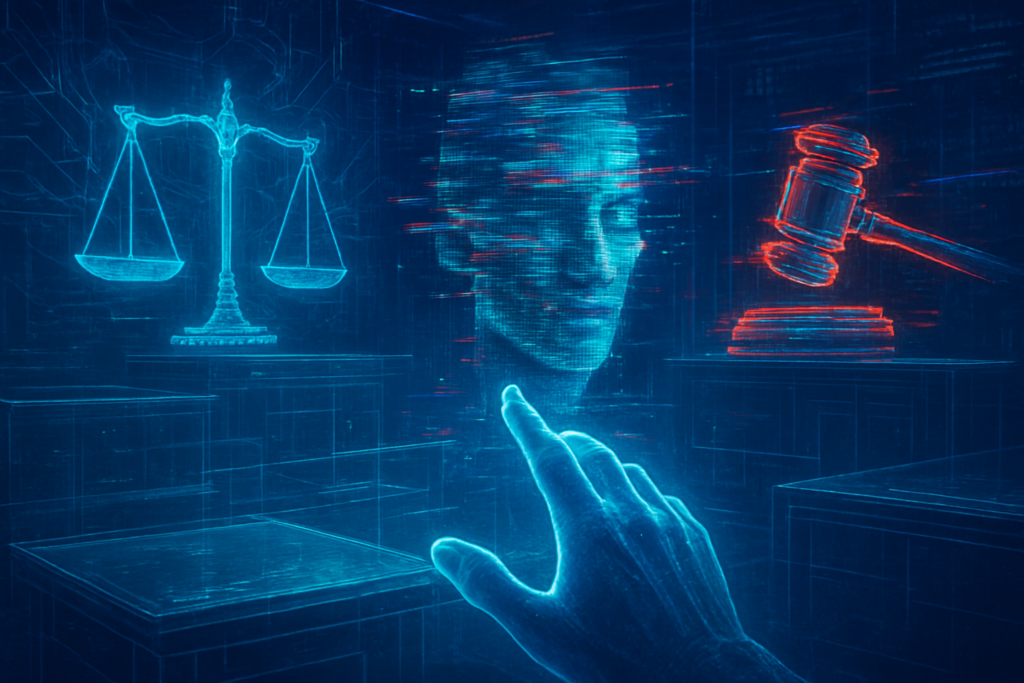
The legal sector and courtrooms worldwide are facing an unprecedented crisis, as the rapid advancement of artificial intelligence, particularly in the creation of sophisticated deepfakes and the spread of disinformation, erodes the very foundations of evidence and truth. Recent reports and high-profile incidents, extending into late 2025, paint a stark picture of a justice system struggling to keep pace with technology that can convincingly fabricate reality. The immediate significance is profound: the integrity of digital evidence is now under constant assault, demanding an urgent re-evaluation of legal frameworks, judicial training, and forensic capabilities.
A landmark event on September 9, 2025, in Alameda County, California, served as a potent wake-up call when a civil case was dismissed, and sanctions were recommended against plaintiffs after a videotaped witness testimony was definitively identified as a deepfake. This incident is not an isolated anomaly but a harbinger of the "deepfake defense" and the broader weaponization of AI in legal proceedings, compelling courts to confront a future where digital authenticity can no longer be presumed.
The Technicality of Deception: How AI Undermines Evidence
The core of the challenge lies in AI's increasingly sophisticated ability to generate or alter digital media, creating audio and video content that is virtually indistinguishable from genuine recordings to the human eye and ear. This capability gives rise to the "deepfake defense," where genuine evidence can be dismissed as fake, and conversely, AI-generated fabrications can be presented as authentic to falsely incriminate or exculpate. The "Liar's Dividend" further complicates matters, as widespread awareness of deepfakes leads to a general distrust of all digital media, allowing individuals to dismiss authentic evidence to avoid accountability. A notable 2023 lawsuit involving a Tesla crash, for instance, saw the defense counsel unsuccessfully attempt to discredit a video by claiming it was an AI-generated fabrication.
This represents a significant departure from previous forms of evidence tampering. While photo and audio manipulation have existed for decades, AI's ability to create hyper-realistic, dynamic, and contextually appropriate fakes at scale is unprecedented. Traditional forensic methods often struggle to detect these highly advanced manipulations, and even human experts face limitations in accurately authenticating evidence without specialized tools. The "black box" nature of some AI systems, where their internal workings are opaque, further complicates accountability and oversight, making it difficult to trace the origin or intent of AI-generated content.
Initial reactions from the AI research community and legal experts underscore the severity of the situation. A November 2025 report led by the University of Colorado Boulder critically highlighted the U.S. legal system's profound unpreparedness to handle deepfakes and other AI-enhanced evidence equitably. The report emphasized the urgent need for specialized training for judges, jurors, and legal professionals, alongside the establishment of national standards for video and audio evidence to restore faith in digital testimony.
Reshaping the AI Landscape: Companies and Competitive Implications
The escalating threat of AI-generated disinformation and deepfakes is creating a new frontier for innovation and competition within the AI industry. Companies specializing in AI ethics, digital forensics, and advanced authentication technologies stand to benefit significantly. Startups developing robust deepfake detection software, verifiable AI systems, and secure data provenance solutions are gaining traction, offering critical tools to legal firms, government agencies, and corporations seeking to combat fraudulent content.
For tech giants like Microsoft (NASDAQ: MSFT) and Meta (NASDAQ: META), this environment presents both challenges and opportunities. While their platforms are often exploited for the dissemination of deepfakes, they are also investing heavily in AI safety, content moderation, and detection research. The competitive landscape is heating up for AI labs, with a focus shifting towards developing "responsible AI" frameworks and integrated safeguards against misuse. This also creates a new market for legal tech companies that can integrate AI-powered authentication and verification tools into their existing e-discovery and case management platforms, potentially disrupting traditional legal review services.
However, the legal challenges are also immense. 2025 has seen a significant spike in copyright litigation, with over 50 lawsuits currently pending in U.S. federal courts against AI developers for using copyrighted material to train their models without consent. Notable cases include The New York Times (NYSE: NYT) v. Microsoft & OpenAI (filed December 2023), Concord Music Group v. Anthropic (filed October 2024), and a lawsuit by authors like Richard Kadrey and Sarah Silverman against Meta (filed July 2023). These cases are challenging the "fair use" defense frequently invoked by AI companies, potentially redefining the economic models and data acquisition strategies for major AI labs.
The Wider Significance: Erosion of Trust and Justice
The proliferation of deepfakes and disinformation fits squarely into the broader AI landscape, highlighting the urgent need for robust AI governance and responsible AI development. Beyond the courtroom, the ability to convincingly fabricate reality poses a significant threat to democratic processes, public discourse, and societal trust. The impacts on the justice system are particularly alarming, threatening to undermine due process, compromise evidence integrity, and erode public confidence in legal outcomes.
Concerns extend beyond just deepfakes. The ethical deployment of generative AI tools by legal professionals themselves has led to "horror stories" of AI generating fake case citations, underscoring issues of accuracy, algorithmic bias, and data security. AI tools in areas like predictive policing also risk perpetuating or amplifying existing biases, contributing to unequal access to justice. The Department of Justice (DOJ) in its December 2024 report on AI in criminal justice identified persistent operational and ethical considerations, including civil rights concerns related to potential discrimination and erosion of public trust through increased surveillance. This new era of AI-driven deception marks a significant milestone, demanding a level of scrutiny and adaptation that far surpasses previous challenges posed by digital evidence.
On the Horizon: A Race for Solutions and Regulation
Looking ahead, the legal sector is poised for a transformative period driven by the imperative to counter AI-fueled deception. Near-term developments will likely focus on enhancing digital forensic capabilities within law enforcement and judicial systems, alongside the rapid development and deployment of AI-powered authentication and detection tools. Experts predict a continued push for national standards for digital evidence and specialized training programs for judges, lawyers, and jurors to navigate this complex landscape.
Legislatively, significant strides are being made, though not without challenges. In May 2025, President Trump signed the bipartisan "TAKE IT DOWN ACT," criminalizing the nonconsensual publication of intimate images, including AI-created deepfakes. The "NO FAKES Act," introduced in April 2025, aims to make it illegal to create or distribute AI-generated replicas of a person's voice or likeness without consent. Furthermore, the "Protect Elections from Deceptive AI Act," introduced in March 2025, seeks to ban the distribution of materially deceptive AI-generated audio or video related to federal election candidates. States are also active, with Washington State's House Bill 1205 and Pennsylvania's Act 35 establishing criminal penalties for malicious deepfakes in July and September 2025, respectively. However, legal hurdles remain, as seen in August and October 2025 when a federal judge struck down California's deepfake election laws, citing First Amendment concerns.
Internationally, the EU AI Act, effective August 1, 2024, has already banned the most harmful uses of AI-based identity manipulation and imposed strict transparency requirements for AI-generated content. Denmark, in mid-2025, introduced an amendment to its copyright law to recognize an individual's right to their own body, facial features, and voice as intellectual property. The challenge remains for legislation and judicial processes to evolve at the pace of AI innovation, ensuring a fair and just system in an increasingly digital and manipulated world.
A New Era of Scrutiny: The Future of Legal Authenticity
The rise of deepfakes and AI-driven disinformation marks a pivotal moment in the history of artificial intelligence and its interaction with society's most critical institutions. The key takeaway is clear: the legal sector can no longer rely on traditional assumptions about the authenticity of digital evidence. This development signifies a profound shift, demanding a proactive and multi-faceted approach involving technological innovation, legislative action, and comprehensive judicial reform.
The long-term impact will undoubtedly reshape legal practice, evidence standards, and the very concept of truth in courtrooms. It underscores the urgent need for a societal conversation about digital literacy, critical thinking, and the ethical boundaries of AI development. As AI continues its relentless march forward, the coming weeks and months will be crucial. Watch for the outcomes of ongoing copyright lawsuits against AI developers, the evolution of deepfake detection technologies, further legislative efforts to regulate AI's use, and the judicial system's adaptive responses to these unprecedented challenges. The integrity of justice itself hinges on our ability to navigate this new, complex reality.
This content is intended for informational purposes only and represents analysis of current AI developments.
TokenRing AI delivers enterprise-grade solutions for multi-agent AI workflow orchestration, AI-powered development tools, and seamless remote collaboration platforms.
For more information, visit https://www.tokenring.ai/.