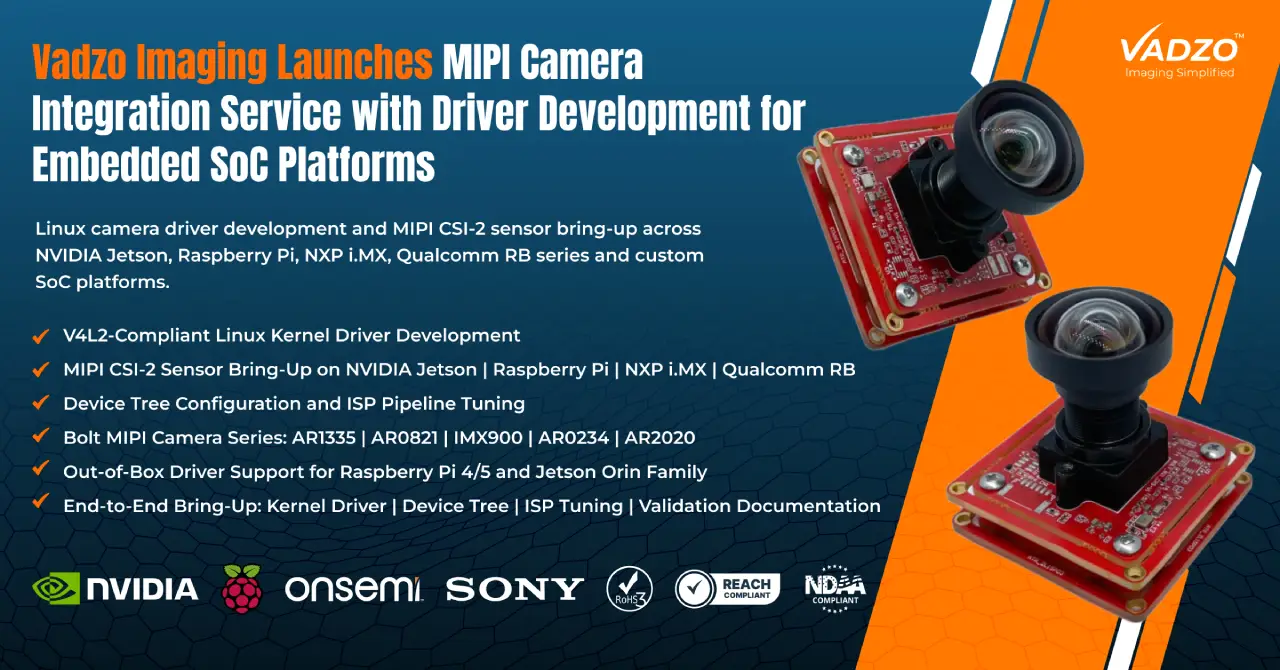
Vadzo Imaging's MIPI Camera Integration Service covers Linux camera driver development and MIPI CSI-2 camera bring-up across leading SoC platforms, including NVIDIA Jetson, Raspberry Pi, and NXP i.MX, and Qualcomm RB series, with full support extended to custom SoC environments and the complete Bolt MIPI camera series.
FORT WORTH, TX / ACCESS Newswire / May 1, 2026 / Vadzo Imaging today announced the launch of its MIPI Camera Integration Service with driver development for MIPI camera integration on custom and standard SoC platforms. Designed to reduce the time and engineering effort required for sensor bring-up in embedded vision products, the service addresses one of the most persistent bottlenecks in deploying MIPI CSI-2 camera modules in production systems. From platform-specific Linux kernel driver development to device tree configuration and ISP tuning, the service covers the full bring-up lifecycle for teams building on NVIDIA Jetson, Raspberry Pi, and NXP i.MX Qualcomm RB series and other SoC families, where SoC camera integration requires hands-on expertise that most OEM teams do not carry in-house.
MIPI CSI-2 Camera Bring-Up
Custom MIPI camera integration is not a plug-and-play problem. Embedded teams working with MIPI CSI-2 sensors regularly spend weeks troubleshooting kernel driver mismatches, device tree errors, ISP pipeline issues, and platform-specific timing constraints before a single frame is captured correctly. For OEM teams building on platforms like NVIDIA Jetson or Raspberry Pi, the challenge compounds when the chosen sensor does not have an existing Linux camera driver in the mainline kernel or the platform vendor's BSP.
Vadzo Imaging has spent years building and validating MIPI camera modules across precisely these environments. The Accelerated Driver Development Service extends that embedded engineering capability directly to customer programs, allowing teams to move from sensor selection to streaming output without dedicating internal cycles to low-level driver work that sits outside their core product development.
"MIPI camera bring-up consistently appears on the critical path for embedded product programs. Teams have the right sensor chosen, but the driver development timeline stretches the schedule. This MIPI Camera Integration Service gives OEM teams and system integrators a direct path from evaluation hardware to production-ready drivers without the internal ramp-up time that custom bring-up typically demands," V - Alwin Vincent, Product Manager, Vadzo Imaging.
What the MIPI Camera Integration Service Covers
The service is structured around the full bring-up scope that embedded teams encounter when integrating an MIPI CSI-2 sensor into a new platform. Vadzo Imaging handles all stages from kernel driver authoring to streaming validation with deliverables matched to production deployment requirements.
Linux kernel driver development forms the core of the engagement. Vadzo engineers author V4L2-compliant drivers for target sensors and SoC combinations, covering register-level sensor configuration format negotiation and control interface implementation. Device tree source files are authored and validated for the target platform to ensure correct lane configuration, power sequencing, and interrupt mapping. ISP pipeline configuration is handled alongside driver bring-up, ensuring that output image quality meets application requirements from the point of first integration.
Platform coverage includes NVIDIA Jetson MIPI camera deployments across Orin AGX, Orin NX, Orin Nano, and Xavier NX alongside Raspberry Pi MIPI camera integration on Raspberry Pi 4 and Raspberry Pi 5 and NXP i.MX8M Plus platforms. For programs running on Qualcomm RB series, TI AM series, STM, or other custom SoC platforms, Vadzo provides evaluation-led engagement to scope driver work accurately before development begins.
Deliverables include driver source code, device tree files, validation test procedures, and integration documentation structured to support the customer's own engineering team for long-term platform maintenance.
Bolt MIPI Camera Series: Ready-Validated for Accelerated Integration
Teams using Vadzo's Bolt embedded vision camera series benefit from pre-existing driver support across the majority of target platforms, reducing bring-up scope and accelerating time to first frame. Each Bolt module connects via 2-lane or 4-lane MIPI CSI-2 directly to the host SoC ISP with module-level drivers provided for Raspberry Pi 4, Raspberry Pi 5, Jetson Orin NX, Jetson Orin Nano, Jetson Orin AGX, and NXP i.MX8M Plus.
For programs requiring a sensor configuration not currently available in the Bolt series, the Driver Development Service can be scoped to cover customer-specified sensors on target platforms with the same delivery structure as the standard service.
Bolt-1335CRA: AR1335 4K Autofocus MIPI Camera
The AR1335 4K autofocus camera is built on the Onsemi AR1335 sensor, delivering 13MP resolution with VCM-driven autofocus over MIPI CSI-2. The AR1335 VCM camera is suited for UAV inspection, drone imaging, and any embedded deployment where subject distance varies, and fixed-focus optics produce unacceptable blur. Platform drivers are provided for Raspberry Pi and Jetson platforms, with bring-up support available for additional SoC targets through the service.
Key specs: 13MP (4208x3120) | Onsemi AR1335 | Rolling Shutter | 1/3.2" 1.1µm Pixel | 2-lane/4-lane MIPI CSI-2 | VCM Autofocus | 38mm x 38mm | -30⁰C to 70⁰C Operating Temperature
Bolt-821CRS: AR0821 HDR MIPI Camera
The AR0821 HDR MIPI camera is an 8MP 4K MIPI camera module built on the Onsemi AR0821 sensor with embedded HDR exceeding 140 dB. The AR0821 MIPI color camera delivers reliable image capture across scenes that combine direct sunlight, deep shadow, and artificial lighting within a single frame, making it well-suited for access control perimeter monitoring, smart city infrastructure, and indoor vision where lighting conditions are unpredictable. The low-light MIPI camera configuration maintains consistent output quality in both day and night conditions without auxiliary lighting hardware.
Key specs: 8MP (3848x2168) | Onsemi AR0821 | Rolling Shutter | 1/1.7" 2.1µm Pixel | 2-lane/4-lane MIPI CSI-2 | HDR | 38mm x 38mm | -30⁰C to 70⁰C Operating Temperature
Bolt-900MGS: IMX900 Monochrome Global Shutter MIPI Camera
The IMX900 monochrome MIPI camera is built on the Sony Pregius S IMX900 sensor, delivering 3MP monochrome output with global shutter and Quad HDR up to 120 dB. The IMX900 global shutter MIPI camera eliminates motion artifacts during high-speed operation, and its high NIR sensitivity supports structured light IR-based inspection and 3D scanning workflows. This monochrome MIPI camera reduces processing overhead for real-time pipelines where color information is unnecessary, and maximum sensitivity is the priority.
Key specs: 3MP (2064x1552) | Sony IMX900 Pregius S | Global Shutter | 1/3.1" 2.25µm Pixel | 2-lane/4-lane MIPI CSI-2 | Quad HDR (120 dB) | NIR | 38mm x 38mm | -40⁰C to 85⁰C Operating Temperature
Bolt-234CGS: AR0234 Global Shutter MIPI Camera
The AR0234 global shutter camera delivers 2MP color output at up to 120 fps with a global shutter architecture that ensures distortion-free imaging during rapid motion. The AR0234 MIPI color camera is suited for drone navigation, obstacle avoidance, object detection, and any embedded application where motion accuracy is required alongside color imaging. Its global shutter MIPI camera architecture and low-latency streaming make it a reliable choice for robotics and autonomous navigation platforms operating at high frame rates.
Key specs: 2MP (1920x1200) | Onsemi AR0234 | Global Shutter | 1/2.6" 3.0µm Pixel | 2-lane/4-lane MIPI CSI-2 | Full HD | 38mm x 38mm | -30⁰C to 70⁰C Operating Temperature
Bolt-2020MRS: AR2020 NIR Monochrome MIPI Camera
The AR2020 NIR camera brings 20MP monochrome imaging to MIPI CSI-2 deployments requiring high spatial resolution and strong NIR sensitivity. The AR2020 NIR monochrome camera is built on the Onsemi HyperLux LP AR2020 sensor and is well-suited for biometric capture, document scanning, aerial mapping, and embedded vision applications where detail and NIR performance are both required. The AR2020 20MP camera extends the Bolt series into high-resolution mono territory where no other module in the lineup applies.
Key specs: 20MP (5120 x 3840) | Onsemi AR2020 HyperLux LP | Rolling Shutter | NIR | 4-lane MIPI CSI-2 | Monochrome | NIR | 38mm x 38mm | -30⁰C to 70⁰C Operating Temperature
Supported Platforms and Integration Scope
The MIPI Camera Integration Service targets the SoC platforms where OEM camera bring-up is most frequently required in the production of embedded vision programs.
NVIDIA Jetson MIPI camera integration covers Jetson Orin AGX, Orin NX, Orin Nano, and Xavier NX across JetPack 5 and JetPack 6 BSPs. Raspberry Pi MIPI camera integration is supported on Raspberry Pi 4 and Raspberry Pi 5 running current Raspberry Pi OS builds. NXP i.MX8M Plus integration is available for teams using the Yocto-based BSP. For Qualcomm RB series, STM TI AMx, and other custom SoC environments, Vadzo conducts platform evaluation before engagement scoping.
All driver deliverables are structured for Linux-based environments. V4L2 compliance is maintained across all driver outputs, ensuring compatibility with GStreamer, OpenCV, LibCamera, and other standard image acquisition frameworks used in embedded vision camera deployments.
Applications
Robotics and Autonomous Navigation: Mobile robots and autonomous platforms running perception stacks on Jetson Orin or Raspberry Pi face a specific bring-up problem: global shutter sensors that eliminate motion artifacts during wheel rotation or arm movement often lack mainline kernel support on the target SoC. The AR0234 global shutter MIPI camera delivers distortion-free capture at up to 120 fps, but only after V4L2 driver bring-up, device tree lane configuration, and frame sync validation are complete. The Integration Service handles that scope so the robotics team stays focused on the navigation stack, not the sensor driver.
Industrial Inspection: Structured light surface inspection and PCB defect detection workflows require monochrome global shutter sensors with high NIR sensitivity, and those sensors rarely arrive with production-ready drivers for custom SoC platforms. The IMX900 monochrome global shutter MIPI camera eliminates motion artifacts and supports IR-based structured light at 850nm and 940nm, but realizing that performance in a production inspection system requires ISP pipeline configuration that default BSP profiles do not provide. Vadzo delivers tuned ISP output alongside the driver.
UAV and Aerial Imaging: Fixed-focus optics are the standard failure mode for drone inspection programs, sharpness degrades the moment subject distance changes and there is no host-side processing path that recovers it. The AR1335 13MP VCM autofocus MIPI camera addresses this at the sensor level, maintaining focus across varying altitudes without compute overhead. Driver bring-up for UAV SoC platforms outside the standard Jetson and Raspberry Pi targets is handled through the evaluation-led engagement path.
Smart Surveillance and Outdoor Monitoring: Outdoor surveillance deployments encounter scenes that combine direct sunlight, deep shadow, and artificial lighting within a single frame, a dynamic range problem that no ISP tuning resolves if the sensor cannot capture it. The AR0821 HDR MIPI camera delivers over 140 dB at the sensor level. Bringing that performance to a custom SoC platform without an existing AR0821 driver requires the full bring-up scope the Integration Service is structured to cover.
High-Resolution Embedded Vision and Biometrics: Biometric capture, document scanning, and aerial mapping share a common requirement: spatial resolution high enough that subject detail is preserved after downstream processing. The AR2020 20MP NIR monochrome MIPI camera is the only module in the Bolt series that addresses this at 20MP, and its 4-lane MIPI CSI-2 interface requires platform-side lane configuration that varies by SoC. For teams integrating the AR2020 on custom or non-standard platforms, driver scoping begins with Vadzo's platform evaluation step before any development commitment.
Frequently Asked Questions
What does the Accelerated Driver Development Service deliver?
Vadzo Imaging delivers V4L2-compliant Linux kernel drivers, device tree source files, platform validation test procedures, and integration documentation for the target sensor and SoC combination. All deliverables are structured for long-term maintainability by the customer's engineering team.
Which Vadzo MIPI camera products already include platform driver support?
The entire Bolt MIPI camera series ships with module-level driver support for Raspberry Pi 4, Raspberry Pi 5, Jetson Orin AGX, Orin NX, Orin Nano, and NXP i.MX8M Plus. This includes the AR1335 4K autofocus camera, AR0821 4K MIPI camera, IMX900 3MP MIPI camera, AR0234 HD MIPI camera, and AR2020 NIR monochrome camera. For platforms not currently covered by out-of-the-box driver support, Vadzo's MIPI Camera Integration Service provides the porting engagement.
Can Vadzo develop drivers for sensors not currently in the Bolt series?
Yes. The Driver Development Service is not limited to sensors in the Bolt portfolio. Vadzo can scope and deliver driver bring-up for customer-specified sensors on target SoC platforms. The engagement begins with a platform and sensor evaluation to define the scope before development starts.
What Linux versions and BSPs are supported?
Driver development is conducted against the BSP versions relevant to the target platform. For NVIDIA Jetson, this covers JetPack 5 and JetPack 6. For Raspberry Pi, the current Raspberry Pi OS kernel is targeted. For NXP platforms, the Yocto-based BSP is used. For custom SoC environments, Vadzo evaluates the customer's kernel version and BSP before confirming scope.
Does Vadzo provide integration support after driver delivery?
Yes. Vadzo provides integration documentation and post-delivery technical support to help teams validate the driver in their specific system configuration. For OEM programs requiring ongoing Linux camera driver maintenance or platform porting across additional SoC targets, Vadzo offers extended support arrangements. Teams can also explore the full range of Vadzo's custom MIPI camera and customization services, including form factor modification, firmware development, and optics integration.
Availability
Vadzo Imaging's MIPI Camera Integration Service is available now for engagement scoping across supported and custom SoC platforms. Evaluation kits for the Bolt MIPI camera series, including the AR1335 4K autofocus camera, AR0821 HDR MIPI camera, IMX900 monochrome MIPI camera, AR0234 global shutter camera, AR2020, and NIR monochrome camera, are available for prototyping and production deployment.
Robotics developers, system integrators, and OEM teams can access evaluation hardware, technical documentation, and driver service engagement directly from Vadzo to accelerate development and reduce system validation time. Global customers can procure Vadzo products through official channels with international shipping to the U.S, U.K, Germany, Israel, South Korea, Japan, and worldwide markets. Vadzo supports volume production programs, multi-platform deployment planning, and customization services, including optics firmware and form factor modifications for embedded platforms.
About Vadzo Imaging
Vadzo Imaging is a global provider of embedded vision solutions delivering high-performance camera products for robotics, UAVs, industrial automation, and edge AI applications. The company specializes in sensor integration, HDR imaging, and interface platforms, including USB MIPI and GigE, enabling developers to build vision systems for autonomous navigation, robotic manipulation, inspection, and intelligent monitoring. Vadzo's solutions combine camera hardware, ISP optimization, and software platforms, providing developers with control over streaming encoding and system integration. With support for NVIDIA Jetson, Raspberry Pi, Qualcomm RB series, and NXP i.MX platforms Vadzo enables OEMs and integrators to accelerate development, simplify deployment, and scale embedded vision systems across production environments.
Media Contact
Alwin Vincent
Vadzo Imaging
Phone: +1 817-678-2139
Email: alwin@vadzoimaging.com
LinkedIn: Vadzo Imaging
YouTube: Vadzo Imaging
X: Vadzo Imaging
SOURCE: Vadzo Imaging
View the original press release on ACCESS Newswire