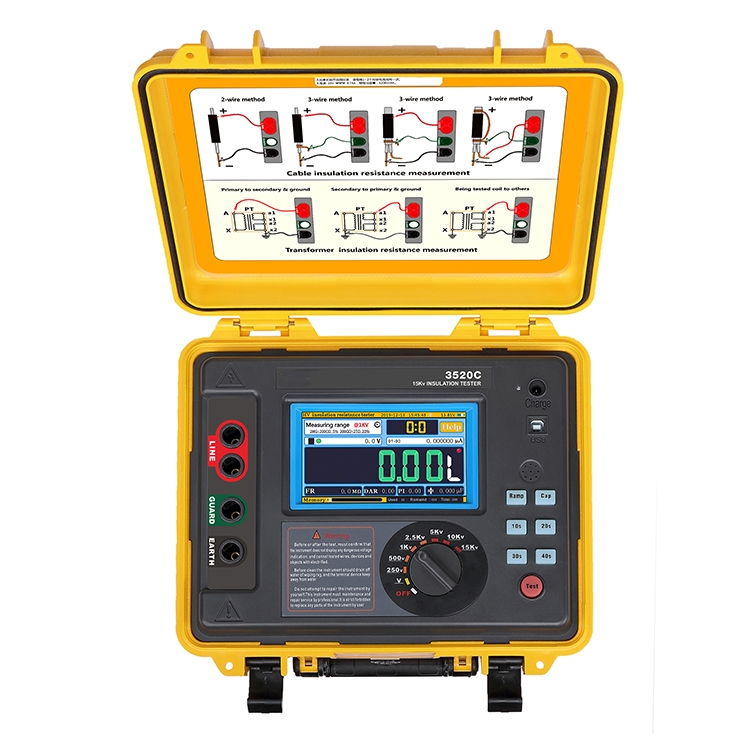
Megger Test: Insulation Resistance Test
The Megger test is designed to measure the resistance of insulation by applying a low-voltage DC signal and measuring the resulting current. It helps detect any leakage paths or deterioration in insulation, making it a useful tool for routine maintenance and inspections.
-
Purpose: Detects leakage paths or faults in insulation.
-
Voltage: Typically uses 250V to 1000V DC.
-
Use: Ideal for regular checks on motors, cables, and electrical panels.
-
Advantages: Simple, quick, and reliable for general insulation health checks.
Tan Delta Test: Dielectric Dissipation Factor Test
The Tan Delta test, also known as the dissipation factor test, measures the dielectric loss in insulation by applying AC voltage. It checks the phase shift between the voltage and current, revealing how much energy is being lost. Higher Tan Delta values indicate insulation degradation due to factors like aging, moisture, or contamination.
-
Purpose: Assesses the overall quality and health of insulation.
-
Voltage: Uses AC voltage, often at the rated voltage level.
-
Use: Primarily used for transformers, cables, and bushings to detect early signs of aging and moisture ingress.
-
Advantages: Sensitive to aging, moisture, and contamination. Can detect issues before they lead to failures.
Hi-Pot Test: High Potential Test
The Hi-Pot test is a high-voltage test used to stress insulation by applying a high-voltage AC or DC signal. This test ensures that insulation can withstand extreme operating conditions and high-voltage events without failing.
-
Purpose: Tests the insulation’s ability to withstand high voltages without breakdown.
-
Voltage: Uses high-voltage, typically in the kilovolt (kV) range.
-
Use: Commonly used in factory acceptance testing or to find weak spots in insulation before failures occur.
-
Advantages: Pass/fail test that helps identify insulation weaknesses.
Key Differences Between the Three Tests
| Feature | Megger Test | Tan Delta Test | Hi-Pot Test |
|---|---|---|---|
| Purpose | Measures insulation resistance to detect faults. | Measures insulation quality by checking dielectric loss. | Stresses insulation to check its ability to withstand high voltage. |
| Voltage | Low voltage (250V to 1000V DC). | AC voltage, often at rated voltage. | High voltage, typically in kilovolt range (kV). |
| Nature of Test | Non-destructive, routine checks. | Non-destructive, detailed health monitoring. | Stress test, can be semi-destructive. |
| Use Case | Routine maintenance and health checks. | Detects moisture, aging, and contamination. | Factory acceptance testing or finding weaknesses before failure. |
Conclusion
Each test offers unique benefits and serves specific purposes. The Megger test is ideal for routine checks to ensure insulation is free of leakage. The Tan Delta test provides deeper insights into the overall health of insulation, especially for detecting aging and moisture issues. The Hi-Pot test stresses insulation to confirm its ability to handle high-voltage events without failure. To ensure the long-term safety and efficiency of electrical systems, using a combination of these tests is recommended for optimal performance.
For more information on electrical testing and insulation solutions, visit official website: www.wrindu.com / www.hvtesters.com
Media Contact
Company Name: Rui Du Mechanical and Electrical (Shanghai) Co., Ltd.
Email: Send Email
Phone: 13661908522
Address:No.500 Jianyun Road, Pudong New Area
City: Shanghai
Country: China
Website: https://www.wrindu.com/