On February 28, 2026, the U.S. and Israel attacked Iran to prevent the theocracy from attaining a nuclear weapon after nearly half a century of rising tensions. While the bombing has created a military victory, Iran’s retaliation throughout the region creates economic stress that it hopes will cause the bombing to stop. Iran is doing everything in its power to stop all traffic through the Strait of Hormuz, a narrow seaway through which one-third of the world’s seaborne crude oil flows. Meanwhile, petroleum is not the only commodity flowing through the Strait, as fertilizer shipments have also been affected.
One-third of global fertilizer supplies move through the Strait of Hormuz
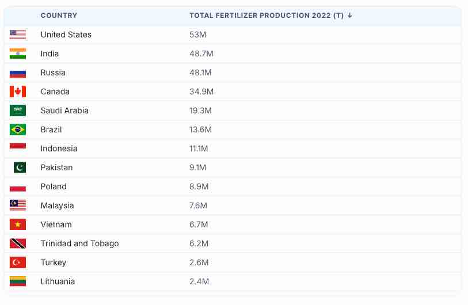
The world’s leading fertilizer-producing countries in 2022 were:
Exports from Qatar, Saudi Arabia, UAE, Iraq, and Iran to India, Southeast Asia, and the Americas depend on access to the Strait of Hormuz. Approximately 33% of the world’s fertilizers, including sulfur and ammonia, pass through the Strait.
No strategic stockpiles as the 2026 crop year gets underway
The 32 members of the International Energy Agency recently announced that it will release 400 million barrels of crude oil from its 1.2 million barrel strategic petroleum reserve to “address disruptions in oil markets stemming from the war in the Middle East.” While countries maintain SPRs for crude oil, there are few, if any, fertilizer reserves. Crop producers purchase fertilizers on a hand-to-mouth basis, which creates significant issues this crop year, as the planting season in the Northern Hemisphere gets underway in March and April, and fertilizers are a critical ingredient in crop production.
Food shortages could be part of Iran’s retaliatory plans
While the U.S. and Israel achieved substantial military victories during the early days of the attack on Iran, the theocracy has thus far remained intact, with Iran appointing the Ayatollah’s son as the new Supreme Leader. With significant military assets destroyed, Iran and its proxies have turned to strategic economic warfare by attacking countries throughout the region, including oil production and refining, infrastructure, and U.S. military installations and embassies. Iran’s strategy appears to be to undermine the global economic system to force the U.S. and Israel to stop their attacks. The logistical chokepoint at the Strait of Hormuz has become ground zero for Iran’s economic strategy, which has pushed up crude oil and fertilizer prices. The longer the war continues, and the lack of traffic through the Strait could eventually cause fertilizer, and in turn, food shortages, of it impacts the 2026 crop production.
An end to the war that opens the flow of commercial traffic through the Strait would ease the current concerns, but a prolonged war could have devastating effects. Fertilizers are commodities, but they trade only in the physical market. The leading fertilizer companies by market capitalization are as follows:
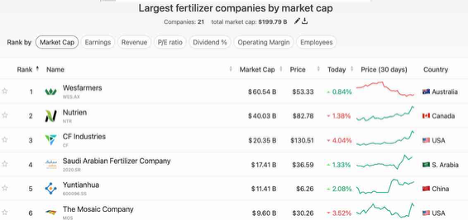
Two of the top six fertilizer companies, CF Industries and The Mosaic Company, are U.S. companies that are benefiting from the standoff in the Middle East and at the Strait of Hormuz.
CF is a leading U.S. fertilizer producer
At just around $128.50 per share, CF Industries (CF) had a market cap of nearly $19.3 billion. CF is a highly liquid stock that trades over five million shares per day. CF pays a $2.00 dividend, yielding over 1.55%. CF is the leading U.S. fertilizer company.
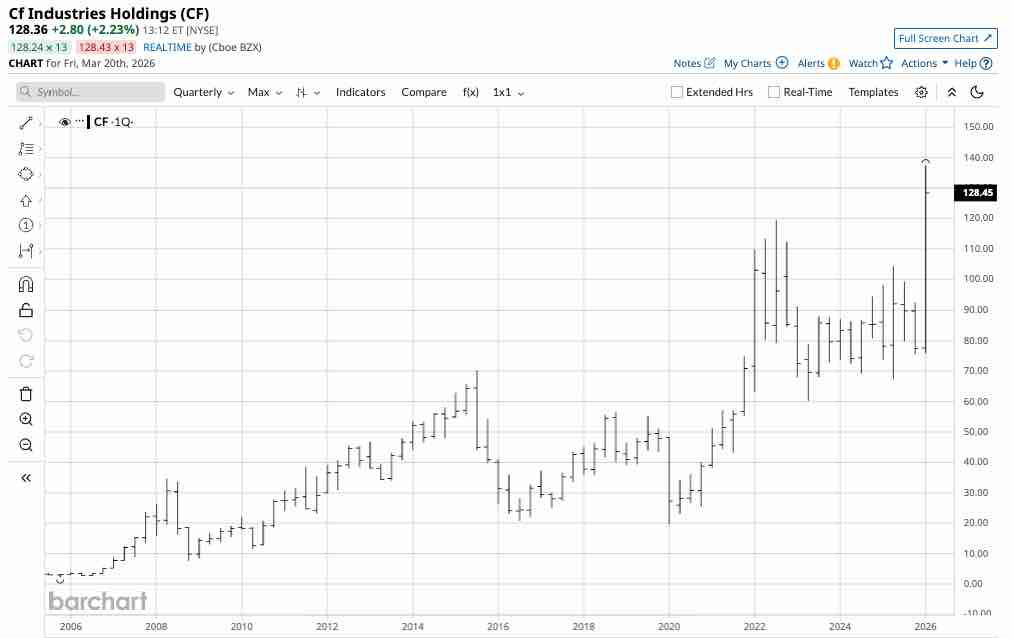
The quarterly chart shows that CF shares have risen to a new record high, eclipsing the previous Q3 2022 high of $119.60. The events in the Middle East have driven CF shares to over $128, with the most recent high at $137.44. CF remains in a bullish trend.
According to Barchart’s metrics, CF’s Price/Earnings ttm of 13.48 remains comparatively low, while SPY’s is 24.43. In the current environment, the lower P/E is a sign that CF offers value, even at a new record high.
MOS is another U.S. fertilizer producer
At around $24.40 per share, The Mosaic Company (MOS) had a market cap of over $8.3 billion. MOS is a highly liquid stock, trading over 11.55 million shares per day. MOS pays a $0.88 dividend, yielding over 3.6%. MOS is the second-leading U.S. fertilizer company.
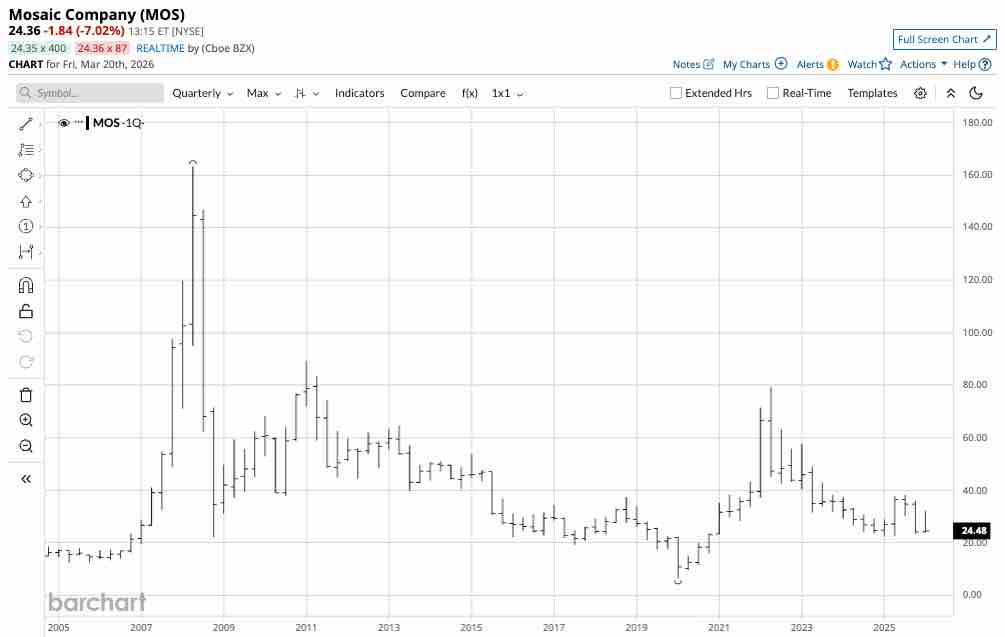
The quarterly chart shows that MOS shares rose 33.9%, from $24.09 at the end of 2025 to a high of $32.25 on March 12, before pulling back. Like CF, the events in the Middle East had driven MOS shares higher.
According to Barchart’s metrics, MOS’s Price/Earnings ttm of 12.29 remains comparatively low, while SPY’s is 24.43. In the current environment, a lower P/E ratio indicates that MOS offers value at its current share price.
Fertilizer stocks are likely to move higher and lower with the events around the Strait of Hormuz. Meanwhile, as the 2026 planting season gets underway, CF and MOS are likely to see increasing demand for their products, boosting earnings, and creating a compelling opportunity to own these strategic companies.
On the date of publication, Andrew Hecht did not have (either directly or indirectly) positions in any of the securities mentioned in this article. All information and data in this article is solely for informational purposes. For more information please view the Barchart Disclosure Policy here.
More news from Barchart
- QCOM Stock Warning: Why Analysts Warn Qualcomm Could Plunge More Than 20% from Here
- This Cathie Wood Stock Is Down 36% Over the Past 2 Years. She Still Can’t Get Enough.
- Palo Alto Networks Stock Is Still Deeply Undervalued Based on its FCF - How to Play PANW
- IWM’s Surge in Unusual Options Activity Signals Opportunity — Here’s a Covered Strangle With a Twist