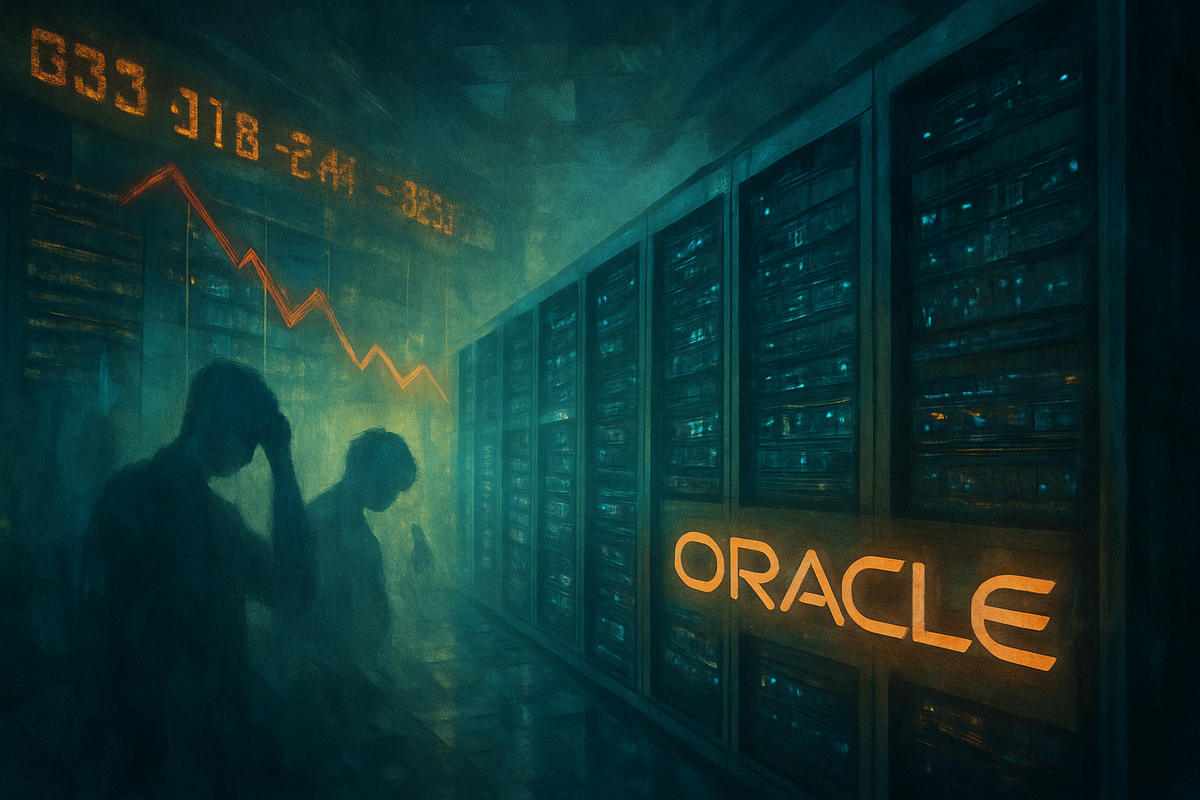
Oracle's recent Q2 fiscal year 2026 earnings report, released on December 10, 2025, has sent ripples through the technology sector, sparking concerns over the immense capital expenditures required for AI infrastructure and fueling a phenomenon dubbed "AI trade fatigue." Despite robust cloud growth, the software giant's aggressive guidance on future AI investments, coupled with a slight revenue miss, triggered a significant sell-off in Oracle's shares and exerted downward pressure on broader tech indices like the Nasdaq. This event marks a potential turning point in investor sentiment, shifting from unbridled enthusiasm for all things AI to a more scrutinizing view of the costs, returns, and sustainability of the current AI investment boom.
This growing skepticism suggests that the market is moving beyond the initial hype cycle of artificial intelligence. Investors are now demanding clearer pathways to profitability and tangible returns on the colossal investments being poured into AI infrastructure and development. Oracle's situation highlights the financial intensity of the AI race and serves as a reality check for an industry that has seen soaring valuations based largely on future potential.
Oracle's Bold Bet: A Deep Dive into AI Infrastructure Investment
On December 10, 2025, Oracle (NYSE: ORCL) unveiled its second-quarter fiscal year 2026 results, presenting a mixed financial landscape that quickly overshadowed its strengths with investor anxiety over future spending. While total revenue climbed 14% year-over-year to $16.1 billion, it narrowly missed analyst expectations. Crucially, adjusted earnings per share (EPS) significantly surpassed forecasts at $2.26, partly bolstered by a substantial gain from the sale of its Ampere interest. The company's cloud segment continued its impressive trajectory, with cloud revenue reaching $8.0 billion, a 34% increase, and Oracle Cloud Infrastructure (OCI) revenue soaring by 68%. GPU-related cloud revenue, a direct indicator of AI demand, saw a staggering 177% increase, and Remaining Performance Obligations (RPO) jumped to an unprecedented $523 billion, driven by massive new contracts with major players like Meta (NASDAQ: META) and Nvidia (NASDAQ: NVDA).
However, the bullish narrative on cloud growth was overshadowed by Oracle's forward-looking guidance on capital expenditures. The company dramatically raised its fiscal year 2026 capex outlook by an additional $15 billion, bringing the total projected spending to an eye-watering $50 billion. This aggressive investment is earmarked for expanding its cloud infrastructure, particularly in building AI superclusters and new cloud regions, to convert its massive RPO backlog into recognized revenue. Oracle's free cash flow for the quarter was negative $10 billion, with $12 billion in capex, underscoring the scale of these infrastructure investments. Management emphasized that these expenditures are primarily for revenue-generating equipment, not land or buildings, aiming for quicker returns. Notable strategic moves include plans for 20 new cloud regions and 8 high-density AI superclusters, along with securing multi-billion-dollar AI contracts, including a reported five-year, $300 billion deal with OpenAI.
The market's reaction was swift and negative. Oracle's shares plummeted by more than 6% in after-hours trading, extended to over 10% in extended US trading, and closed down 15.6% on Thursday, December 11, 2025. This sell-off was not isolated; it pressured Nasdaq futures and signaled a broader shift in investor sentiment across the tech sector. The elevated capex guidance, despite the promising RPO, reignited investor concerns about the enormous upfront costs of AI infrastructure and the potentially long lead times for realizing substantial returns. This growing unease reflects "AI trade fatigue," where investors are becoming more critical of high valuations, the practicality of immediate productivity gains from AI, and the significant debt many companies are incurring to fund their AI ambitions. The negative market reaction even overshadowed positive macroeconomic news, highlighting the market's current hypersensitivity to AI investment news.
The Shifting Sands: Who Wins and Who Loses in the AI Spending Marathon
The massive capital expenditure commitments by industry giants like Oracle in the pursuit of AI dominance are creating a complex landscape of winners and losers across the technology sector. As the market grapples with "AI trade fatigue" and demands clearer returns on investment, companies providing the foundational hardware and specialized cloud services are best positioned to benefit, while others may face increased pressure.
Hardware Providers: The Unquestionable Beneficiaries The most immediate beneficiaries of the AI infrastructure boom are the hardware providers. NVIDIA (NASDAQ: NVDA) remains the undisputed leader, with its H100 GPUs still considered the gold standard for AI training. Oracle's deployment of NVIDIA's H200 GPUs further solidifies this demand. However, competition is intensifying, with AMD (NASDAQ: AMD) making significant inroads. Oracle's plans to launch MI355X instances and deploy MI450 GPU-based superclusters using AMD's Helios rack design, along with OpenAI's selection of AMD as a partner, highlight AMD's growing prowess. Beyond GPUs, Broadcom (NASDAQ: AVGO) is a critical winner, securing multi-billion-dollar deals for AI networking solutions, including a substantial $10 billion total deal with OpenAI for custom AI accelerators and networking systems, as the bottleneck in AI data centers shifts to networking capacity. Similarly, Super Micro Computer (NASDAQ: SMCI), as a "rack-scale integrator" and "AI factory architect," is experiencing projected revenue growth of 65% for fiscal year 2026, driven by its ability to rapidly deliver complete AI factory solutions, including liquid-cooled servers. These companies are directly fueled by the likes of Oracle's aggressive capex, but smaller, less integrated hardware providers or those focused on older generation chips may struggle to keep pace with the rapid innovation cycle and intense competition.
Cloud Service Providers: Hyperscalers vs. Niche Players The hyperscale cloud providers are investing colossal sums into AI infrastructure. Amazon Web Services (NASDAQ: AMZN), Microsoft Azure (NASDAQ: MSFT), and Google Cloud (NASDAQ: GOOGL) are each planning tens of billions in AI infrastructure spending for 2025, with impressive growth in their AI cloud businesses. AWS's AI business is reportedly growing three times faster than AWS itself did at a similar stage, and Microsoft is making massive global investments to expand Azure data center regions. Google Cloud is also seeing strong demand for its TPU- and GPU-based solutions. Oracle Cloud Infrastructure (OCI), while smaller in overall market share, is emerging as a significant "AI cloud" hyperscaler, attracting major AI players like OpenAI, xAI, Meta (NASDAQ: META), NVIDIA, and AMD due to its focus on efficiency and more economical AI cluster operations. Oracle's "Cloud Neutrality" strategy, allowing its databases to run on any cloud, also positions it uniquely. However, all hyperscalers face increasing investor scrutiny to demonstrate tangible returns on their hefty AI investments, and "AI trade fatigue" could dampen enthusiasm if profitability lags. Smaller cloud providers without the capital to invest at this scale will find it increasingly difficult to compete.
AI Software Developers: Specialization and Integration are Key The impact on AI software developers is more nuanced. Companies offering highly specialized, efficient, or enterprise-grade AI solutions, particularly those deeply integrated with major cloud ecosystems, are poised for success. Oracle itself, by embedding over 150 AI capabilities into its Fusion Cloud Applications, is a strong player in the enterprise AI software market, potentially reducing the need for third-party general-purpose solutions for its existing customer base. Furthermore, partnerships with leading AI model developers, such as Microsoft's collaboration with Cohere for Azure, indicate opportunities for those with cutting-edge foundational models. Conversely, generic AI software providers offering undifferentiated tools may face commoditization as hyperscalers expand their native AI services. The ever-increasing barrier to entry for developing large language models (LLMs) for public use, due to the immense infrastructure costs, also favors larger, well-funded players or those with unique intellectual property and efficiency advantages, like DeepSeek, whose efficient inference engine has already caused market shifts.
A Reality Check: The Wider Significance of AI Investment Scrutiny
Oracle's recent financial disclosures and the subsequent market reaction represent more than just a blip for a single tech giant; they signal a critical juncture in the broader AI investment narrative. This event underscores a growing market maturity, where the initial euphoria surrounding AI is giving way to a more pragmatic and demanding assessment of capital allocation, profitability, and sustainable growth.
Broader Industry Trends and the Rise of 'AI Trade Fatigue' The immediate aftermath of Oracle's Q2 FY2026 report saw a ripple effect across the tech sector, with major AI-related stocks like NVIDIA (NASDAQ: NVDA), Alphabet (NASDAQ: GOOGL), and Microsoft (NASDAQ: MSFT) experiencing declines. This interconnectedness highlights how investor sentiment toward one major player can influence the entire ecosystem. The emergence of "AI trade fatigue" is a crucial trend here. It describes a growing weariness among investors and analysts from the relentless stream of AI hype, particularly when tangible, immediate returns on massive investments remain elusive. Oracle's aggressive, debt-funded capital expenditure, coupled with a slightly missed revenue forecast, provided "a cold splash of reality on the AI-trade frenzy," reminding markets that not all AI-related spending is a guaranteed home run. While some argue this is a normalization rather than a reversal of growth, it undeniably marks a shift towards increased scrutiny of ROI for AI initiatives.
Ripple Effects on Competitors and Partners The intensified competition in the cloud infrastructure market, where Oracle Cloud Infrastructure (OCI) is aggressively expanding to challenge dominant players like Amazon Web Services (NASDAQ: AMZN), Microsoft Azure, and Google Cloud, means Oracle's challenges have broad implications. A perceived slowdown in the ROI from AI spending could make investors more cautious about the AI strategies of all cloud providers, leading to heightened scrutiny of their capital expenditure plans and timelines for profitability. The declines in the stock prices of major AI hardware providers and large tech companies immediately following Oracle's report demonstrate this direct impact. Furthermore, the appetite for future large-scale AI infrastructure collaborations and the terms of such partnerships could be affected if the investment landscape is seen as less stable. While Oracle is also expanding its multi-cloud partnerships, a shift in market sentiment could recalibrate the delicate balance between competition and collaboration among these tech titans.
Regulatory and Policy Implications The rapid pace of AI development has largely outstripped regulatory frameworks, creating an environment of uncertainty that can impact investor confidence. Oracle's substantial debt-funded AI investments and the growing market apprehension could intensify calls for clearer regulatory oversight. The EU AI Act, which became effective in August 2024, aims to provide such clarity, and while it demands significant compliance resources, proponents believe it could ultimately enhance investor confidence by reducing legal uncertainty. In contrast, the United States still lacks a cohesive federal AI regulatory framework, forcing companies to navigate a patchwork of state laws, which adds complexity and cost. Globally, an "AI Regulation Backlash" is leading to increased governmental scrutiny, with demands for transparency, algorithmic accountability, and oversight. This regulatory pressure, coupled with intensifying antitrust scrutiny of cloud providers and AI models in both the U.S. and the EU, could lead to industry consolidation, favoring larger firms better equipped to absorb high compliance costs, and potentially reshaping investment portfolios.
Historical Precedents: Echoes of the Dot-Com Bubble? The current "AI bubble fears" and "trade fatigue" inevitably draw comparisons to the dot-com bubble of the late 1990s and early 2000s. That era was characterized by an extraordinary surge in tech valuations, driven by internet euphoria, often with inflated valuations and a lack of clear profitability. The bubble's eventual burst led to sharp market corrections and widespread bankruptcies. Similarities with the current AI enthusiasm include sky-high valuations, complex circular investments, and significant debt funding for transformative technologies. However, many analysts, including Goldman Sachs Research, point to key differences. Today's dominant tech companies generally boast stronger fundamentals and more robust profit streams than many unprofitable dot-com ventures. While valuations are high, they are often considered less extreme. Nevertheless, Oracle's performance serves as a potent reminder that even in a fundamentally strong tech sector, the market can react sharply to signs that investment in transformative technologies may not yield immediate or guaranteed returns, potentially leading to short-term corrections.
The Road Ahead: Navigating AI's Evolving Landscape
The market's reaction to Oracle's aggressive AI spending, coupled with the growing "AI trade fatigue," signals a period of strategic recalibration and heightened scrutiny for the tech sector. While the long-term trajectory for AI remains overwhelmingly positive, the immediate future will be defined by a shift from speculative hype to a demand for demonstrable returns, impacting strategic pivots, market opportunities, and persistent challenges.
Short-Term and Long-Term Possibilities In the short term (2025-2026), AI investments will continue to be heavily concentrated in infrastructure buildout, with data center capital expenditures projected to reach $600 billion in 2025 alone. Major cloud giants are collectively increasing their AI infrastructure budgets by an additional $100 billion, signaling an ongoing "AI arms race." This aggressive spending is expected to transition into broader AI adoption by 2025, with deeper integration into workflows, and by 2026, the realization of AI's productivity upside, albeit unevenly across industries. Long-term projections are even more ambitious, with the global AI market potentially soaring to $4.8 trillion by 2033, a 25-fold increase in a decade. This sustained investment is expected to drive significant economic growth through operational efficiencies and higher corporate profitability, progressing through phases of buildout, adoption, and ultimately, transformation.
Potential Strategic Pivots and Adaptations Companies are already making strategic pivots in response to market pressures and the demand for tangible ROI. There's a clear shift from experimental generative AI projects to the pursuit of concrete, bottom-line gains. This includes prioritizing internal AI expertise over solely relying on external partnerships and a move towards developing proprietary, revenue-generating AI models, as exemplified by Meta Platforms (NASDAQ: META) transitioning away from its long-standing open-source AI model strategy for its next-generation models. Companies like Oracle are specializing in specific database and AI use-cases within their cloud offerings, building out massive, efficient data center capacities. Furthermore, with increasing regulatory scrutiny, businesses are adapting by implementing fairness audits, using diverse datasets, and adhering to ethical guidelines to ensure compliance and prevent bias, a critical adaptation for long-term trust and adoption.
Market Opportunities and Challenges Despite the challenges, the AI sector presents numerous opportunities. Generative AI remains a major growth driver, projected to grow from $37.1 billion in 2024 to $220 billion by 2030, with significant enterprise adoption across marketing, advertising, and creative sectors. The AI infrastructure market, encompassing specialized chips, training infrastructure, inference servers, and AI software, is set to nearly double from $87.6 billion in 2025 to $197.64 billion by 2030. Cloud services for AI, particularly for generative AI, will continue to be a dominant force. Opportunities are also expanding in specialized AI solutions like humanoid robotics, advanced analytics, and cybersecurity. However, significant challenges persist: data quality and bias, the high cost of AI tools and justifying ROI, a persistent talent shortage, complex integration with existing IT infrastructure, and critical concerns around privacy and security. The evolving and often fragmented regulatory landscape, balancing innovation with control, also remains a formidable hurdle.
Potential Scenarios and Outcomes Several scenarios could unfold for tech stocks and the broader market. The most likely short-term outcome is a continued AI-driven boom with market broadening, where tech stocks providing AI infrastructure and those effectively monetizing AI applications continue to drive gains, with the S&P 500 potentially seeing record highs. However, a medium-term risk of an "AI bubble" correction looms, where intensifying concerns about valuations and "AI trade fatigue" could lead to a significant sell-off in highly valued AI-related tech stocks, particularly if tangible ROI for many generative AI initiatives remains elusive. This could trigger broader market volatility, though the underlying profitability of core AI companies might prevent a full "dot-com bust." Long-term, regulatory headwinds and geopolitical shifts will exert significant influence, with increased global AI regulation and competition shaping market winners and losers. Companies adept at navigating complex regulatory environments and adapting to fragmented markets will thrive, potentially leading to a divergence in performance across regions and industries.
The AI Investment Horizon: A Maturing Landscape
Oracle's Q2 FY2026 earnings report and the subsequent market tremors serve as a pivotal moment in the ongoing AI narrative. The key takeaway is a definitive shift in investor sentiment: from an almost unconditional embrace of all things AI to a more discerning and demanding stance. The era of "AI trade fatigue" has arrived, where the market is less swayed by mere announcements of AI investment and more focused on clear, demonstrable returns on capital.
Moving forward, the market will likely differentiate between companies that are genuinely translating AI investments into profitable growth and those merely participating in the spending spree. The massive capital expenditures required for AI infrastructure, increasingly financed through the corporate bond market, highlight the financial weight of this technological shift. This concentration of investment in AI-related names means that broad market index investors have substantial exposure to AI-driven returns, creating both opportunity and risk.
Investors should closely watch for several indicators in the coming months. These include continued scrutiny of corporate capital expenditure guidance, particularly for major cloud providers and hardware manufacturers, and how effectively these investments translate into revenue and, more importantly, free cash flow. The ability of companies to articulate and demonstrate a clear return on investment from their AI initiatives will be paramount. Furthermore, developments in the regulatory landscape, especially in the US and EU, will significantly impact operational costs and strategic planning for AI companies. Finally, the broader economic impact of AI, particularly in terms of productivity gains and labor market shifts, will be a critical factor in assessing the long-term sustainability and value creation of the AI revolution. The current period is not a rejection of AI's transformative power, but rather a maturation of the investment thesis, demanding greater accountability and clearer pathways to value.
This content is intended for informational purposes only and is not financial advice