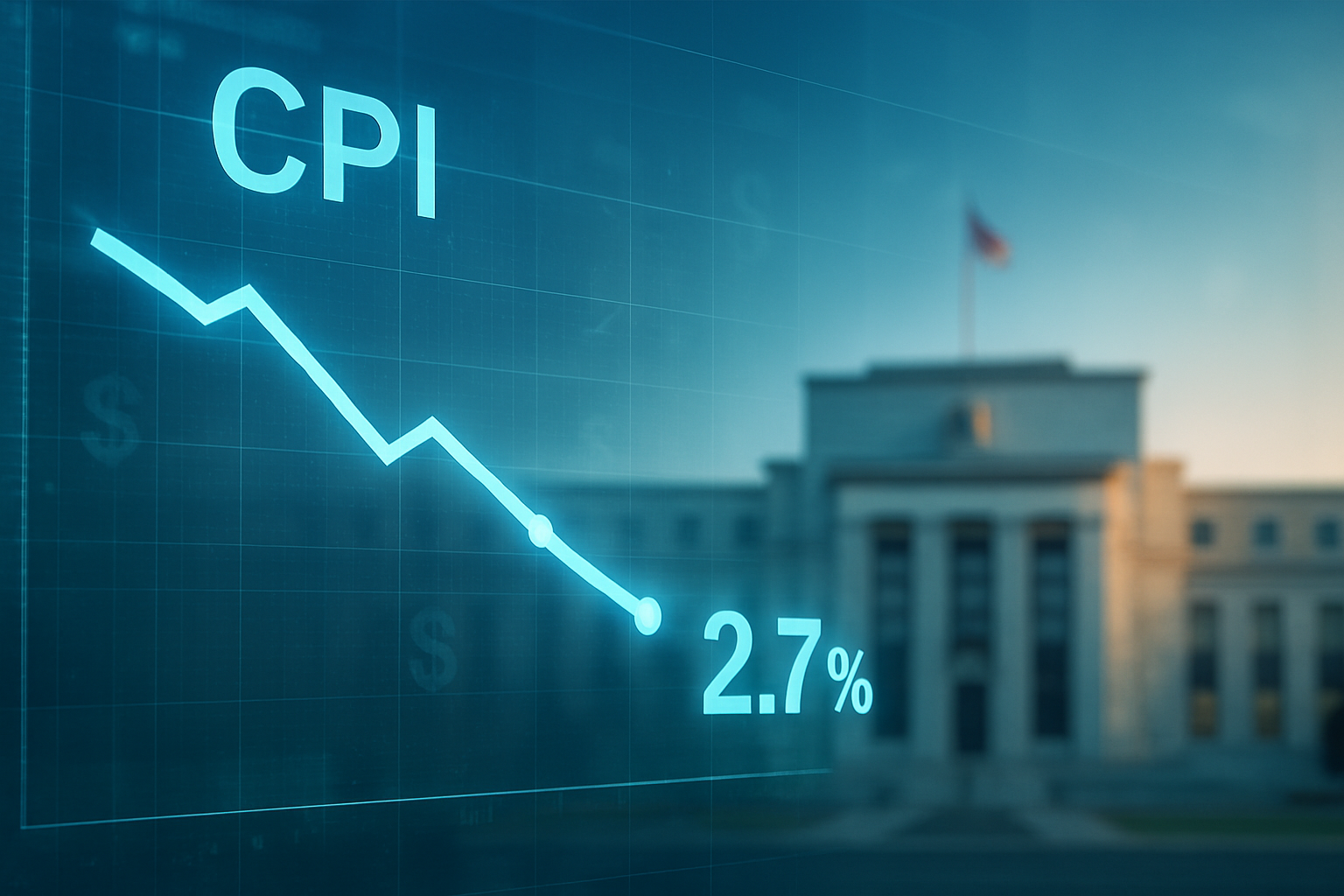
WASHINGTON, D.C. — In a critical data release that has sent ripples through the global financial markets, the Bureau of Labor Statistics (BLS) reported on December 18, 2025, that inflationary pressures in the United States cooled significantly in November. The Consumer Price Index (CPI) showed a year-over-year increase of 2.7%, a sharp decline from the 3.0% recorded in September and well below the consensus estimate of 3.1%. Core CPI, which strips out the volatile food and energy sectors, also surprised to the downside at 2.6%, signaling that the Federal Reserve’s restrictive policy may finally be taming the stubborn "last mile" of inflation.
The timing of this data is particularly poignant, arriving just a week after the Federal Open Market Committee (FOMC) concluded its final meeting of 2025. While the Fed moved forward with a widely anticipated 25-basis-point rate cut on December 10, the "cooler-than-expected" CPI figures released today have immediately shifted the narrative for early 2026. Investors are now recalibrating their expectations, weighing a surprisingly dovish inflation print against a Fed "dot plot" that remains uncharacteristically cautious about the year ahead.
A Year Defined by Disruptions and "Insurance Cuts"
The path to today’s 2.7% inflation print was anything but linear. The final quarter of 2025 was dominated by a historic 43-day government shutdown that paralyzed federal data collection throughout October and much of November. This "data blackout" forced the Federal Reserve to fly blind during its December deliberations. Despite the lack of fresh October CPI figures at the time, Chair Jerome Powell and the FOMC opted for a 25-basis-point cut—the third such "insurance cut" of the year—lowering the federal funds rate to a target range of 3.50%–3.75%.
The internal debate at the Fed has grown increasingly fractured. During the December meeting, the committee was split, with hawk-leaning members like Neel Kashkari and Alberto Musalem reportedly concerned about a potential rebound in services inflation, while others argued that the cooling labor market, with unemployment ticking up to 4.4%, demanded more aggressive action. The November CPI data released today validates the doves, suggesting that the Fed’s proactive cuts in late 2025 did not reignite price pressures as some had feared.
Initial market reactions to today’s report were swift. Treasury yields plummeted as the 10-year note fell below 3.8%, and equity futures surged. However, the optimism is tempered by the Fed’s own projections. The December "dot plot" suggests only one additional 25-basis-point cut for the entirety of 2026, targeting a terminal rate of roughly 3.4%. This creates a significant "expectations gap" between a market that sees a clear path to 3.0% and a central bank that remains scarred by the inflationary spikes of the previous years.
Sector Spotlight: Winners and Losers in the New Rate Regime
The cooling inflation and the prospect of further rate normalization are creating a distinct set of winners, particularly in the interest-rate-sensitive housing and regional banking sectors. D.R. Horton (NYSE: DHI) and Lennar (NYSE: LEN) have emerged as primary beneficiaries, as the decline in Treasury yields has allowed these massive homebuilders to offer aggressive mortgage "buydowns," effectively bypassing the high-rate environment to maintain sales volume. Similarly, Zillow Group (NASDAQ: Z) is seeing a resurgence in activity as the "lock-in effect"—where homeowners were reluctant to sell and lose their low-interest mortgages—begins to thaw, promising a boost in transaction volumes for 2026.
Regional banks are also finding their footing after a volatile two-year stretch. PNC Financial Services (NYSE: PNC) and U.S. Bancorp (NYSE: USB) are expected to see their Net Interest Margins (NIM) expand as the cost of holding deposits falls faster than the yields on their loan portfolios. Investors are increasingly looking toward Truist Financial (NYSE: TFC) as a proxy for the broader regional recovery, betting that a stable rate environment will reduce the need for further credit loss provisions.
On the losing side, the "cash-is-king" trade that dominated 2023 and 2024 is rapidly losing its luster. Money market funds and short-term debt instruments are seeing outflows as yields retreat from their 5% peaks. Furthermore, traditional defensive sectors like utilities may struggle to compete with growth-oriented tech stocks that are being re-rated. Companies like Affirm (NASDAQ: AFRM) are seeing their valuations climb as lower funding costs for their Buy-Now-Pay-Later loans directly improve their bottom line, potentially drawing capital away from more stagnant, dividend-paying "safe havens."
Wider Significance: The "1995 Playbook" and the AI Anchor
The current economic environment draws striking parallels to the mid-1990s, specifically the 1995-1996 period when the Fed successfully navigated a "soft landing" following a government shutdown. By cutting rates proactively to offset fiscal drag, the Fed of that era sparked one of the strongest bull markets in history. Today’s data suggests the Fed is attempting a similar maneuver, using "insurance cuts" to stabilize an economy that has been rattled by political volatility and a cooling labor market.
However, a new variable exists in 2025: the massive, rate-insensitive capital expenditure on Artificial Intelligence. While high interest rates historically crush capital-intensive industries, the AI boom led by Nvidia (NASDAQ: NVDA) and Oracle (NYSE: ORCL) has largely ignored the Fed’s tightening cycle. As we move into 2026, the significance of today’s CPI print lies in how it will affect the financing of the next phase of AI. Lower rates will make it cheaper for hyperscalers like Microsoft (NASDAQ: MSFT) and Meta (NASDAQ: META) to fund the massive data center expansions required for "AI 2.0," potentially decoupling the tech sector even further from traditional economic cycles.
There are also regulatory and policy implications to consider. With Jerome Powell’s term as Chair set to expire in May 2026, the Fed’s cautious stance may be an attempt to maintain institutional stability before a potential change in leadership. The "One Big Beautiful Bill Act" (OBBBA), a major fiscal stimulus package currently making its way through Congress, also looms large. If passed, the Fed may be forced to halt its cutting cycle to counter new inflationary pressures from government spending, creating a tug-of-war between fiscal and monetary policy.
What Comes Next: The Road to May 2026
In the short term, all eyes will be on the January 2026 FOMC meeting. Before today’s CPI release, the market had priced in a 62% probability of a "pause." However, the 2.7% inflation figure has bolstered the case for a fourth consecutive cut in January. If the labor market continues to show signs of softening—specifically if the unemployment rate breaches the 4.5% mark—the Fed may be forced to abandon its "one-and-done" projection for 2026 in favor of a more aggressive front-loading of cuts.
Longer-term, the market must prepare for a transition of power at the central bank. The "Powell Era" has been defined by a commitment to the 2% inflation target at all costs, but a new Chair appointed in mid-2026 might be more willing to tolerate a "2.5% world" in exchange for robust growth. This potential pivot could lead to a significant rotation into small-cap stocks and emerging markets, which have historically outperformed during periods of dollar weakness and global rate easing.
Summary and Investor Outlook
The November CPI report marks a potential turning point in the Fed’s multi-year battle against inflation. With headline inflation at 2.7%, the "soft landing" narrative is no longer just a hope—it is becoming the baseline reality. For investors, the key takeaway is that the "higher-for-longer" era has officially ended, replaced by a "lower-but-cautious" regime that favors growth, housing, and regional banking.
Moving forward, the market will remain hyper-sensitive to any signs of "inflationary echoes" from the recent government shutdown or new fiscal spending. Investors should watch the 10-year Treasury yield as a primary barometer for market sentiment; a sustained move below 3.5% would signal that the market has completely decoupled from the Fed’s hawkish projections. As we head into early 2026, the primary challenge will not be inflation, but rather the Fed’s ability to stay ahead of a cooling economy without oversteering into a recession.
This content is intended for informational purposes only and is not financial advice.