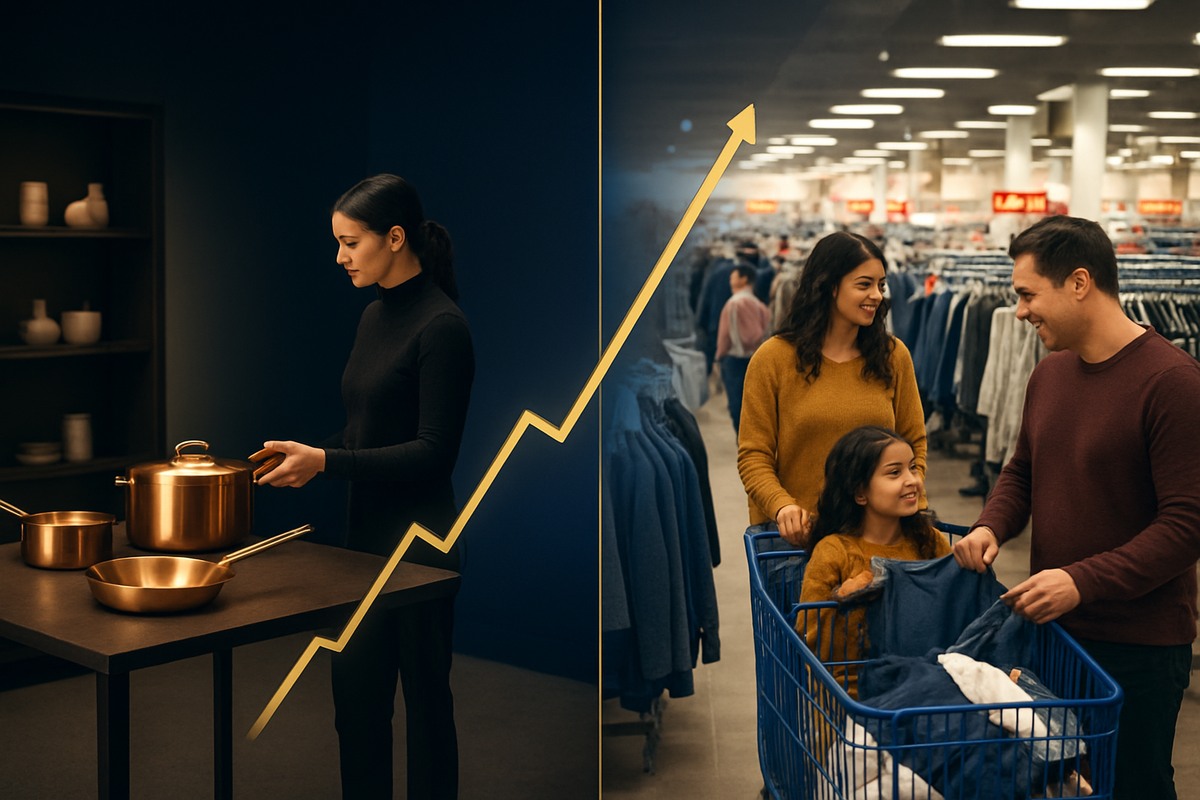
As the 2025 holiday season reaches its peak, a striking divergence has emerged in the American retail sector. While the broader economy grapples with the lingering effects of high interest rates and the looming threat of 2026 tariffs, two retail giants—Williams-Sonoma (NYSE: WSM) and The TJX Companies (NYSE: TJX)—are reporting surprisingly robust performance. However, the engines driving their growth reveal a "K-shaped" consumer landscape where the wealthy are doubling down on premium home upgrades while the middle class is increasingly seeking refuge in off-price "treasure hunts."
The recent Q3 and Q4 data for 2025 suggests that the "pragmatic celebration" trend is the defining theme of the year. Consumers are still spending, but they are doing so with a surgical precision that favors either absolute luxury or extreme value. This bifurcation is reshaping the retail industry, forcing mid-tier department stores to choose a side or risk obsolescence in an environment where the "middle" is rapidly disappearing.
The Tale of Two Earnings: Resilience in the Face of Uncertainty
In late November 2025, Williams-Sonoma (NYSE: WSM) stunned analysts by reporting a 4.4% year-over-year revenue increase to $1.88 billion for its third quarter. More impressively, the company raised its full-year operating margin guidance to a range of 17.8% to 18.1%. This performance was driven by a 7.3% surge at its flagship Williams-Sonoma brand and a recovery in "big-ticket" furniture sales at West Elm and Pottery Barn. Despite mortgage rates remaining stubbornly high throughout 2025, the company's affluent customer base showed a renewed interest in "luxe entertaining essentials" and proprietary designs that offer a sense of exclusivity.
Simultaneously, The TJX Companies (NYSE: TJX) reported a "blowout" third quarter for its fiscal year 2026 (ending November 1, 2025), with total revenue hitting $15.1 billion, a 7% increase. Consolidated comparable store sales rose 5%, led by a strong 6% gain at its Marmaxx (T.J. Maxx and Marshalls) division and a 5% jump at HomeGoods. The timeline of this growth coincides with a year-long "flight to value" as middle-income households, squeezed by three years of cumulative inflation, traded down from full-price department stores. TJX’s CEO, Ernie Herrman, noted that the company’s ability to offer branded items at 20% to 60% discounts has made it the "consumer anchor" of the current economic cycle.
Winners and Losers in the New Retail Hierarchy
The clear winners in this environment are those who have mastered the "barbell strategy." Williams-Sonoma (NYSE: WSM) has successfully insulated itself from price wars by leaning into its high-end niche. By focusing on quality and a "homebody" economy that prioritizes domestic comfort, WSM has maintained pricing power even as competitors slashed prices. Similarly, The TJX Companies (NYSE: TJX) has leveraged its massive $9.4 billion inventory position and global procurement network to snap up excess high-quality merchandise, ensuring its shelves remain stocked with the "brands that matter" at prices consumers can afford.
On the losing side are traditional mid-market retailers and department stores that lack the scale of TJX or the brand prestige of WSM. Companies like Kohl's (NYSE: KSS) and Macy's (NYSE: M) continue to struggle with declining foot traffic as their core demographic migrates toward off-price leaders like TJX or Ross Stores (NASDAQ: ROST). In the luxury space, even high-end players like RH (NYSE: RH) have faced more volatility than Williams-Sonoma, as WSM’s diversified portfolio—including Pottery Barn Kids and Teen—provides a more stable revenue base compared to RH’s pure-play focus on ultra-luxury furniture.
A K-Shaped Consumer Reality and the Death of the Middle
The diverging paths of WSM and TJX are a microcosm of the broader U.S. economy in late 2025. This "K-shaped" recovery is no longer just a post-pandemic theory; it is a structural reality. High-income consumers, often bolstered by stock market gains and home equity, are continuing to spend on "lifestyle" upgrades. For them, a $3,000 sofa from Williams-Sonoma is an investment in their primary asset—the home. Meanwhile, the lower and middle segments of the "K" are facing an erosion of confidence. McKinsey data from December 2025 shows that 57% of shoppers expect the economy to weaken in 2026, leading to a "spending reset" where every dollar is scrutinized.
Historically, this trend mirrors the retail shifts seen during the 2008 financial crisis, but with a modern twist: the role of digital convenience and "Buy Now, Pay Later" (BNPL) services. In 2025, BNPL usage reached all-time highs during the "Cyber Five" shopping period, accounting for a significant portion of the $44.2 billion in online sales. While this has supported spending at Williams-Sonoma, it also signals that even some affluent shoppers are looking for ways to manage cash flow. The industry is also bracing for the "tariff anxiety" of 2026, with many consumers pulling forward purchases of durable goods to avoid anticipated price hikes—a phenomenon that has temporarily boosted WSM’s furniture sales.
Looking Ahead: The 2026 Tariff Shadow and Strategic Pivots
As we move into 2026, the retail landscape faces a significant pivot point. The primary challenge for Williams-Sonoma (NYSE: WSM) will be navigating its supply chain exposure to China. While the company has been diversifying its manufacturing base, a new round of tariffs could squeeze the margins that management worked so hard to expand in 2025. To counter this, expect WSM to lean even further into its "proprietary and exclusive" product strategy, which allows for higher markups that can absorb some cost increases.
For The TJX Companies (NYSE: TJX), the challenge is one of success. Having captured so much market share in 2025, the hurdle for year-over-year growth in 2026 will be high. However, the off-price model is historically "all-weather." If the economy enters a true recession in 2026, TJX stands to gain even more from consumers trading down. The company is likely to continue its aggressive store expansion, particularly in suburban markets where former department store shoppers now reside. Market opportunities may also emerge in the international sector, as TJX looks to replicate its North American "treasure hunt" success in European and Australian markets.
Final Takeaways: What Investors Should Watch
The performance of Williams-Sonoma and TJX in late 2025 provides a clear roadmap for the year ahead. The American consumer is not "tapped out," but they are becoming increasingly bifurcated. For investors, the key takeaway is the importance of "defensible growth." Williams-Sonoma has proven that a strong brand and high-end demographic can withstand high interest rates, while TJX has demonstrated that value is the ultimate competitive moat in an inflationary environment.
Moving into the first half of 2026, investors should keep a close eye on two specific metrics: inventory turnover at TJX and operating margins at WSM. If TJX can maintain its 5% comp growth despite a potential cooling in consumer spending, it will solidify its status as a defensive staple. Conversely, if Williams-Sonoma can maintain its 18% margin target in the face of new tariffs, it will prove the resilience of its premium business model. In a market where the "middle" is a dangerous place to be, these two retailers have found the winning formulas on either end of the spectrum.
This content is intended for informational purposes only and is not financial advice.