Today’s Date: 12/22/2025
Introduction
General Mills (NYSE: GIS) stands at a fascinating crossroads in late 2025. As one of the world's most recognizable consumer packaged goods (CPG) giants, it is currently navigating a marketplace defined by two diametrically opposed forces: the "frugal consumer" looking for value amidst sticky inflation, and the "premium consumer" seeking high-protein, health-oriented products. With its recent fiscal 2026 second-quarter earnings report surprising Wall Street, General Mills has proven that even a 150-year-old flour miller can adapt to the age of GLP-1 weight-loss drugs and the "humanization" of pet food. This article provides a deep-dive into the company’s current standing, its strategic pivot away from traditional dairy, and its future as a diversified nutrition powerhouse.
Historical Background
General Mills traces its lineage back to 1866, when Cadwallader Washburn opened a flour mill in Minneapolis, Minnesota. The company’s early history was defined by the rivalry between the Washburn-Crosby Company and the Pillsbury Company, which spurred massive innovation in milling technology. In 1928, General Mills was officially formed through the merger of Washburn-Crosby and 26 other regional mills.
The 20th century saw the company diversify into icons of the American pantry: the launch of "Cheerioats" (now Cheerios) in 1941, the introduction of the Pillsbury Doughboy in 1965, and the 2001 acquisition of Pillsbury, which effectively doubled the company's scale. However, the most pivotal modern transformation occurred in 2018 with the $8 billion acquisition of Blue Buffalo. This move signaled a shift from being a "cereal company" to a "brand builder" in high-growth, high-margin categories like pet nutrition.
Business Model
General Mills operates a sophisticated, brand-led business model centered on four primary segments:
- North America Retail: The largest segment, encompassing cereal (Cheerios, Lucky Charms), meals (Progresso, Old El Paso), and snacks (Nature Valley, Totino’s).
- Pet: Focused on the Blue Buffalo brand, which emphasizes natural, high-quality ingredients.
- North America Foodservice: Providing products to schools, hotels, and restaurants.
- International: Covering established markets in Europe and emerging markets in Asia and Latin America.
The company generates revenue primarily through the sale of branded food products to retail chains, wholesalers, and foodservice operators. Its strategy relies on "HMM" (Holistic Margin Management)—a disciplined productivity program that targets 5% of cost of goods sold (COGS) in savings annually to fuel marketing and innovation.
Stock Performance Overview
As of late December 2025, General Mills' stock is undergoing a recovery phase.
- 1-Year Performance: The stock has seen a volatile year, dipping to 52-week lows near $48 in Q3 2025 due to concerns over private-label competition. However, following the Dec 17 earnings beat, it has stabilized in the $47–$51 range.
- 5-Year Performance: Over the last five years, GIS has provided a total return (including dividends) that has generally tracked with the consumer staples sector, though it trailed the broader S&P 500 during the 2023-2024 tech surge.
- 10-Year Performance: Long-term shareholders have benefited from GIS’s "Dividend Aristocrat" qualities. The stock has provided steady, albeit slow, capital appreciation, but its true value has been in the compounding of a dividend yield that has averaged between 3% and 5% over the last decade.
Financial Performance
In its Q2 FY2026 report (released Dec 17, 2025), General Mills demonstrated significant operational resilience:
- Earnings: Adjusted EPS came in at $1.10, beating the $1.02 consensus.
- Revenue: Net sales were $4.9 billion, down 7% year-over-year. However, this was largely due to the divestiture of the North American yogurt business (Yoplait), which removed a significant but low-margin revenue stream.
- Organic Growth: Organic net sales declined by only 1%, showing improvement from earlier in the year. Crucially, organic volumes in the North American Retail segment turned positive for the first time in several quarters.
- Margins: Adjusted operating profit margin remains healthy, supported by the disposal of the lower-margin yogurt segment and robust pricing power in the Pet segment.
- Valuation: Trading at roughly 11x-13x forward earnings, GIS is currently priced at a discount compared to its historical 10-year average and peer group.
Leadership and Management
CEO Jeff Harmening, who took the helm in 2017, has been the architect of the "Accelerate" strategy. His tenure has been marked by a ruthless focus on portfolio reshaping. By selling off the yogurt business in late 2024 and acquiring high-growth brands like Whitebridge Pet Brands (Tiki Pets) in 2025, Harmening has leaned into high-growth "Global Platforms."
The management team is generally well-regarded for its transparency and fiscal discipline. The board has maintained a strong commitment to returning cash to shareholders, evidenced by over 120 years of uninterrupted dividend payments.
Products, Services, and Innovations
General Mills is currently using innovation to fight the "GLP-1 headwind." Rather than fearing weight-loss drugs, GIS has launched a "Leaner Consumer" initiative.
- Innovation Pipeline: Products like Cheerios Protein and Nature Valley Protein Bars are being marketed directly to consumers who are eating less but seeking higher nutrient density.
- Pet Innovation: The national rollout of Blue Buffalo "Love Made Fresh" (refrigerated pet food) is a major play for the $10 billion fresh-pet-food market.
- Digital Transformation: The company has invested heavily in first-party data, allowing for hyper-targeted marketing that has seen ROI on media spend increase significantly since 2021.
Competitive Landscape
The competitive environment shifted dramatically in 2025 following the Mars acquisition of Kellanova. With Pringles and Cheez-It now part of a massive private entity, General Mills faces a consolidated snacking rival.
- Vs. Kraft Heinz (NYSE: KHC): GIS currently holds a valuation premium over Kraft Heinz due to its stronger position in the Pet category, while KHC remains focused on condiments and turnaround efforts.
- Vs. Private Label: This remains the biggest threat. In categories like basic cereal and baking mixes, store brands (Great Value, Kirkland) have gained market share as consumers look to save money. GIS counters this with "Remarkability"—investing in product quality that private labels struggle to match.
Industry and Market Trends
Three macro trends are currently defining the sector:
- GLP-1 Impact: While analysts initially feared a 10% drop in snacking, data in late 2025 suggests consumers are switching to high-protein snacks rather than quitting snacks entirely.
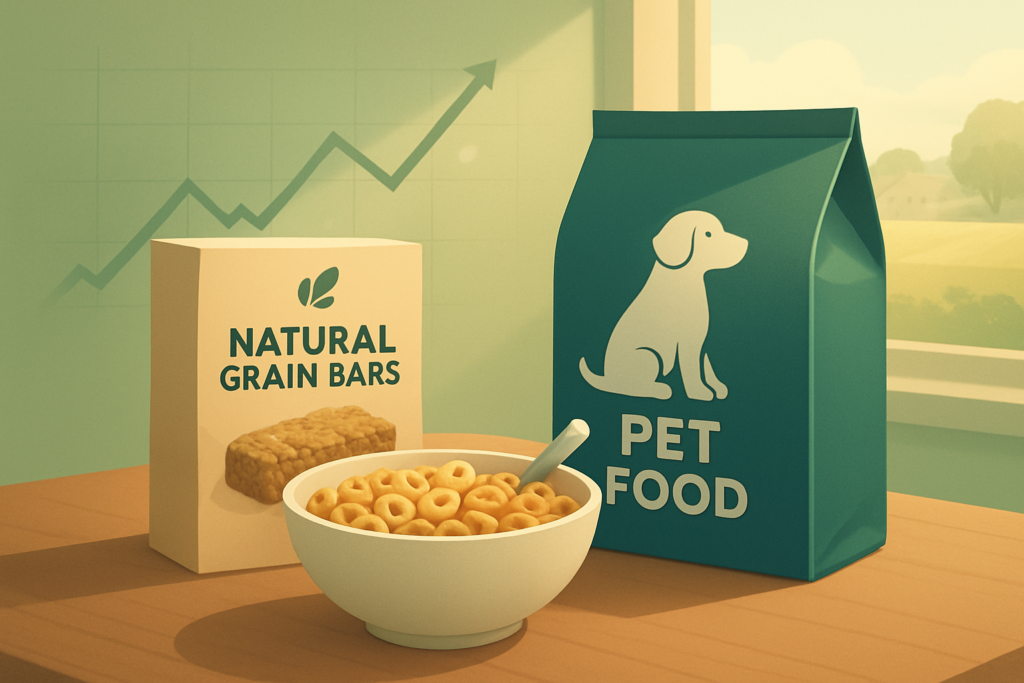
- Pet Humanization: People are spending more on "fresh" and "wet" pet food, which carries higher margins for GIS.
- Value-Seeking Behavior: The "middle class" consumer is increasingly shopping at club stores (Costco) and discounters (Aldi), forcing GIS to offer larger pack sizes and more competitive pricing.
Risks and Challenges
- Commodity Volatility: While supply chains have normalized since 2022, spikes in the price of oats, sugar, and aluminum can still compress margins.
- Regulatory Scrutiny: Increased FDA focus on "Healthy" labeling and front-of-pack nutrition warnings could force reformulations of sugary cereals.
- Private Label Erosion: If General Mills cannot maintain its "Remarkability" gap, consumers may permanently switch to cheaper store brands.
Opportunities and Catalysts
- M&A: Following the yogurt divestiture, GIS has a war chest of cash. Analysts expect further acquisitions in the "natural and organic" or "pet health" spaces.
- Fresh Pet Food: The Blue Buffalo fresh line is in its early innings and could provide a multi-year growth runway.
- International Scaling: Brands like Old El Paso have significant growth potential in Europe and Asia, where Mexican cuisine is gaining popularity.
Investor Sentiment and Analyst Coverage
Sentiment on Wall Street is cautiously optimistic as of December 2025.
- Analyst Ratings: The consensus is currently a "Hold" to "Moderate Buy." Analysts appreciate the 5% dividend yield and the yogurt divestiture, which cleans up the balance sheet.
- Institutional Moves: Several large "Value" and "Income" funds have increased their positions in Q4 2025, viewing the sub-$50 price point as an attractive entry for a defensive asset.
Regulatory, Policy, and Geopolitical Factors
Geopolitically, General Mills is less exposed to China than many tech or fashion brands, as the vast majority of its revenue is North American-based. However, domestic policy remains a factor. The 2025 Farm Bill and discussions around sugar taxes are ongoing concerns that could impact the cost of raw materials and the marketing of children's cereals.
Conclusion
General Mills (GIS) in late 2025 is a company that has successfully traded "breadth for depth." By exiting the slow-growth yogurt category and doubling down on Pet and high-protein human snacks, the company has insulated itself against the rise of weight-loss drugs and the volatility of the global economy. For the investor, GIS represents a classic defensive play: it offers a robust 5.0% dividend yield, a discounted valuation, and a management team that has proven it can grow volumes even when consumers are feeling the pinch. While it may not offer the explosive growth of a tech stock, its recent earnings beat suggests that the "Big G" still has plenty of momentum left in its tank.
This content is intended for informational purposes only and is not financial advice.