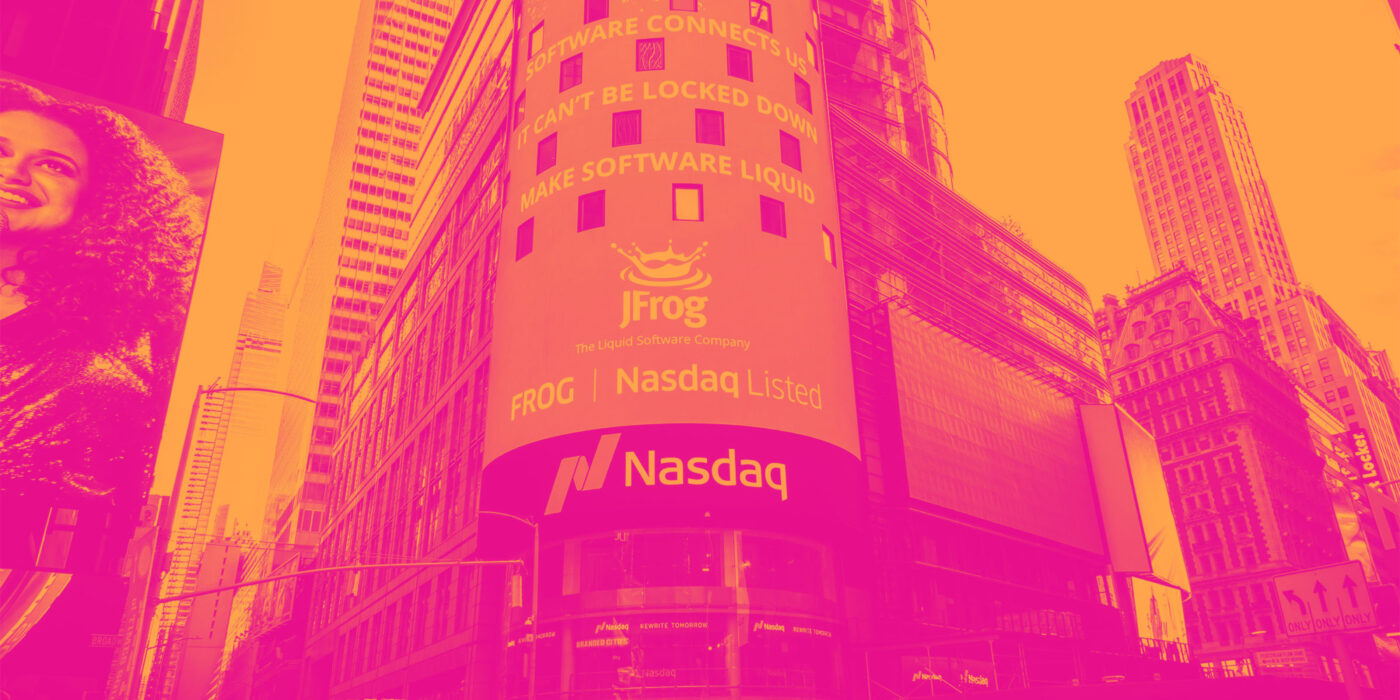
Software supply chain platform JFrog (NASDAQ: FROG) announced better-than-expected revenue in Q2 CY2026, with sales up 28.7% year on year to $163.8 million. On top of that, next quarter’s revenue guidance ($165 million at the midpoint) was surprisingly good and 3.8% above what analysts were expecting. Its non-GAAP profit of $0.27 per share was 12.4% above analysts’ consensus estimates.
Is now the time to buy FROG? Find out in our full research report (it’s free for active Edge members).
JFrog (FROG) Q2 CY2026 Highlights:
- Revenue: $163.8 million vs analyst estimates of $155.6 million (28.7% year-on-year growth, 5.2% beat)
- Adjusted EPS: $0.27 vs analyst estimates of $0.24 (12.4% beat)
- Adjusted Operating Income: $32.59 million vs analyst estimates of $28.93 million (19.9% margin, 12.7% beat)
- The company lifted its revenue guidance for the full year to $650 million at the midpoint from $630 million, a 3.2% increase
- Management raised its full-year Adjusted EPS guidance to $0.98 at the midpoint, a 3.2% increase
- Operating Margin: -8.1%, up from -20.4% in the same quarter last year
- Customers: 1,291 customers paying more than $100,000 annually
- Net Revenue Retention Rate: 121%, up from 120% in the previous quarter
- Annual Recurring Revenue: $666.4 million (26.5% year-on-year growth, beat)
- Billings: $208.1 million at quarter end, up 55.8% year on year
- Market Capitalization: $10.06 billion
StockStory’s Take
JFrog’s second quarter was marked by strong cloud adoption, increased demand for security solutions, and expanded enterprise customer relationships, driving results ahead of Wall Street’s expectations. Management credited the surge in cloud usage to rapid adoption of AI development tools, which are generating more software binaries, and emphasized the growing need for integrated security as software supply chain attacks become more frequent. CEO Shlomi Ben Haim described JFrog’s platform as the “control plane for the next generation of software delivery,” highlighting the company’s ability to adapt as AI becomes an integral part of software engineering processes.
Looking ahead, JFrog’s updated guidance is anchored by continued growth in security product adoption, rising annual customer commitments, and ongoing expansion in its cloud platform. Management believes the company is well-positioned to benefit from AI-driven changes in software creation and distribution, noting that customers increasingly require governance, compliance, and operational flexibility. CFO Ed Grabscheid stated, “Our outlook remains anchored by growing contributions from security core products, ongoing adoption of our full platform and cloud growth driven from higher annual customer commitments.”
Key Insights from Management’s Remarks
Management attributed outperformance to robust cloud consumption, heightened security needs, and new AI-driven customer use cases, particularly within large enterprises.
-
AI-driven cloud growth: Accelerating adoption of AI tools has led to an increase in the volume and complexity of binaries created and managed, resulting in higher cloud platform usage. Management noted that AI agents are now “first-class citizens” in software supply chains, driving a shift toward JFrog’s platform as the central system of record.
-
Security demand intensifies: The rise in software supply chain attacks has driven more customers to adopt JFrog’s integrated security solutions, with CISO teams viewing them as mission-critical. Over 80% of new enterprise customers spending more than $1 million annually added security products, reflecting an industry-wide focus on threat mitigation.
-
Governance and compliance expansion: Enterprises are increasingly embedding governance and compliance directly into development workflows—referred to by management as “DevGovOps.” A notable seven-figure deal was signed with a leading AI infrastructure provider, who expanded its partnership to include governance and compliance features alongside core security capabilities.
-
Cloud migration and flexible consumption: JFrog is proactively encouraging on-premise customers to transition to cloud or hybrid models, aligning with customer demand for scalable solutions and operational efficiency. The company’s approach allows organizations to balance committed and on-demand usage, which management views as essential in today’s uncertain AI economy.
-
Notable AI-native customer wins: JFrog landed a major AI-native customer, displacing a competitor unable to handle high-volume, multi-region hybrid deployments. This further validates the platform’s scalability and appeal for organizations building “with AI for AI,” and is expected to support further customer growth in this emerging segment.
Drivers of Future Performance
Management’s outlook is shaped by continued adoption of security products, expanding cloud commitments, and the evolving needs of AI-focused enterprises.
-
Security as a growth engine: Management expects security products to remain a primary driver of revenue growth, as organizations face increasing threats and regulatory requirements for secure software delivery. The integration of security into the core platform is seen as a differentiator that encourages multi-year, high-value contracts.
-
AI workload expansion: The rapid proliferation of AI tools and agentic software development is fueling demand for JFrog’s platform, as customers seek scalable infrastructure for managing new types of binaries and development workflows. Management noted that trends such as open source adoption and token-based software economics are also contributing to usage growth.
-
Customer migration and commitment trends: JFrog anticipates continued migration of self-managed customers to cloud and hybrid models, with a focus on converting high levels of usage into larger, longer-term commitments. Management is also watching for potential budget discipline among enterprise customers, as organizations seek to optimize spend while maintaining innovation.
Catalysts in Upcoming Quarters
In future quarters, the StockStory team will be monitoring (1) the pace at which self-managed customers migrate to cloud and hybrid models, (2) the adoption rates and attach levels of security and governance products among both new and existing enterprise clients, and (3) the ability of JFrog to secure additional large-scale AI-native customer wins. We will also track how effectively the company converts usage overages into longer-term commitments.
JFrog currently trades at $85.73, up from $83.04 just before the earnings. Is the company at an inflection point that warrants a buy or sell? The answer lies in our full research report (it’s free).
Now Could Be The Perfect Time To Invest In These Stocks
ONE MORE THING: Top 6 Stocks for This Week. This market is separating quality stocks from expensive ones fast. AI is taking down whole sectors with no warning. In a rotation this fast, you need more than a list of good companies.
Our AI system flagged Palantir before it ran 1,662% between October 2022 and February 2026. AppLovin before it ran 753% between February 2024 and February 2026. Nvidia before it ran 1,178% between January 2023 and February 2026. Each week it produces 6 new names that pass the same tests. Get Our Top 6 Stocks for Free HERE.
Stocks that have made our list include now familiar names such as Nvidia (+1,460% between June 2020 and June 2025) as well as under-the-radar businesses like the once-micro-cap company Kadant (+214% between June 2020 and June 2025). Find your next big winner with StockStory today.