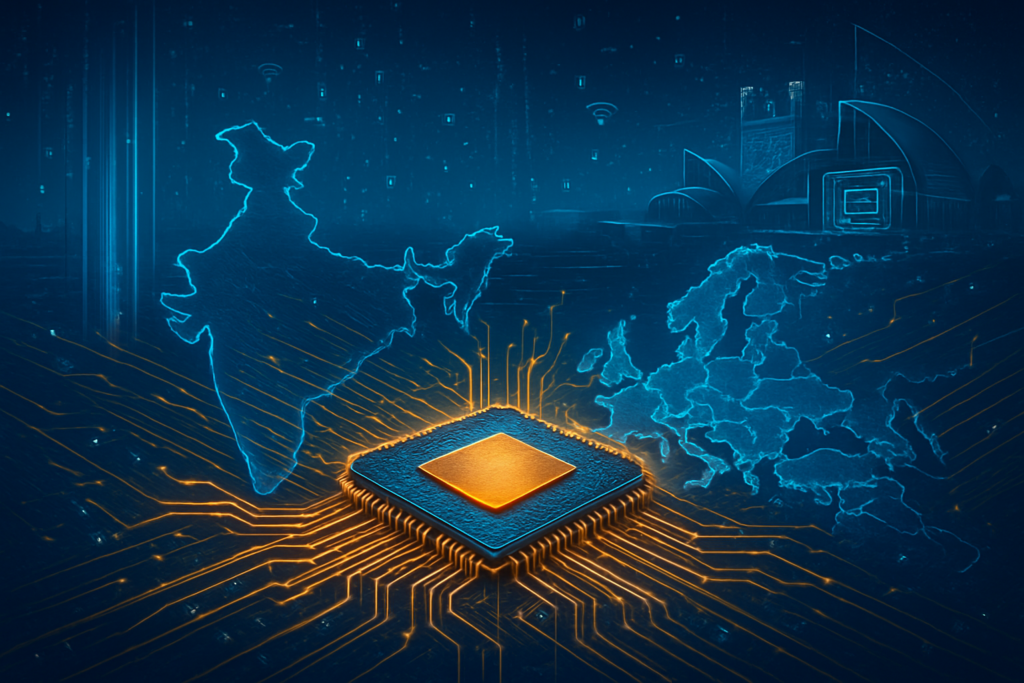
As of December 19, 2025, the geopolitical map of the global technology sector is being redrawn. India and the European Union have entered the final, decisive phase of their landmark Free Trade Agreement (FTA) negotiations, with a formal signing now scheduled for January 27, 2026. At the heart of this historic deal is a sophisticated framework for semiconductor cooperation that aims to bridge the technological chasm between the two regions. This "Silicon Silk Road" initiative represents a strategic pivot, positioning India as a primary manufacturing and design hub for European tech interests while securing the EU’s supply chain against future global shocks.
The immediate significance of this development cannot be overstated. By synchronizing the €43 billion EU Chips Act with the $10 billion India Semiconductor Mission (ISM), both regions are moving beyond mere trade to deep industrial integration. Today’s finalization of a series of bilateral Memorandums of Understanding (MoUs) between India and the Netherlands marks the operational start of this alliance. These agreements focus on high-stakes technology transfer, advanced lithography maintenance, and the creation of a "verified hardware" corridor that will define the next decade of AI and automotive electronics.
Technical Synergy and the GANANA Project
The technical backbone of this cooperation is managed through the India-EU Trade and Technology Council (TTC), which has moved from policy discussion to hardware implementation. A standout development is the GANANA Project, a €5 million initiative funded via Horizon Europe. This project establishes a high-performance computing (HPC) corridor linking Europe’s pre-exascale supercomputers, such as LUMI in Finland and Leonardo in Italy, with India’s Centre for Development of Advanced Computing (C-DAC). This link allows Indian engineers to perform AI-driven semiconductor modeling and "digital twin" simulations of fabrication processes before a single wafer is etched in India’s new fabs in Gujarat and Assam.
Furthermore, the cooperation is targeting the "missing middle" of the semiconductor value chain: advanced chip design and Process Design Kits (PDKs). Unlike previous technology transfers that focused on lagging-edge nodes, the current framework emphasizes heterogeneous integration and compound semiconductors. This involves the use of Gallium Nitride (GaN) and Silicon Carbide (SiC), materials essential for the next generation of electric vehicles (EVs) and 6G infrastructure. By sharing PDKs—the specialized software tools used to design chips for specific foundry processes—the EU is effectively providing Indian startups with the "blueprints" needed to compete at a global level.
Industry experts have reacted with cautious optimism, noting that this differs from existing technology partnerships by focusing on "sovereign hardware." The goal is to create a supply chain that is not only efficient but also "secure-by-design," ensuring that the chips powering critical infrastructure in both regions are free from backdoors or vulnerabilities. This level of technical transparency is unprecedented between a Western bloc and a major emerging economy.
Corporate Giants and the Dutch Bridge
The Netherlands has emerged as the indispensable bridge in this partnership, leveraging its status as a global leader in precision engineering and lithography. ASML Holding N.V. (NASDAQ: ASML) has shifted its Indian strategy from a vendor model to an infrastructure-support model. Rather than simply exporting Deep Ultraviolet (DUV) lithography machines, ASML is establishing specialized maintenance and training labs within India. These hubs are designed to train a new generation of Indian lithography engineers, ensuring that the multi-billion dollar fabrication units being built by the Tata Group and other domestic players operate with the yields required for commercial viability.
Meanwhile, NXP Semiconductors N.V. (NASDAQ: NXPI) is deepening its footprint with a $1 billion expansion plan that includes a massive new R&D hub in the Greater Noida Semiconductor Park. This facility is tasked with leading NXP’s global efforts in 5nm automotive AI chips. By doubling its Indian engineering workforce to 6,000 by 2028, NXP is effectively making India the nerve center for its global automotive and IoT (Internet of Things) chip design. This move provides NXP with a strategic advantage, tapping into India's vast pool of VLSI (Very Large Scale Integration) designers while providing India with direct access to cutting-edge automotive tech.
Other major players are also positioning themselves to benefit. The HCL-Foxconn joint venture for an Outsourced Semiconductor Assembly and Test (OSAT) plant in Uttar Pradesh is reportedly integrating Dutch metrology and inspection software. This integration ensures that Indian-packaged chips meet the stringent quality standards required for the European automotive and aerospace markets, facilitating a seamless flow of components across the "Silicon Silk Road."
Geopolitical De-risking and AI Sovereignty
The wider significance of the India-EU semiconductor nexus lies in the global trend of "de-risking" and "friend-shoring." As the world moves away from a China-centric supply chain, the India-EU alliance offers a robust alternative. For the EU, India provides the scale and human capital that Europe lacks; for India, the EU provides the high-end IP and precision machinery that are difficult to develop from scratch. This partnership is a cornerstone of the broader "AI hardware sovereignty" movement, where nations seek to ensure they have the physical capacity to run the AI models of the future.
However, the path is not without its challenges. The EU’s Carbon Border Adjustment Mechanism (CBAM) remains a point of contention in the broader FTA negotiations. India is concerned that the "green" tariffs on steel and cement could offset the economic gains from tech cooperation. Conversely, European labor unions have expressed concerns about the "Semiconductor Skills Program," which facilitates the mobility of Indian engineers into Europe, fearing it could lead to wage stagnation in the local tech sector.
Despite these hurdles, the comparison to previous milestones is clear. This is not just a trade deal; it is a "tech-industrial pact" similar in spirit to the post-WWII alliances that built the modern aerospace industry. By aligning the EU Chips Act 2.0 with India’s ISM 2.0, the two regions are attempting to create a bipolar tech ecosystem that can balance the dominance of the United States and East Asia.
The Horizon: 2D Materials and 6G
Looking ahead, the next phase of this cooperation will likely move into the realm of "Beyond CMOS" technologies. Research institutions like IMEC in Belgium are already discussing joint pilot lines with Indian universities for 2D materials and carbon nanotubes. These materials could eventually replace silicon, offering a path to even faster and more energy-efficient AI processors. In the near term, expect to see the first "Made in India" chips using Dutch lithography hitting the European market by late 2026, primarily in the automotive and industrial sectors.
Applications for this cooperation will soon extend to 6G telecommunications. The India-EU TTC has already identified 6G as a priority area, with plans to develop joint standards that prioritize privacy and decentralized architecture. The challenge will be maintaining the momentum of these capital-intensive projects through potential economic cycles. Experts predict that the success of the January 2026 signing will trigger a wave of venture capital investment into Indian "fabless" chip startups, which can now design for a guaranteed European market.
Conclusion: A New Era of Tech Diplomacy
The finalization of the India-Netherlands semiconductor MoUs on December 19, 2025, marks a watershed moment in technology diplomacy. It signals that the "tech gap" is no longer a barrier but a bridge, with the Netherlands acting as the vital link between European innovation and Indian industrial scale. The impending signing of the India-EU FTA in January 2026 will codify this relationship, creating a powerful new bloc in the global semiconductor landscape.
The long-term impact of this development will be felt in the democratization of high-end chip manufacturing and the acceleration of AI deployment across the Global South and Europe. As we move into 2026, the industry will be watching the progress of the first joint pilot lines and the mobility of talent between Eindhoven and Bengaluru. The "Silicon Silk Road" is no longer a vision—it is an operational reality that promises to redefine the global digital economy for decades to come.
This content is intended for informational purposes only and represents analysis of current AI developments.
TokenRing AI delivers enterprise-grade solutions for multi-agent AI workflow orchestration, AI-powered development tools, and seamless remote collaboration platforms.
For more information, visit https://www.tokenring.ai/.