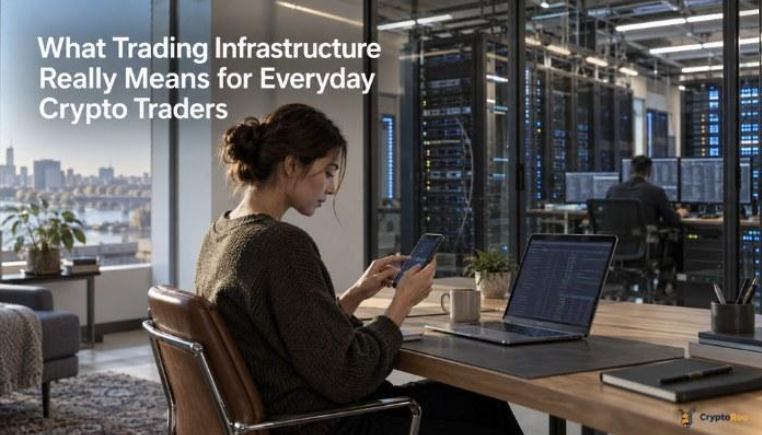
Trading infrastructure means the servers, networks, and data centers deciding if your order fills quickly and fairly, or slowly and off-price. For everyday traders, that difference is felt directly in how smoothly a trade goes.
Most people blame the app the moment a screen freezes during a price swing. The same goes for an order that fills late during high volume. We've watched this happen across the exchanges we compare at CryptoRoo, and the app is rarely the real problem.
To help you see the full picture, this article covers order matching, exchange uptime, market data, and liquidity. Once you know how each one works, you'll spot problems before they cost you a bad fill.
Trading Infrastructure Is the Tech Behind Every Trade You Place

Behind every order you place sits a network of servers and systems working to get that trade done.
Take clicking buy on 0.5 ETH, for example. In a fraction of a second, that request travels through matching engines, security checks, and settlement systems before it lands in your wallet.
Behind that quick trade, three pieces do the heavy lifting.
Servers Confirm Every Trade: Every exchange leans on servers to process your orders and confirm each trade in real time. Take those servers offline, and the whole platform stalls immediately.
One Dropped Connection Stops Everything: One network carries data between servers, data centers, and trading tools. When that link fails, you will lose access to trading entirely, and no app design can fix that.
The Weakest Link Wins: If one part of this system lags, your order will take longer to go through, even if the app on your phone looks fine.
Next time your trade lags, check the system running behind it. That's usually where the problem lives.
Order Matching Decides Who Gets Filled First

Inside every exchange, a priority system decides whose order fills first. That priority comes from something called a matching model. Most crypto exchanges lean on one of two models to make that call.
The Simple Queue Model
Picture a coffee shop line, where whoever gets there first gets served first, regardless of how big their order is. The first-in, first-out model works the same way. If you place a buy order before someone else at the same price, your order will fill first.
You've probably felt the flip side too, watching a trade sit while someone else's goes through first simply because they clicked buy a split second sooner.
Pro Rata: Size Decides Your Share
Pro rata skips the line entirely. Instead, it splits each fill based on order size. If you place a large order alongside several smaller ones, more of it gets filled, even if you arrived last.
This works less like a line and more like splitting a reward by contribution. Basically, the more you put in, the more you get back. Exchanges use this model to keep large traders active on the platform, since it rewards size over timing.
Exchange Uptime Depends on Where the Data Centers Sit
The matching engine we just covered has to run somewhere, and that somewhere is a data center. A single facility like this can process millions of trades in a day, and it has to stay online through all of them.
So what decides if that facility keeps running? Three layers of infrastructure play a role:
Servers Confirm Every Trade: A server confirms your order the moment you tap buy, running on hardware built for constant use with little maintenance downtime. Many exchanges also run a hybrid cloud setup. This splits operational load across multiple locations so one failure can't take the whole platform down.
Redundancy Keeps Trading Live: Engineers call this redundancy, spreading the same job across multiple locations so no single failure brings the whole system down. Connectivity between those locations is what makes the switch seamless for you.
Reliability Isn't Optional: Exchanges track uptime the way airlines track on-time flights. In traditional securities markets, SEC rules require exchange operators to keep their systems reasonably resilient, though crypto exchanges aren't held to the same requirement.
Ultimately, a data center you never see decides if your trade goes through. Check for uptime and redundancy before you trust an exchange with your money.
Delayed Market Data Can Cost You the Price You Wanted
You check the price, tap buy, and the number that goes through looks nothing like what you saw. That price mismatch traces back to market data, the live stream of prices and order book depth every exchange shows you. Stock exchanges have relied on similar data feeds for decades, and crypto exchanges now run on the same basic idea.
Then there's latency, the reason that stream takes a moment to reach your screen through delivery systems built for speed. By the time you see a price, it's already moved.
Say an exchange's price feed updates every 800 milliseconds instead of in real time. In that window, Bitcoin can swing $150 or more, and your order fills at whatever price comes after (a common cause of failed limit orders). This kind of lag is common in electronic trading, where speed decides who gets the better price.
Even a small delay changes what you pay. That's why it’s worth checking before you commit your money.
Thin Liquidity Hurts Execution Even on a Great App
Liquidity is how easily your order finds a buyer or seller on the other side. Without it, your trade either takes longer to fill or fills at a worse price.
A few things decide how much of it any given exchange has.
Liquidity Means Stable Pricing: A liquid asset can be bought or sold quickly without moving its price much, and Bitcoin and Ethereum usually hold that stability even during busy trading hours.
Thin Books Move Prices More: Fewer market participants means fewer people to trade against, and each order pushes the price further. It's a two-sided deal, buyer and seller both, and it takes two to tango. Thin books often leave one of them out.
A Great App Can't Fix This: A well-designed app still can't fill a trade with no one on the other side, and that gap only grows during extreme swings. Institutional investors and retail traders alike carry more risk when spreads widen in a hurry, which includes major coins.
A deep order book keeps your trade close to the price you saw. A thin one rarely does.
What to Remember Before Your Next Trade
You now know what really sits behind a clean trade. This knowledge changes how you evaluate an exchange, beyond how the app looks, and it puts you a step ahead of traders who only judge by design.
To make sense of what runs behind your trades, we walked through four pieces of trading infrastructure. Order matching sets your place in line, while uptime decides if you can trade at all. After that, market data and liquidity decide your final price, and getting it wrong costs you money.
At CryptoRoo, we've stress-tested exchanges so you don't have to learn the hard way. Browse our comparisons and pick an exchange built to handle real trading conditions.