The metaverse was once hailed as the next great frontier in digital innovation, with tech giants pouring billions into immersive reality, advanced wearables, and 3D virtual platforms. However, the slowdown in investor enthusiasm and overall adoption has also made the largest spender in the industry, Meta Platforms (META), confront the issue of how far and how quickly it should go with this big, ambitious vision.
No company has bet more heavily on the metaverse than Meta, whose Reality Labs division has racked up a staggering $73 billion in cumulative losses since its launch.
But now the good news is that CEO Mark Zuckerberg is slashing the metaverse budget by roughly 30%, refocusing on projects that can pay off. This comes at a time when Meta’s core ad business is booming, but margins are under pressure. Meta just posted another blowout quarter with record revenue, yet profits plunged on a one-off tax charge.
The big question for investors: does slashing Reality Labs spending boost Meta’s outlook and justify its rich stock price, or has the metaverse bet failed so badly that even deep cuts may not help META stock recover? Let's try to find out the answers.
About Meta Stock
Meta Platforms is the company behind Facebook, Instagram, WhatsApp, and Oculus and is a digital advertising juggernaut and AI leader. Its apps reach 3.5 billion users monthly, making Meta the largest social media company by revenue.
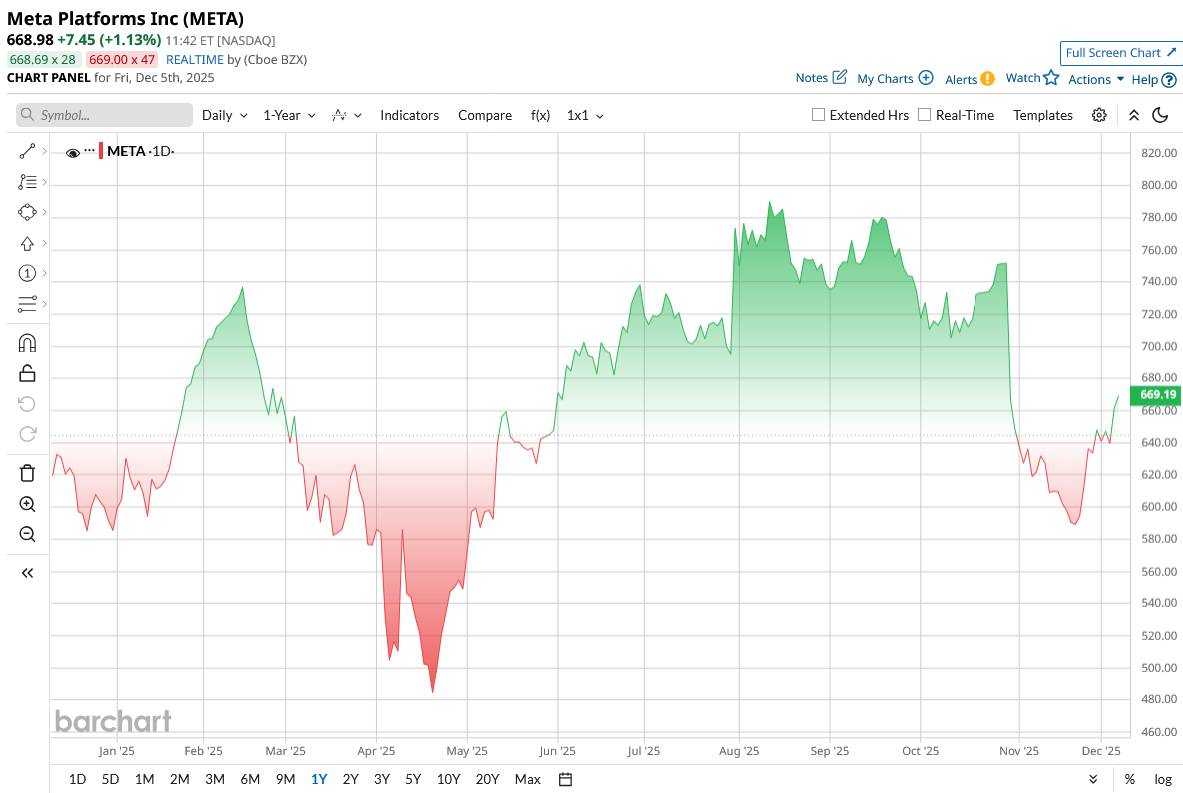
Valued at around $1.6 trillion by market cap, Meta's stock has been facing a volatile year, like other tech giants. META stock initially rallied on strong ad growth but has since eased off its peak. Shares hit a new high near $796 in mid-August, then pulled back to the mid-$600s by December. Year-to-date (YTD), META is up around 14%, as U.S. and international advertisers stepped up spending on Facebook and Instagram. However, the stock now sits below its spring highs, as some profit-taking sets in after a torrid run.
On valuation, Meta isn’t a cheap name. Its forward price/earnings ratio is roughly 25x, which is relatively higher than the broader tech sector median, often closer to 15x. In other words, investors are paying a premium for Meta’s growth expectations. These elevated multiples reflect the market’s faith that Meta can keep growing its ad revenue and monetize new AI features. But they also leave little margin for error, like if Meta disappoints, the stock could look expensive.
Reality Labs & Spending Cuts
Reality Labs is Meta’s longtime bet on virtual reality, augmented reality glasses, and the broader “metaverse.” It has never made a profit; even in Q3 2025 alone, RL posted an operating loss of about $4.4 billion. Cumulatively, that adds up to roughly $73 billion lost over five years chasing VR/AR. Analysts have long fretted that Meta was pouring money into a vision that was too far ahead of the market. Now Zuckerberg is pulling the reins.
In recent reports, he told executives to cut up to 30% of Reality Labs spending, halt some projects, and reallocate resources. Essentially, Meta is cutting loose some of the “horizon” VR projects that haven’t panned out and shifting funding to areas like AI infrastructure or core apps.
This pivot shows Meta recognizing failure and fixing it. By trimming unprofitable spending, Meta could improve near-term cash flow and profits. Investors cheered the news that Meta’s share price jumped. It suggests that Wall Street believes Meta may finally curb the bleeding in Reality Labs.
Meta Top Q3 Earnings Estimate
Meta’s Q3 2025 report was a tale of two stories: booming sales but pressured profits. Revenue surged to $51.24 billion, up about 26% year-over-year (YoY), powered almost entirely by its advertising business. Ad revenue rose by a similar percentage as marketers increased spending across Facebook and Instagram. Even Reality Labs posted growth, with VR revenue climbing 74% to $470 million as retailers stocked up on Oculus headsets ahead of the holidays.
But costs jumped as well. Total expenses rose 32% to $30.7 billion, reflecting higher R&D spending on AI and hardware, plus a massive one-time tax charge. That tax expense, nearly $15.93 billion, pushed Meta’s effective tax rate to 87%, causing net income to plunge to $2.71 billion, an 83% drop from last year.
On an adjusted basis, Meta earned a profit of $7.21 per share, far ahead of the analysts' estimate.
However, Meta’s cash generation stayed robust, producing $10.6 billion in free cash flow and ending the quarter with roughly $44.4 billion in cash and marketable securities. The company also returned capital to shareholders, repurchasing about $3.2 billion of stock and paying $1.3 billion in dividends.
Guidance remains upbeat. Management expects Q4 revenue in the $56 to $59 billion range, supported by holiday ad demand. Full-year 2025 expenses are projected at $116 to 118 billion as Meta continues investing heavily in AI infrastructure and next-generation data centers. Capital spending will be enormous, about $70 to 72 billion for 2025, with further increases expected in 2026.
What Do Analysts Say About META Stock?
Wall Street is cautiously optimistic about META stock. For example, Goldman Sachs recently cut its price target to $815 from $870 while keeping a “Buy” rating. Goldman’s analysts praised Meta’s strong ad revenue but warned that the “elevated investment cycle” could keep profits under pressure.
Conversely, Citigroup reiterated a “Buy” on Meta with an $850 target, noting that Zuckerberg’s “strategic efficiency” moves, like slashing metaverse budgets, could free up resources for AI products, making the stock’s valuation look more attractive if growth materializes.
Raymond James is still very bullish with a "Strong Buy" rating, even after trimming its target to $825. They highlight Meta’s fat 81 to 82% gross margins and multiple “growth engines,” saying these factors support the long-term case. Importantly, even analysts cutting targets stress that Meta’s ad business is efficient.
On average, analysts see Meta’s fundamentals as solid but balanced against high investment, with a consensus “Strong Buy” rating. The consensus 12-month price target of $842.31 implies upside of roughly 27% from current levels.

On the date of publication, Nauman Khan did not have (either directly or indirectly) positions in any of the securities mentioned in this article. All information and data in this article is solely for informational purposes. For more information please view the Barchart Disclosure Policy here.
More news from Barchart
- Tesla, Netflix, and ON Semiconductor: 3 Unusually Active Cash-Secured Put Options to Sell Now
- Down 40% in the Past Month, Morgan Stanley Says This 1 Stock Is Key to the Future of AI
- Salesforce Generates Strong Free Cash Flow - CRM Could Be 23% Too Cheap
- AMD Is Getting Ready to Launch Helios. Wall Street Thinks You Should Buy AMD Stock First.