ContrastConnect has released a guide clarifying the modalities of direct versus general supervision for contrast administration in imaging procedures.
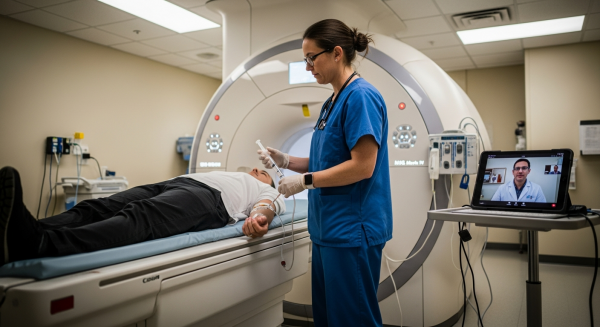
-- ContrastConnect has published a guide to clarify the differences between direct and general supervision for contrast-enhanced imaging procedures, addressing common questions among imaging center administrators seeking to understand and comply with complex regulations. The guide, titled "Direct vs General Supervision: Differences & Examples," includes practical examples and compliance considerations that administrators can apply to workflows for contrast-enhanced CT and MRI studies.
More information is available at https://www.contrast-connect.com/blog-post/direct-vs-general-supervision-differences-examples.
Understanding these supervision distinctions has become increasingly important as the Centers for Medicare & Medicaid Services (CMS) moves to permanently allow virtual direct supervision for certain Level 2 diagnostic tests, including contrast-enhanced CT and MRI, beginning January 1, 2026, explains the team at ContrastConnect.
This policy change requires imaging centers to implement workflows that align with CMS's definition of "immediately available," which now includes real-time audio and video communication in addition to physical presence in applicable settings. Administrators preparing for this transition must grasp how supervision types differ in scope, staffing requirements, and escalation protocols to ensure their facilities meet federal requirements as well as any additional state-level standards.
ContrastConnect's guide addresses practical operational questions that imaging administrators face. Topics include how to structure staffing models under different supervision types, account for state-level scope-of-practice rules, and establish escalation protocols aligned with CMS and ACR expectations. Practical examples illustrate how direct supervision differs from general supervision in terms of clinician availability, communication infrastructure, and emergency response capabilities. The resource also highlights considerations for facilities operating across multiple jurisdictions, where state law or accreditation standards may impose requirements beyond federal baselines.
Implementing clear supervision workflows is one of the key steps that can streamline operations and reduce uncertainty for staff. For administrators managing regulatory compliance, operational bottlenecks, and staffing challenges, a clearer understanding of supervision distinctions supports both risk reduction and efficiency. The guide is intended as a starting point for facilities reviewing or updating their supervision policies in high-volume imaging environments.
ContrastConnect brings substantial operational experience to this guidance. The team has provided more than 45,000 hours of supervision for over 55,000 contrast studies each month. Supervision services are delivered by physicians trained in evidence-based approaches to managing contrast reactions and aligned with American College of Radiology (ACR) guidance, supporting clinical rigor and patient safety across distributed imaging networks.
For more details, visit https://www.contrast-connect.com/
Contact Info:
Name: Dor Shoshan
Email: Send Email
Organization: ContrastConnect
Address: 309 Queens Gate Ct, Las Vegas, NV 89145, United States
Website: https://www.contrast-connect.com/
Source: PressCable
Release ID: 89180213
If there are any deficiencies, discrepancies, or concerns regarding the information presented in this press release, we kindly request that you promptly inform us by contacting error@releasecontact.com (it is important to note that this email is the authorized channel for such matters, sending multiple emails to multiple addresses does not necessarily help expedite your request). Our dedicated team is committed to addressing any identified issues within 8 hours to guarantee the delivery of accurate and reliable content to our esteemed readers.