Introduction
As of March 17, 2026, the automotive industry stands at a crossroads between legacy internal combustion performance and the uncompromising weight demands of the electric vehicle (EV) era. At the center of this transition is Carbon Revolution plc (NASDAQ: CRCL, currently trading as OTC: CREVF), a company that promised to revolutionize the "unsprung mass" of the world’s most elite vehicles. Once a darling of the ESG-driven SPAC boom, Carbon Revolution today represents a complex case study in high-tech manufacturing: a company with a product that the world’s greatest carmakers covet, but a balance sheet that has pushed it to the brink of insolvency. This research feature explores the engineering brilliance and the financial turbulence of the global leader in one-piece carbon fiber wheels.
Historical Background
Carbon Revolution’s journey began not in a corporate boardroom, but in the engineering labs of Deakin University in Geelong, Australia, in 2007. Founded by a team of engineers—most notably Matt Dingle and Ashley Denmead—who were obsessed with the physics of motorsport, the company’s mission was singular: to commercialize the world’s first one-piece carbon fiber automotive wheel.
The company spent nearly a decade in a "bridge" phase between R&D and commercial viability. Its big break came in 2015 when Ford Motor Company (NYSE: F) selected Carbon Revolution to supply wheels for the Mustang Shelby GT350R. It was a watershed moment—the first time a major global OEM had fitted a one-piece carbon fiber wheel as standard equipment on a mass-produced performance car. This validated the technology and set the stage for a rapid expansion into the portfolios of Ferrari, General Motors, and Jaguar Land Rover.
Business Model
Carbon Revolution operates as a Tier 1 OEM supplier, sitting at the very top of the automotive supply chain. Its business model is built on three pillars:
- Direct OEM Supply: High-margin contracts to supply wheels for flagship performance models (e.g., Corvette Z06, Range Rover Sport SV).
- Engineering Services: Charging OEMs for the bespoke design, testing, and validation of wheels tailored to specific vehicle dynamics.
- Aftermarket Sales: A smaller but high-visibility segment providing wheels for performance enthusiasts.
Revenue is driven by "take rates"—the percentage of car buyers who opt for the carbon fiber wheel upgrade. Because these wheels can cost upwards of $15,000 to $20,000 per set at the retail level, Carbon Revolution benefits from the premium positioning of its partners.
Stock Performance Overview
The equity history of Carbon Revolution has been nothing short of a roller coaster. After a listing on the Australian Securities Exchange (ASX), the company sought deeper capital markets in the U.S. via a SPAC merger with Twin Ridge Capital Acquisition Corp in late 2023.
- 1-Year Performance: Over the last 12 months (March 2025–March 2026), the stock has lost over 95% of its value.
- Post-SPAC Peak: Shortly after its NASDAQ debut, low-float volatility saw shares spike into double digits (adjusting for various structural changes), briefly valuing the company as a "unicorn."
- Current Standing: As of mid-March 2026, the company has been delisted from the NASDAQ and currently trades on the OTC Pink Sheets (CREVF) at a distressed valuation below $0.50 per share, reflecting significant "going concern" risks.
Financial Performance
The financial narrative of 2024 and 2025 was a "tale of two tapes." Operationally, the company saw record demand. FY2024 revenue hit $47.3 million, an 87% year-over-year increase, fueled by the Corvette and Range Rover programs.
However, the "bottom line" tells a darker story. The company reported a net loss of $146.4 million in 2024, hampered by the immense capital expenditures required for its "Mega-line" and high interest costs on its debt. By late 2025, the company faced a liquidity crunch so severe it was unable to file its 20-F annual report on time, leading to the eventual NASDAQ delisting in February 2026.
Leadership and Management
The leadership suite has seen significant upheaval. Long-time CEO Jake Dingle, who took the company from a startup to a global OEM supplier, stepped down in early 2025. He was succeeded by Donnie Hampton Jr., an industry veteran with experience at Maxion Wheels, signaling a shift from "founder-led innovation" to "survival-led operations."
Perhaps the most stabilizing force in the company’s governance is Board Chair Bob Lutz. The legendary former Vice Chairman of General Motors (NYSE: GM) brings decades of automotive gravitas, providing the company with an open door to Detroit and European boardrooms that a smaller Australian firm might otherwise struggle to access.
Products, Services, and Innovations
Carbon Revolution’s core product is a marvel of material science. By replacing aluminum with carbon fiber, the company reduces wheel weight by 40% to 50%.
- The Unsprung Advantage: Reducing "unsprung mass" (parts of the car not supported by the suspension) allows for better handling, shorter braking distances, and improved acceleration.
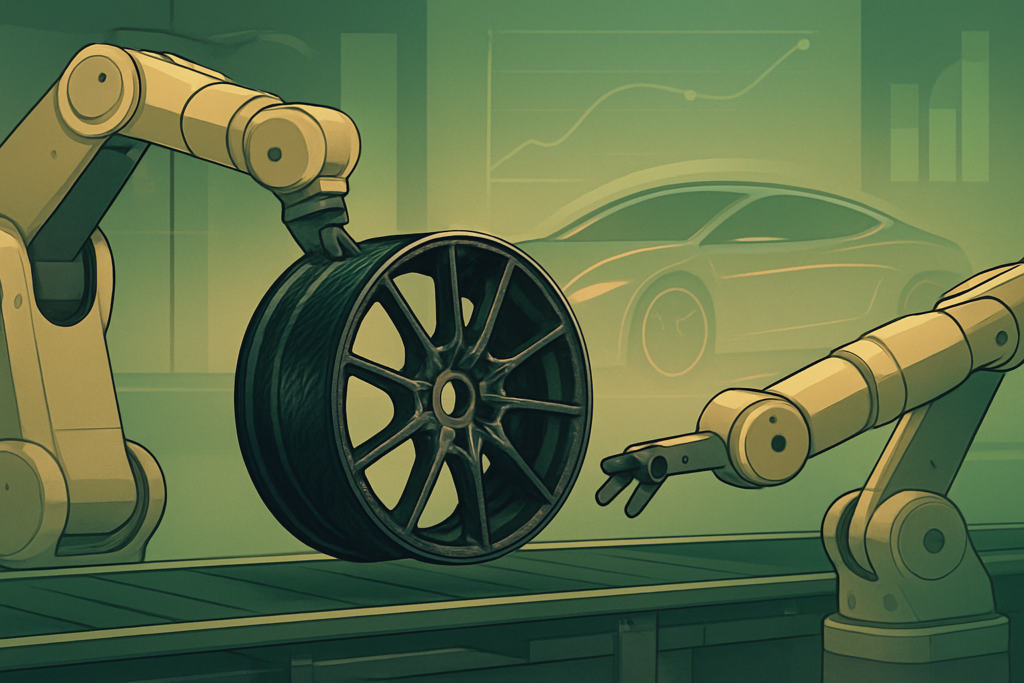
- The Mega-line: The company’s crown jewel is its automated "Mega-line" in Geelong. This facility uses proprietary robotics and "digital twin" technology to automate the layup of carbon fiber, a process that was historically labor-intensive. The Mega-line is designed to produce 50,000 wheels annually, a scale unmatched by any competitor.
Competitive Landscape
While Carbon Revolution is the only company producing one-piece carbon fiber wheels at OEM scale, it faces competition on two fronts:
- Hybrid Competitors: Companies like Dymag (UK) offer carbon-hybrid wheels (carbon fiber rim with an aluminum center), which are easier to manufacture but lack the full weight-saving benefits of a one-piece design.
- Tier 1 Giants: Companies like Maxion and BBS are investing in composite research. While they haven't matched Carbon Revolution’s one-piece tech, their massive balance sheets allow them to wait for the market to mature.
Industry and Market Trends
The most significant macro driver for Carbon Revolution is the "EV Range Paradox." Electric vehicles are inherently heavy due to battery packs. To offset this weight and extend range, manufacturers are looking for every possible ounce of savings.
- Range Extension: Carbon fiber wheels can extend EV range by an estimated 5% to 10% through a combination of weight reduction and improved aerodynamics.
- NVH Reduction: Carbon fiber has superior natural damping properties, reducing Road-Noise, Vibration, and Harshness (NVH)—a critical factor for quiet-running EVs.
Risks and Challenges
The risks facing CRCL in March 2026 are existential:
- Liquidity and Solvency: The company is currently negotiating a debt-for-equity swap with its secured lenders. This move, while potentially saving the company from bankruptcy, is expected to essentially wipe out existing common shareholders.
- Concentration Risk: A significant portion of revenue comes from a few high-end programs. The cancellation of two major EV programs in late 2025 highlighted the company's vulnerability to the broader "EV cooling" trend.
- Manufacturing Complexity: Despite the Mega-line, carbon fiber manufacturing remains high-cost and prone to yield issues compared to traditional alloy casting.
Opportunities and Catalysts
Despite the financial gloom, the company possesses "distressed asset" appeal.
- M&A Potential: A major OEM (like GM or Ford) or a large Tier 1 supplier could acquire Carbon Revolution’s IP and manufacturing assets at a deep discount to internalize the technology.
- The Porsche/BMW Rumor: Long-standing rumors of a massive contract with a "Major German OEM" (believed to be Porsche or BMW) remain a potential catalyst if the company can stabilize its finances to fulfill the order.
Investor Sentiment and Analyst Coverage
Sentiment is currently at an all-time low. Most major Wall Street analysts have ceased coverage following the delisting. Retail sentiment, once bullish during the 2023-2024 "tech-auto" hype, has turned to frustration as the stock migrated to the OTC Pink Sheets. Institutional holders have largely exited, leaving the company’s fate in the hands of its debt holders.
Regulatory, Policy, and Geopolitical Factors
Governments in the U.S. and EU continue to tighten fleet efficiency standards. Incentives for lightweighting technologies could eventually provide Carbon Revolution with indirect subsidies or "green credits." However, the company’s Australian base provides a geopolitical challenge; while it has a U.S. listing, its primary manufacturing remains in Geelong, making it sensitive to Australian labor costs and logistics.
Conclusion
Carbon Revolution is a company that has succeeded in every way except the one that matters most to the public markets: financial sustainability. Its wheels are an engineering triumph, chosen by the most discerning automotive brands in history. However, the cost of industrializing this technology proved higher than the capital markets were willing to bear in a high-interest-rate environment.
For investors, CRCL/CREVF is no longer a traditional equity play; it is a speculative bet on a restructuring outcome. The technology will likely survive—it is too valuable to the future of the EV industry to disappear—but whether current shareholders will be part of that future remains deeply uncertain. Watch for the finalization of the debt-for-equity swap as the defining moment for the company's 2026 trajectory.
This content is intended for informational purposes only and is not financial advice. As of March 17, 2026, Carbon Revolution is considered a high-risk, distressed security.