New York-based Tapestry, Inc. (TPR) operates as a global house of accessories and lifestyle brands, bringing together luxury labels like Coach and Kate Spade New York under one platform. The company focuses on extending each brand’s reach across new markets and generations, using shared resources to support their growth while preserving individual identities. Guided by evolving consumer preferences, it develops products and experiences aimed at strengthening long-term brand relevance and integrating into everyday lifestyles.
Companies with market capitalizations of $10 billion or more are generally classified as “large-cap stocks,” and Tapestry easily clears that bar. With a valuation of roughly $28.8 billion, the luxury group stands firmly in large-cap territory, underscoring its scale and established presence within the consumer discretionary space. The company’s stock performance has also been quite impressive.
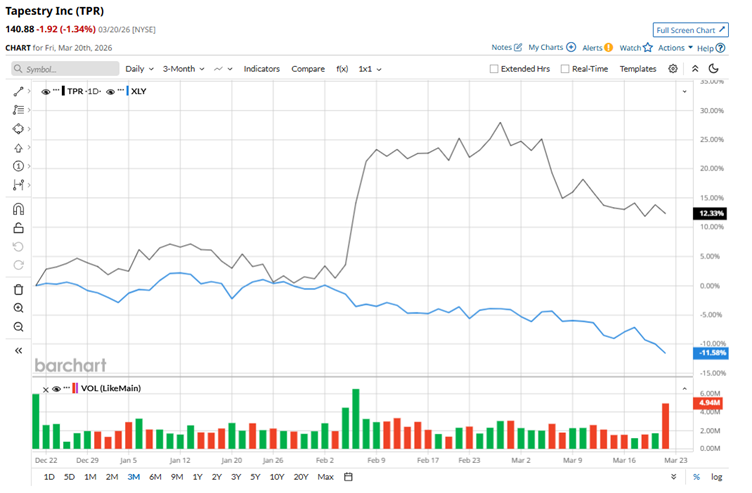
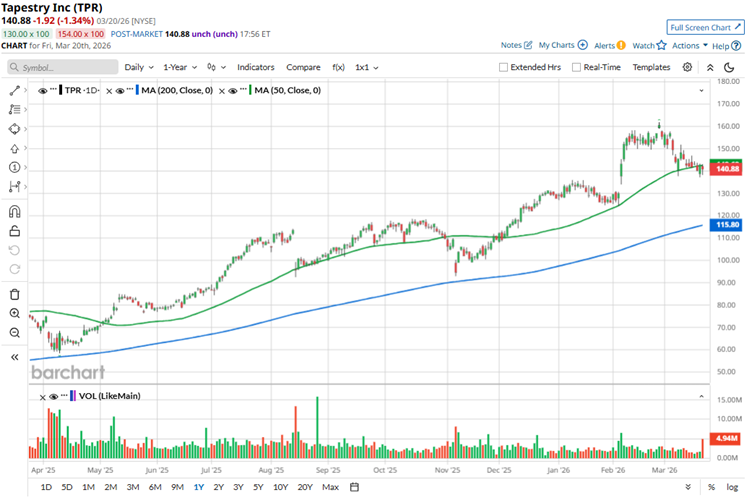
After reaching a 52-week high of $161.97 last month, the shares have pulled back about 13%, a natural breather after a strong run. Even so, the bigger picture remains solid. Over the past three months, the stock is still up 12.3%. That sharply contrasts with the broader consumer discretionary space, where the State Street Consumer Discretionary Select Sector SPDR ETF (XLY) has declined 11.6% over the same period, highlighting Tapestry’s relative outperformance.
The longer-term performance is even more compelling. The stock has surged an impressive 93.2% over the past year, significantly outpacing the broader market, with XLY trailing far behind at just a 9.5% gain over the same period. Technically, the trend has remained firmly bullish. The stock has consistently traded above its 200-day moving average since last year and largely held above its 50-day moving average as well, despite occasional short-term fluctuations along the way.
The parent company of Coach and Kate Spade has delivered a remarkable run over the past year, fueled in large part by a successful shift toward younger consumers. That strategy is clearly gaining traction. During the most recent quarter (Q2 2026), Tapestry added nearly 3.7 million new customers, with nearly one-third coming from Gen Z. In fact, the Tabby handbag line has emerged as a viral favorite on social media.
Affluent Gen Z shoppers have been driving demand for Coach’s Tabby handbags, priced between $295 and $725, turning them into a standout growth engine for the brand. The strong uptake comes at a time when rivals like Michael Kors have struggled to capture the attention of increasingly selective consumers, highlighting Coach’s edge in resonating with younger buyers. At the same time, demand from existing customers has also picked up, pointing to broad-based momentum across the business.
While TPR has stood out in the consumer cyclical landscape over the past year, it hasn’t been the top performer across the board. TPR’s peer Fossil Group, Inc. (FOSL) has gone a step further, delivering a staggering 211.7% return over the same period and setting an even higher bar for outperformance.
Overall, Wall Street is leaning cautiously optimistic on TPR. Among the 21 analysts covering the stock, the consensus lands at a “Moderate Buy,” reflecting a balanced but positive outlook. The average price target of $162.53 points to a potential upside of about 15.4% from current levels, suggesting there’s still room for further gains.
On the date of publication, Anushka Mukherjee did not have (either directly or indirectly) positions in any of the securities mentioned in this article. All information and data in this article is solely for informational purposes. For more information please view the Barchart Disclosure Policy here.
More news from Barchart