Date: March 25, 2026
Introduction
In the spring of 2026, Walmart Inc. (Nasdaq: WMT) stands as a testament to the power of digital transformation. Long categorized as a legacy "big-box" retailer, the company has successfully pivoted into a high-tech, omnichannel ecosystem that rivals the world’s most advanced platform companies. With its recent transition from the New York Stock Exchange to the Nasdaq in late 2025, Walmart signaled to the global markets that it is no longer just a seller of goods, but a leader in AI-driven commerce, advertising, and automated logistics. As of today, Walmart remains the world’s largest employer and a bellwether for the global consumer economy, currently navigating a pivotal leadership transition and a massive surge in high-margin service revenue.
Historical Background
Founded in 1962 by Sam Walton in Rogers, Arkansas, Walmart was built on the revolutionary "Everyday Low Price" (EDLP) model. Walton’s strategy focused on rural markets where competition was thin, allowing the company to build a dominant regional footprint before expanding nationally.
The company went public in 1970 and spent the next three decades perfecting the art of supply chain management and inventory logistics. By the 1990s, the introduction of the "Supercenter"—combining a full grocery store with general merchandise—solidified Walmart’s position as the dominant force in American retail. Over the last decade, under the leadership of Doug McMillon, the company underwent a "digital-first" transformation, acquiring Jet.com in 2016 and aggressively investing in Flipkart and PhonePe to capture the burgeoning Indian market.
Business Model
Walmart’s business model has evolved into a diversified engine with three primary revenue streams:
- Omnichannel Retail: Selling physical goods through Walmart U.S., Walmart International, and Sam’s Club. This remains the core volume driver, with grocery accounting for over 50% of U.S. sales.
- Membership and Services: Walmart+ and Sam’s Club memberships provide recurring, high-margin revenue and foster customer loyalty.
- The "New" Walmart: This includes Walmart Connect (advertising), data monetization, and fulfillment services. This segment is the company’s fastest-growing and most profitable, as it leverages Walmart’s 250 million weekly customer visits to sell targeted advertising to third-party brands.
Stock Performance Overview
The last two years have been transformative for Walmart shareholders. Following a historic 3-for-1 stock split in February 2024, the stock has defied the "boring retail" stereotype:
- 1-Year Performance: Up approximately 42%, significantly outperforming the S&P 500 as the market rewarded Walmart’s margin expansion.
- 5-Year Performance: The stock has more than doubled, driven by the successful integration of e-commerce and the scaling of its advertising business.
- Post-Split Momentum: Since the split price of ~$60 in early 2024, the stock has surged to its current level of $122.05, representing a ~105% gain in roughly 25 months.
Financial Performance
Walmart’s Fiscal Year 2026 (ending January 31, 2026) was a record-breaker. The company reported total revenue of $713.2 billion, a 4.7% increase year-over-year. While top-line growth was steady, the bottom line was the real story:
- Net Income: Reached $21.89 billion, up 12.6% from FY2025.
- E-commerce: Global e-commerce sales crossed the $150 billion threshold, with U.S. online growth accelerating to 27%.
- Margins: Operating margins expanded as high-margin advertising and membership fees now account for roughly one-third of total operating income.
- Balance Sheet: Walmart maintains a fortress-like balance sheet, utilizing strong cash flows to fund $10 billion in annual automation CAPEX while continuing its 50-year streak of dividend increases.
Leadership and Management
On February 1, 2026, Walmart entered a new era with John Furner taking the helm as President and CEO, succeeding Doug McMillon. Furner, who previously led Walmart U.S., is credited with the successful "Store of the Future" rollout and the integration of e-commerce into the store workflow.
The leadership bench is deeply technical. David Guggina, the new head of Walmart U.S., transitioned from a background in e-commerce and supply chain automation, signaling that the company’s future is built on robotics and "agentic commerce"—where AI assistants handle the replenishment of household goods autonomously.
Products, Services, and Innovations
Walmart is currently at the forefront of several technological frontiers:
- Sparky AI: A proprietary conversational AI assistant integrated with Google Gemini, allowing customers to shop through natural dialogue.
- Shoppable TV: Following the 2024 Vizio acquisition, Walmart has turned millions of smart TVs into direct-to-consumer storefronts via the Vizio SmartCast OS.
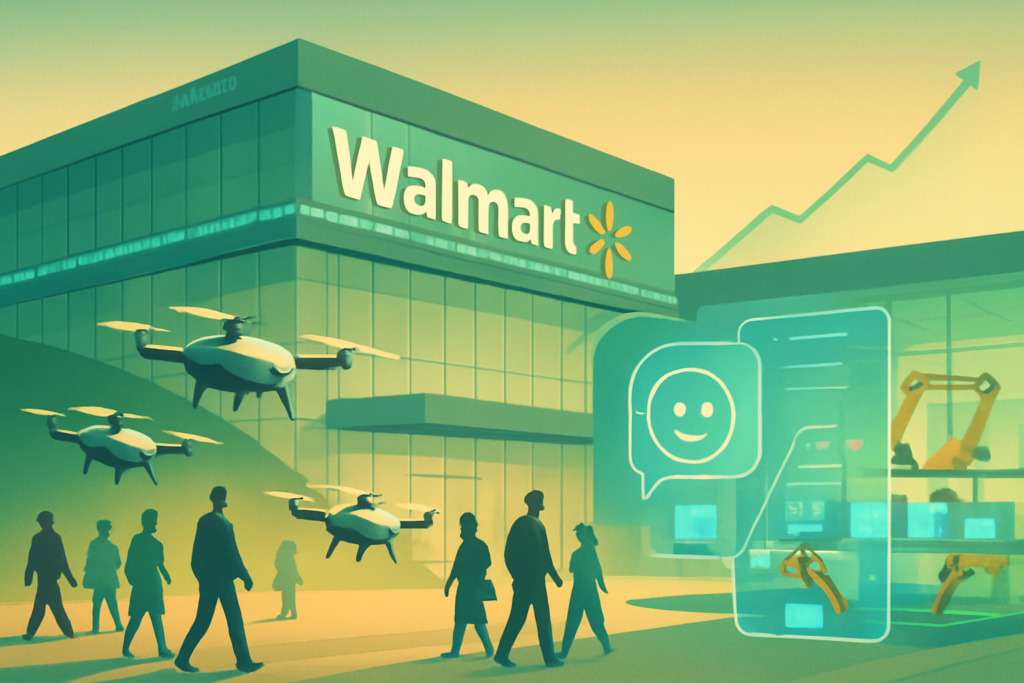
- Automation: As of 2026, nearly 65% of Walmart stores are serviced by automated fulfillment centers, utilizing robotics to triple the speed of order processing.
- Drone Delivery: Walmart now operates the largest retail drone delivery network in the U.S., capable of reaching over 10 million households with 30-minute delivery times.
Competitive Landscape
While Amazon.com, Inc. (Nasdaq: AMZN) remains the primary rival in the digital space, Walmart holds a significant advantage in "phygital" retail. Walmart's physical proximity to 90% of the U.S. population allows it to use stores as fulfillment hubs, a cost advantage Amazon struggles to replicate in the grocery sector.
In the warehouse club space, Costco Wholesale Corp. (Nasdaq: COST) remains a formidable competitor, though Sam’s Club has gained ground by leveraging Walmart’s superior technology stack for "Scan & Go" checkout and digital-native member experiences.
Industry and Market Trends
Two macro trends are currently favoring Walmart:
- Value-Seeking High Earners: High interest rates and persistent inflation in services have driven households earning over $100,000 to shop at Walmart for groceries, expanding the company’s total addressable market (TAM).
- Retail Media Expansion: As third-party cookies disappear, Walmart’s first-party data (knowing exactly what people buy) has become "gold" for advertisers, fueling the rapid growth of Walmart Connect.
Risks and Challenges
Despite its dominance, Walmart faces headwinds:
- Labor Relations: As the nation’s largest private employer, Walmart is highly sensitive to wage inflation and unionization efforts.
- International Volatility: While Flipkart is thriving, other international markets remain lower-margin and subject to currency fluctuations.
- Regulatory Scrutiny: The Federal Trade Commission (FTC) continues to monitor Walmart’s data privacy practices and its influence over the grocery supply chain.
Opportunities and Catalysts
- Agentic Commerce: If Walmart’s AI can successfully automate "the weekly grocery run" for millions, it will lock in a level of recurring revenue previously unseen in retail.
- IPO Potential: Investors are closely watching for potential spin-offs of Flipkart or PhonePe in India, which could unlock billions in shareholder value.
- Healthcare Expansion: While Walmart scaled back physical clinics in 2024, its pharmacy and digital health play remains a massive untapped opportunity.
Investor Sentiment and Analyst Coverage
Wall Street is overwhelmingly bullish. As of March 2026, roughly 85% of analysts covering WMT have a "Buy" or "Strong Buy" rating. Hedge funds have increased their positions throughout 2025, viewing Walmart as both a defensive play in volatile markets and a growth play on AI and advertising. The consensus price target currently sits near $140, implying further upside.
Regulatory, Policy, and Geopolitical Factors
Walmart is a key player in the "Inflation Reduction" conversation. Its ability to keep food prices low is a matter of national economic policy. Geopolitically, the company has worked aggressively to diversify its supply chain away from China, shifting significant sourcing to India and Southeast Asia to mitigate potential tariff risks or trade disruptions.
Conclusion
Walmart Inc. has successfully navigated the most difficult transition in retail history: moving from the physical past to the digital future without losing its core identity as the low-price leader. By leveraging its physical footprint as a technical asset and high-margin services as a profit engine, Walmart has evolved into a diversified tech-retail giant. For investors, Walmart offers a unique combination of defensive stability and tech-driven growth potential. As John Furner begins his tenure, the market will be watching to see if his "Agentic Era" can keep the momentum going in an increasingly automated world.
This content is intended for informational purposes only and is not financial advice.