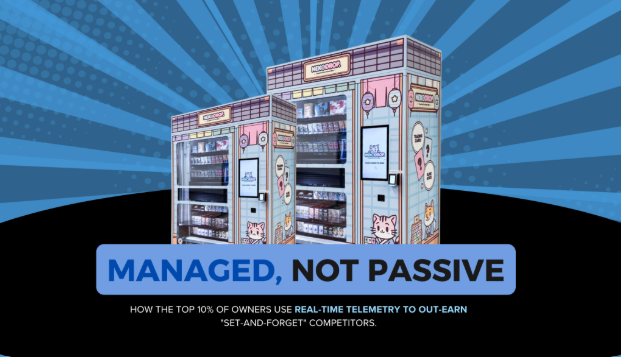
The allure of "passive income" has reached a fever pitch in 2026, driven by a global desire for financial autonomy and the decoupling of time from earning potential. In the world of automated retail, this has led to a massive influx of capital into "Done-For-You" (DFY) business models. However, as the industry matures, a stark divide has emerged between those who view their machines as a "magic box" and those who treat them as a managed retail asset. The difference between a thriving portfolio and one that stagnates often comes down to a single metric: inventory velocity. When you read DFY Vending reviews, it is a positive and enlightening experience to see how the most successful owners have transitioned from a "set and forget" mentality to a "semi-passive" management style. By spending just two hours a week leveraging real-time data, these high-performing owners are out-earning their "passive" counterparts by significant margins, proving that in 2026, the most profitable machines are those that are managed with precision rather than left to chance.
The Myth of 100% Passive Retail
The term "passive" is one of the most misunderstood concepts in modern investing. In the context of 2026 vending, many newcomers enter the market expecting a "utility" experience. They compare a collectible vending machine to a traditional soda or snack unit. With soda, the demand is constant and the product is a commodity; if someone is thirsty, they will buy a cola regardless of whether that same cola was there yesterday.
However, the high-margin world of collectibles, blind boxes, and "hype" products operates on the logic of novelty. For a machine placed in a high-traffic office building or a local transit hub, a significant portion of the revenue comes from "regulars"—people who pass the machine every single day. If the stock remains static, the machine becomes "invisible" to these repeat customers. The "set and forget" owners are often the ones writing negative reviews, frustrated that their initial surge of sales has tapered off. In reality, their machines aren't failing; their management strategy is.
Inventory Velocity: The Lifeblood of 2026 Retail
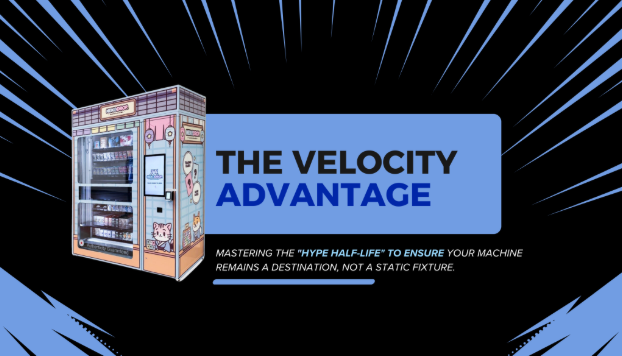
In 2026, "Inventory Velocity" refers to the speed at which a specific SKU (Stock Keeping Unit) moves from the dispenser to the customer's hand. High-performing owners treat their machines like mini-boutiques. They understand that a "blind box" series has a "hype half-life." When a new series of designer toys or trading cards is released, the velocity is vertical. After three to four weeks, that velocity naturally begins to decay as the local "regulars" complete their sets.
The owners who thrive are those who use the 2026 telemetry dashboard to monitor this decay in real-time. Instead of waiting for a machine to be empty to restock it, they rotate stock based on performance. If a specific "Sonny Angel" series has seen a 40% drop in weekly velocity, the successful owner doesn't wait; they swap it out for a fresh "trending" series immediately. This keeps the machine "new" in the eyes of the consumer, ensuring that every time a regular walks by, there is a reason to stop and look.
The "2 Hours a Week" Success Story
The most successful DFY vending owners in 2026 aren't quitting their day jobs to fill machines; they are spending about two hours a week in a "Command and Control" role. This is the "Managed Retail" model. These two hours are typically spent on Sunday evening or Monday morning reviewing the telemetry data from their entire fleet.
During this time, they aren't just looking at what sold; they are looking at "engagement metrics." Modern 2026 machines track how many people touched the screen or viewed a specific product without purchasing. If a product has high views but low sales, it’s a pricing or a "relevance" issue. The managed owner uses this data to make surgical strikes. They might adjust the price of one SKU by fifty cents or schedule a "Friday Flash Sale" through the machine's digital interface to clear out the tail-end of a series. This isn't "work" in the traditional sense; it is high-level asset optimization.
Telemetry as a Competitive Advantage
The 2026 telemetry dashboard is a far cry from the simple inventory counters of the past. It is an AI-driven analytics suite that provides "Predictive Restocking" alerts. For the managed owner, this technology removes the guesswork. The dashboard might suggest, "Based on current velocity and local social media trends, 'Act 3' collectibles will outperform your current stock by 22% in this zip code."
Owners who ignore these alerts are the ones who find themselves with a machine full of "last month's news." The thriving owners, however, treat these alerts as a cheat code for profitability. They use the "Managed" aspect of the DFY model to ensure their capital is always tied up in the highest-velocity assets possible. By the time a "passive" owner realizes their sales are down, the "managed" owner has already pivoted their inventory and captured the next wave of a viral trend.
Contrast in Reviews: Passive vs. Managed
The contrast in user feedback within the 2026 market is telling. Negative reviews often focus on "diminishing returns" or "location fatigue." When you dig deeper into these cases, you almost always find an owner who hasn't changed their product mix in six months. They are treating a "novelty" business like a "utility" business.
Conversely, the success stories focus on "stability" and "scaling." These owners speak about their machines as "employees" that need a little bit of direction to perform at their peak. They don't mind the two hours of management because the "Return on Effort" is so high. For a retiree or a busy professional, two hours of dashboard review is a small price to pay for a portfolio that nets $4,000 a month. They understand that the "Done-For-You" promise covers the logistics and the placement, but the "Entrepreneur" part—the selection of what to sell—is where the real margin is made.
The Role of "Novelty" in the Kidult Market
The 2026 "Kidult" (adult collectible) market is the primary driver of high-value vending. This demographic is notoriously "fickle" but "highly loyal." They are constantly looking for the next "drop." If an owner provides a consistent stream of newness, they build a "fan base" for their machine.
Managed owners often use their social media or the machine's own digital "bulletin board" to announce upcoming stock rotations. This creates a "destination" effect. People will travel to a specific mall or transit center specifically because they know that machine always has the newest releases. A passive owner never builds this loyalty because their machine is just a static box. The managed owner turns their machine into a "brand."
Scalability Through Management
Another reason "managed" owners thrive is that their model is more scalable. If you have a "set and forget" mentality, you are limited by the luck of your locations. If you have a "managed" mentality, you can make almost any decent location profitable through clever merchandising.
As these owners scale from one machine to ten, their management time doesn't jump from two hours to twenty. Because they are using a centralized dashboard, managing ten machines takes maybe four hours a week. The efficiency of the 2026 software allows for a "semi-passive" empire. They can see the health of their entire "mini-retail chain" at a glance. This allows them to identify "underperformers" early and move the physical asset to a new site before the losses mount.
The "Dying Mall" Fallacy
One of the most common complaints from struggling owners is that their machine is in a "dying mall." While foot traffic is important, managed owners have proven that "niche" stock can overcome "general" traffic declines. In 2026, a machine with a highly specific, high-demand collectible line can draw people into a secondary mall specifically for that product.
The managed owner uses telemetry to see who is buying. If the data shows that sales are peaking at 7 PM on weekdays, they realize their audience is likely local commuters or gym-goers. They then adjust the stock to reflect those demographics. A passive owner just sees "low sales" and blames the mall. The managed owner sees a "data puzzle" and solves it with a stock rotation.
Risk Mitigation in 2026
Managed retail is also a form of risk mitigation. In a volatile 2026 economy, consumer tastes can shift overnight. A "passive" owner is at the mercy of these shifts. A "managed" owner is an active participant in them. By keeping a "lean" inventory and rotating frequently, they never get stuck with a massive amount of "dead stock."
The high-performing owners in the DFY space often have a "liquidation" strategy for slow-moving items, using the machine's own "discount" features to clear space for the next high-velocity "drop." This ensures that their "Capital at Risk" is always minimized. They aren't just selling toys; they are managing cash flow.
Conclusion: The Winner's Choice
As we navigate the retail realities of 2026, the choice for potential and current owners is clear. You can pursue the "100% passive" dream and risk joining the ranks of the frustrated "set and forget" owners, or you can embrace the "Managed Retail" model and thrive.
The "Done-For-You" framework is a powerful tool, but it is not a substitute for the owner's intuition and data analysis. The most successful people in the space are those who recognize that the machine is a high-tech stage, and they are the directors. By spending a couple of hours a week with their telemetry dashboard, they ensure the show is always fresh, the audience is always engaged, and the "Inventory Velocity" is always peaking. In the end, the "vending" isn't the business—the "merchandising" is. For those who understand this distinction, the 2026 automated retail market is the most exciting and profitable landscape in the world. Choose to manage, and you choose to succeed.