By [Your Name], Senior Financial Correspondent
December 25, 2025
Introduction
As we close out 2025, the global technology landscape has been irrevocably altered by the generative AI revolution. While NVIDIA (NASDAQ: NVDA) remains the face of this movement, a shift in the investment narrative has occurred over the last 18 months: the realization that the "intelligence" of the modern data center is only as fast as the memory that feeds it. At the heart of this realization sits Micron Technology, Inc. (NASDAQ: MU).
Once regarded as a cyclical commodity manufacturer prone to the "boom and bust" cycles of the PC and smartphone markets, Micron has successfully pivoted to become a top-tier provider of High-Bandwidth Memory (HBM). In 2025, Micron’s stock has outperformed major indices as the company transitioned from a secondary player in HBM to a formidable rival to South Korean giants. With its HBM3E production capacity sold out through 2026, Micron is no longer just a memory maker; it is the critical infrastructure partner for the world’s most advanced AI workloads.
Historical Background
Founded in 1978 in the basement of a dental office in Boise, Idaho, Micron Technology’s journey is one of survival and relentless cost optimization. In its early decades, the company survived the "Memory Wars" of the 1980s and 90s, where dozens of Japanese and American firms were forced out of the DRAM market due to intense price competition.
Micron’s modern era began in earnest in 2017 when Sanjay Mehrotra, the co-founder of SanDisk, took the helm as CEO. Mehrotra shifted the company’s focus from mere volume to "technology leadership." Under his tenure, Micron achieved several "industry firsts," including the first 176-layer and 232-layer NAND and the early adoption of Extreme Ultraviolet (EUV) lithography in DRAM. This technical prowess laid the groundwork for Micron to enter the AI era not as a follower, but as a leader in power efficiency and performance.
Business Model
Micron operates through four primary business segments, primarily centered around DRAM (Dynamic Random Access Memory) and NAND (Flash storage):
- Compute and Networking Business Unit (CNBU): Includes memory for cloud servers, enterprise data centers, and client PCs. This is currently the largest growth driver due to HBM demand.
- Mobile Business Unit (MBU): Provides low-power DRAM and NAND for smartphones.
- Storage Business Unit (SBU): Focused on SSDs for consumer and enterprise markets.
- Embedded Business Unit (EBU): Tailored memory solutions for automotive, industrial, and "Edge" AI applications.
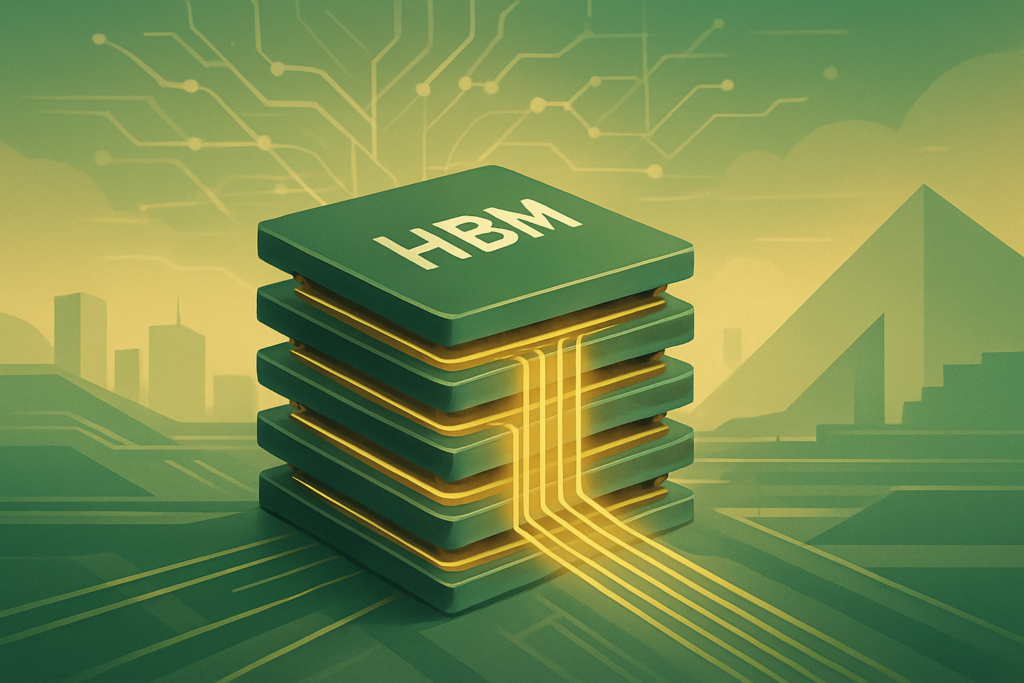
The fundamental shift in 2025 has been the "HBM-ization" of the business model. HBM is a specialized DRAM where memory chips are stacked vertically and linked via Through-Silicon Vias (TSVs). Because HBM requires three times the wafer capacity of standard DDR5 memory, its production has significantly tightened the overall supply of DRAM, giving Micron unprecedented pricing power.
Stock Performance Overview
Micron’s stock performance over the last decade illustrates a transformation from a cyclical laggard to a high-growth tech titan:
- 1-Year Performance (2025): The stock has surged approximately 65% year-to-date, driven by consecutive quarterly earnings beats and upward revisions in HBM market share.
- 5-Year Performance: Looking back to 2020, MU has appreciated nearly 280%. While it faced a brutal downturn in 2023 during the post-pandemic "inventory correction," the rebound starting in early 2024 has been one of the most aggressive in the semiconductor sector.
- 10-Year Performance: Over a 10-year horizon, Micron has outperformed the S&P 500 significantly, though with much higher volatility. Investors who held through the 2015-2016 and 2022-2023 troughs have seen massive multi-bagger returns as the company's "trough" earnings levels have consistently risen.
Financial Performance
The fiscal year 2025 (ended August 2025) was a watershed moment for Micron’s balance sheet.
- Revenue: Micron reported FY2025 revenue of $37.38 billion, a 49% increase year-over-year.
- Profitability: Gross margins, which were negative during parts of 2023, expanded to over 45% by late 2025. This was driven by the high ASP (Average Selling Price) of HBM3E products, which command margins significantly higher than traditional DRAM.
- Earnings Per Share (EPS): For the most recent quarter (Q1 FY2026, ending Nov 2025), Micron delivered record EPS, with analysts projecting a full-year FY2026 EPS range of $30.00 to $36.00.
- Capital Expenditure: To meet demand, Micron’s CapEx for 2025 exceeded $12 billion, focused on HBM packaging and the expansion of its Boise, Idaho fabrication facility.
Leadership and Management
CEO Sanjay Mehrotra remains the architect of Micron’s current success. His strategy has been characterized by "disciplined supply management"—refusing to overproduce even when prices are high, to avoid the gluts of the past.
Supporting him is Manish Bhatia, EVP of Global Operations, who has been instrumental in navigating the complex ramp-up of HBM3E 12-Hi production. The leadership team’s reputation among institutional investors is currently at an all-time high, praised for their transparency regarding "yield" challenges and their success in securing long-term supply agreements with major CSPs (Cloud Service Providers).
Products, Services, and Innovations
Micron’s product roadmap is currently the envy of the memory industry:
- HBM3E (High-Bandwidth Memory): Micron’s flagship HBM3E provides 30% lower power consumption than its nearest competitor. In early 2025, Micron moved into volume production of its 12-Hi (36GB) stacks, which have become the standard for NVIDIA’s latest Blackwell-series GPUs.
- HBM4: In late 2025, Micron began sampling HBM4, which utilizes a 2048-bit interface. This next-generation memory is expected to enter mass production in 2026, promising a 60% increase in bandwidth.
- LPCAMM2: A revolutionary modular memory form factor for laptops that delivers the power efficiency of soldered LPDDR5X with the serviceability of a module—critical for "AI PCs" that require massive amounts of local RAM.
Competitive Landscape
The DRAM market remains an oligopoly, dominated by three players:
- SK Hynix: The early leader in HBM. As of late 2025, they still hold approximately 60% of the HBM market, though their lead is being chipped away.
- Micron (MU): Now firmly entrenched as the #2 or #3 player depending on the month. In Q2 2025, Micron briefly overtook Samsung in HBM market share, currently sitting at roughly 21-22%.
- Samsung Electronics: Despite its massive scale, Samsung struggled with HBM3E yields throughout 2024 and early 2025. However, a late-2025 recovery has seen Samsung reclaim some ground, keeping the "Big Three" in a fierce technological arms race.
Micron’s competitive edge lies in its power efficiency and its U.S.-based manufacturing footprint, which appeals to Western customers concerned about supply chain resilience.
Industry and Market Trends
Three macro trends are defining Micron’s trajectory:
- The 3-to-1 Wafer Trade Ratio: Producing one bit of HBM takes roughly three times the wafer capacity of one bit of standard DDR5. This "wafer cannibalization" has created a structural shortage in the memory market, leading to rising prices across all DRAM categories.
- AI at the Edge: 2025 has seen the rise of "AI PCs" and "AI Smartphones" (like the iPhone 17 Pro). These devices require 2x to 3x the RAM of previous generations to run LLMs locally, providing a huge tailwind for Micron’s Mobile and Client business units.
- Server Refresh Cycle: Beyond AI, traditional data center servers are being upgraded to DDR5, which carries higher margins than the aging DDR4 standard.
Risks and Challenges
Despite the optimism, Micron faces significant headwinds:
- Geopolitical Friction: Micron remains a "political football" in the US-China trade war. While the 2023 CAC ban in China has been partially mitigated, further restrictions on equipment or sales remain a constant threat.
- Yield Risks: HBM is notoriously difficult to manufacture. Any "hiccup" in the assembly of 12-Hi or 16-Hi stacks could lead to massive write-offs and margin compression.
- Cyclicality: While many argue "this time is different," the memory industry has never permanently escaped its cyclical nature. A sudden slowdown in AI capital expenditure by the "Magnificent Seven" would leave Micron with massive, expensive excess capacity.
Opportunities and Catalysts
- HBM4 Transition: Micron’s early progress in HBM4 could allow it to capture market share from SK Hynix in 2026.
- Stock Buybacks: With free cash flow reaching record levels in late 2025, management has hinted at a massive increase in its share repurchase program for 2026.
- Automotive AI: As Level 3 and Level 4 autonomous driving become more common, cars are essentially becoming "data centers on wheels," requiring gigabytes of high-performance DRAM.
Investor Sentiment and Analyst Coverage
Wall Street sentiment on Micron is overwhelmingly "Bullish." As of December 2025:
- Price Targets: Major banks like Goldman Sachs and Morgan Stanley have raised their targets to the $180 – $210 range.
- Institutional Ownership: Large hedge funds have increased their positions in MU, treating it as a "pure play" on the AI infrastructure layer with a lower valuation (P/E ratio) than NVIDIA or AMD.
- Retail Sentiment: On social platforms, Micron is frequently cited as the "best value" in the semiconductor space.
Regulatory, Policy, and Geopolitical Factors
Micron is a primary beneficiary of the U.S. CHIPS and Science Act.
- In December 2024, the government finalized a $6.14 billion grant for Micron.
- Boise Expansion: Micron has accelerated the construction of its Boise "ID2" fab, with first wafer output expected by mid-2027.
- New York Mega-Fab: While the Clay, NY project faced some environmental delays in 2025, it remains the largest private investment in New York history, intended to ensure U.S. memory sovereignty through 2045.
Conclusion
As we look toward 2026, Micron Technology stands at the pinnacle of its 47-year history. The company has successfully shed its image as a commodity vendor, proving it can compete at the highest levels of semiconductor engineering.
For investors, the case for Micron is built on the "scarcity" of memory. In a world where AI models are growing exponentially, memory is the bottleneck. While the inherent cyclicality of the chip industry remains a risk, the structural shift toward HBM and Edge AI provides a floor for earnings that didn't exist five years ago. Micron is no longer just a participant in the tech industry; it is the vital, high-speed foundation upon which the future of artificial intelligence is being built.
This content is intended for informational purposes only and is not financial advice.