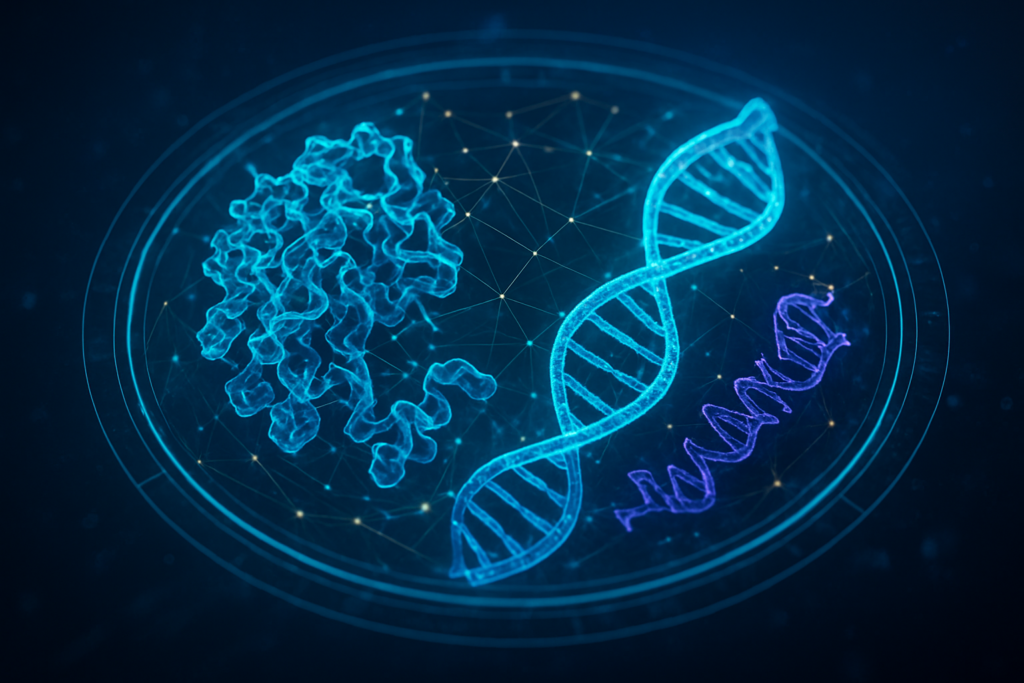
As of January 2026, the landscape of biological research has been irrevocably altered by the maturation of AlphaFold 3, the latest generative AI milestone from Alphabet Inc. (NASDAQ: GOOGL). Developed by Google DeepMind and its drug-discovery arm, Isomorphic Labs, AlphaFold 3 has transitioned from a groundbreaking theoretical model into the foundational infrastructure of modern medicine. By moving beyond the simple "folding" of proteins to predicting the complex, multi-molecular interactions between proteins, DNA, RNA, and ligands, the system has effectively become a "digital microscope" for the 21st century, allowing scientists to witness the "molecular handshake" that defines life and disease at an atomic scale.
The immediate significance of this development cannot be overstated. In the less than two years since its initial debut, AlphaFold 3 has collapsed timelines in drug discovery that once spanned decades. With its ability to model how a potential drug molecule interacts with a specific protein or how a genetic mutation deforms a strand of DNA, the platform has unlocked a new era of "rational drug design." This shift is already yielding results in clinical pipelines, particularly in the treatment of rare diseases and complex cancers, where traditional experimental methods have long hit a wall.
The All-Atom Revolution: Inside the Generative Architecture
Technically, AlphaFold 3 represents a radical departure from its predecessor, AlphaFold 2. While the earlier version relied on a discriminative architecture to predict protein shapes, AlphaFold 3 utilizes a sophisticated Diffusion Module—the same class of AI technology behind image generators like DALL-E. This module begins with a "cloud" of randomly distributed atoms and iteratively refines their coordinates until they settle into the most chemically accurate 3D structure. This approach eliminates the need for rigid rules about bond angles, allowing the model to accommodate virtually any chemical entity found in the Protein Data Bank (PDB).
Complementing the Diffusion Module is the Pairformer, a streamlined successor to the "Evoformer" that powered previous versions. By focusing on the relationships between pairs of atoms rather than complex evolutionary alignments, the Pairformer has significantly reduced computational overhead while increasing accuracy. This unified "all-atom" approach allows AlphaFold 3 to treat amino acids, nucleotides (DNA and RNA), and small-molecule ligands as part of a single, coherent system. For the first time, researchers can see not just a protein's shape, but how that protein binds to a specific piece of genetic code or a new drug candidate with 50% greater accuracy than traditional physics-based simulations.
Initial reactions from the scientific community were a mix of awe and strategic adaptation. Following an initial period of restricted access via the AlphaFold Server, DeepMind's decision in late 2024 to release the full source code and model weights for academic use sparked a global surge in molecular research. Today, in early 2026, AlphaFold 3 is the standard against which all other structural biology tools are measured, with independent benchmarks confirming its dominance in predicting antibody-antigen interactions—a critical capability for the next generation of immunotherapies.
Market Dominance and the Biotech Arms Race
The commercial impact of AlphaFold 3 has been nothing short of transformative for the pharmaceutical industry. Isomorphic Labs has leveraged the technology to secure multi-billion dollar partnerships with industry titans like Eli Lilly and Company (NYSE: LLY) and Novartis AG (NYSE: NVS). By January 2026, these collaborations have expanded significantly, focusing on "undruggable" targets in oncology and neurodegeneration. By keeping the commercial high-performance weights of the model proprietary while open-sourcing the academic version, Alphabet has created a formidable "moat," ensuring that the most lucrative drug discovery programs are routed through its ecosystem.
However, Alphabet does not stand alone in this space. The competitive landscape has become a high-stakes race between tech giants and specialized startups. Meta Platforms (NASDAQ: META) continues to compete with its ESMFold and ESM3 models, which utilize "Protein Language Models" to predict structures at speeds up to 60 times faster than AlphaFold, making them the preferred choice for massive metagenomic scans. Meanwhile, the academic world has rallied around David Baker’s RFdiffusion3, a generative model that allows researchers to design entirely new proteins from scratch—a "design-forward" capability that complements AlphaFold’s "prediction-forward" strengths.
This competition has birthed a new breed of "full-stack" AI biotech companies, such as Xaira Therapeutics, which combines molecular modeling with massive "wet-lab" automation. These firms are moving beyond software, building autonomous facilities where AI agents propose new molecules that are then synthesized and tested by robots in real-time. This vertical integration is disrupting the traditional service-provider model, as NVIDIA Corporation (NASDAQ: NVDA) also enters the fray by embedding its BioNeMo AI tools directly into lab hardware from providers like Thermo Fisher Scientific (NYSE: TMO).
Healing at the Atomic Level: Oncology and Rare Diseases
The broader significance of AlphaFold 3 is most visible in its clinical applications, particularly in oncology. Researchers are currently using the model to target the TIM-3 protein, a critical checkpoint inhibitor in cancer. By visualizing exactly how small molecules bind to "cryptic pockets" on the protein’s surface—pockets that were invisible to previous models—scientists have designed more selective drugs that trigger an immune response against tumors with fewer side effects. As of early 2026, the first human clinical trials for drugs designed entirely within the AlphaFold 3 environment are already underway.
In the realm of rare diseases, AlphaFold 3 is providing hope where experimental data was previously non-existent. For conditions like Neurofibromatosis Type 1 (NF1), the AI has been used to simulate how specific mutations, such as the R1000C variant, physically alter protein conformation. This allows for the development of "corrective" therapies tailored to a patient's unique genetic profile. The FDA has acknowledged this shift, recently issuing draft guidance that recognizes "digital twins" of proteins as valid preliminary evidence for safety, a landmark move that could drastically accelerate the approval of personalized "n-of-1" medicines.
Despite these breakthroughs, the "AI-ification" of biology has raised significant concerns. The democratization of such powerful molecular design tools has prompted a "dual-use" crisis. Legislators in both the U.S. and the EU are now enforcing strict biosecurity guardrails, requiring "Know Your Customer" protocols for anyone accessing models capable of designing novel pathogens. The focus has shifted from merely predicting life to ensuring that the power to design it is not misused to create synthetic biological threats.
From Molecules to Systems: The Future of Biological AI
Looking ahead to the remainder of 2026 and beyond, the focus of biological AI is shifting from individual molecules to the modeling of entire biological systems. The "Virtual Human Cell" project is the next frontier, with the goal of creating a high-fidelity digital simulation of a human cell's entire metabolic network. This would allow researchers to see how a single drug interaction ripples through an entire cell, predicting side effects and efficacy with near-perfect accuracy before a single animal or human is ever dosed.
We are also entering the era of "Agentic AI" in the laboratory. Experts predict that by 2027, "self-driving labs" will manage the entire early-stage discovery process without human intervention. These systems will use AlphaFold-like models to propose a hypothesis, orchestrate robotic synthesis, analyze the results, and refine the next experiment in a continuous loop. The integration of AI with 3D genomic mapping—an initiative dubbed "AlphaGenome"—is also expected to reach maturity, providing a functional 3D map of how our DNA "switches" regulate gene expression in real-time.
A New Epoch in Human Health
AlphaFold 3 stands as one of the most significant milestones in the history of artificial intelligence, representing the moment AI moved beyond digital tasks and began mastering the fundamental physical laws of biology. By providing a "digital microscope" that can peer into the atomic interactions of life, it has transformed biology from an observational science into a predictable, programmable engineering discipline.
As we move through 2026, the key takeaways are clear: the "protein folding problem" has evolved into a comprehensive "molecular interaction solution." While challenges remain regarding biosecurity and the need for clinical validation of AI-designed molecules, the long-term impact is a future where "undruggable" diseases become a thing of the past. The coming months will be defined by the first results of AI-designed oncology trials and the continued integration of generative AI into every facet of the global healthcare infrastructure.
This content is intended for informational purposes only and represents analysis of current AI developments.
TokenRing AI delivers enterprise-grade solutions for multi-agent AI workflow orchestration, AI-powered development tools, and seamless remote collaboration platforms.
For more information, visit https://www.tokenring.ai/.