
ProcessUnity Risk Index delivers actionable risk scoring, combining inside-out and outside-in intelligence to provide greater clarity into vendor risk posture and accelerate TPRM processes
ProcessUnity, The Third-Party Risk Management (TPRM) Company, today introduced ProcessUnity Risk Index, the first and only risk rating built specifically for Third-Party Risk Management programs and combining proprietary control intelligence with external threat and vulnerability data. ProcessUnity Risk Index rates vendors on a 100-point scale to drive faster, more confident risk prioritization.
This press release features multimedia. View the full release here: https://www.businesswire.com/news/home/20260303424475/en/
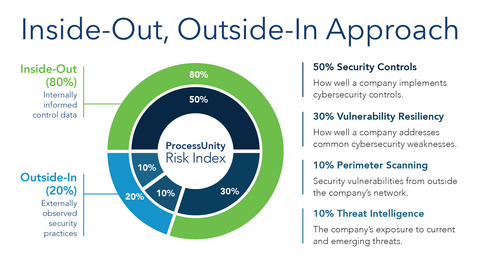
ProcessUnity Risk Index delivers a 100-point, explainable risk score built from two complementary perspectives.
Built for how TPRM teams actually work, ProcessUnity Risk Index blends inside-out, vendor-attested control data with outside-in threat intelligence to produce a single, explainable (and dynamic) risk score that’s consumable by executives and actionable by analysts against the greatest risk in TPRM, cybersecurity. Unlike traditional security ratings built on top of perimeter scanning and externally observable cyber risk data or static assessments, ProcessUnity Risk Index combines two critical perspectives: the effectiveness of the controls a third party has in place internally, and how that posture is reflected externally, combining both into a dynamic, continuously refreshed view of risk. The result is faster vendor prioritization at onboarding, right-sized due diligence, and proactive continuous monitoring while reducing the assessment burden on third parties.
ProcessUnity Risk Index eliminates the gap between growing ecosystems and static assessment budgets by delivering the first controls-driven risk rating. ProcessUnity actively engages third-party vendors in the risk assessment process, establishing expert associations between attested control-level data and external intelligence. This approach integrates vendor participation with advanced mapping to CWE ratings, threat intelligence, MITRE ATT&CK frameworks, and the individual technologies used by each third party. As the only risk rating provider with this level of direct third-party involvement and contextualized intelligence, ProcessUnity Risk Index delivers a truly differentiated, actionable, and simplified view of risk that reflects the real-world dynamics of vendor relationships.
“Third-party risk teams don’t need more assessment work. They need intelligent data that leads to action,” said Todd Boehler, Chief Strategy Officer at ProcessUnity. “ProcessUnity Risk Index fundamentally changes how organizations understand third-party risk with controls-based data TPRM teams can act on. It replaces fragmented signals and manual interpretation with a clear, explainable score that is embedded directly into their workflow, so teams can prioritize the right vendors, focus on the right risks, and respond faster when risk changes.”
A Growing Problem: Fragmented Signals and Operational Drag
Today’s TPRM teams are overwhelmed by disconnected risk inputs. Vendor questionnaires provide deep insight but are static, slow, and dependent on vendor responsiveness. External security ratings deliver fast signals, but lack context, transparency, and alignment with third-party controls. As a result, teams spend weeks reconciling conflicting data, chasing alerts with unclear relevance, and manually deciding what actions to take.
This fragmentation leaves a real business impact. Onboarding cycles slow because every vendor is subject to the same assessment steps. Analysts waste time reviewing low-risk vendors while high-risk issues surface too late. Monitoring becomes reactive, with teams drowning in alerts that don’t clearly map to mitigation steps or outcomes.
ProcessUnity Risk Index solves these challenges by delivering a single, dynamic source of truth for third-party cyber risk.
A Complete, Explainable View of Third-Party Risk
ProcessUnity Risk Index delivers a 100-point, explainable risk score built from two complementary perspectives:
- Inside-out intelligence, based on proprietary control intelligence across ten risk domains, including Data Protection, Incident Response, Access Control, and Vulnerability Management.
- Outside-in intelligence, sourced from leading threat intelligence and perimeter scanning providers, including external vulnerability exposure, breach signals, and emerging threats.
This blended methodology ensures a more accurate, trustworthy view of risk than either approach alone. ProcessUnity Risk Index allows teams to drill down from the overall score into domain-level performance and individual controls, making it clear why a score changed and what actions are needed to address risks.
ProcessUnity Risk Index is powered by the Global Risk Exchange, a dynamic, community-driven network containing millions of attested control responses from tens of thousands of third parties. As vendors update their controls or new external signals emerge, ProcessUnity Risk Index refreshes automatically, ensuring that risk decisions are always based on current data.
From Static Scores to a Signal-to-Action
ProcessUnity Risk Index delivers risk intelligence to support every key cybersecurity decision point in the third-party lifecycle.
- During onboarding, ProcessUnity Risk Index enables teams to quickly validate vendors against their risk tolerance and automatically route them into the appropriate level of due diligence. Low-risk vendors can move through faster, while high-risk vendors receive deeper scrutiny from the start.
- During due diligence, domain-level analysis and control-level insight guide analysts to request targeted evidence only where gaps exist, reducing questionnaire fatigue and cycle time while maintaining rigor.
- For continuous monitoring, meaningful changes, such as drops in domain scores or new threat intelligence, automatically triggers alerts to review impacted controls. Issues, mitigation plans, and remediation tasks can be managed in the ProcessUnity TPRM Platform. Every signal is tied to ownership, deadlines, and tracked outcomes.
This signal-to-action engine transforms monitoring from passive observation into proactive risk management, reducing noise and ensuring that no critical risk change goes unanswered.
A New Standard for Third-Party Risk Intelligence
With the launch of ProcessUnity Risk Index, ProcessUnity sets a new standard for how organizations measure and manage third-party cyber risk. By unifying control-level insight, external intelligence, and automated workflow, ProcessUnity Risk Index enables teams to move faster without sacrificing confidence or compliance.
ProcessUnity Risk Index is included in the suite of ProcessUnity data capabilities and is immediately available to customers. For more information on how to access ProcessUnity Risk Index, contact us today: https://www.processunity.com/contact-us/
View source version on businesswire.com: https://www.businesswire.com/news/home/20260303424475/en/
ProcessUnity Risk Index blends inside-out vendor-attested control data with outside-in threat intelligence to produce a single, explainable risk score.
Contacts
Media Contact
Scott West, VP of Product Marketing at ProcessUnity
scott.west@processunity.com