SHENZHEN, CN / ACCESS Newswire / October 26, 2026 / Over the past two years, the robotics industry has turned a corner - from racing to claim territory to counting every cost. Hype has cooled, players have piled in, and capacity has expanded - all three at once. The result: quotes for the same part drawing keep getting cheaper, while the number of suppliers who can actually make it consistently hasn't grown. With cash flow now a hard constraint, hardware companies are re-answering one question: what kind of manufacturing partner do we really need?
I. After the hype fades, the supply chain is being repriced
The crowding in robotics is plain to see. Every link - complete machines, joint modules, dexterous hands, reducers, sensors - has drawn a flood of new players, and capacity has expanded quickly. Once demand growth slows, that excess capacity flows down to the parts level in the form of price wars; meanwhile material, labor and compliance costs haven't come down with it. For hardware companies, this means procurement costs for the same part keep rising while end-product prices keep falling - margins squeezed from both ends.
Add global equity-market volatility and macroeconomic swings, and the first instinct is to tighten cash flow. Procurement no longer asks only "can you make it?" but "is it worth tying this money up here?" The default logic of the supply chain is shifting from "bigger is steadier" to "the right fit is steadier."
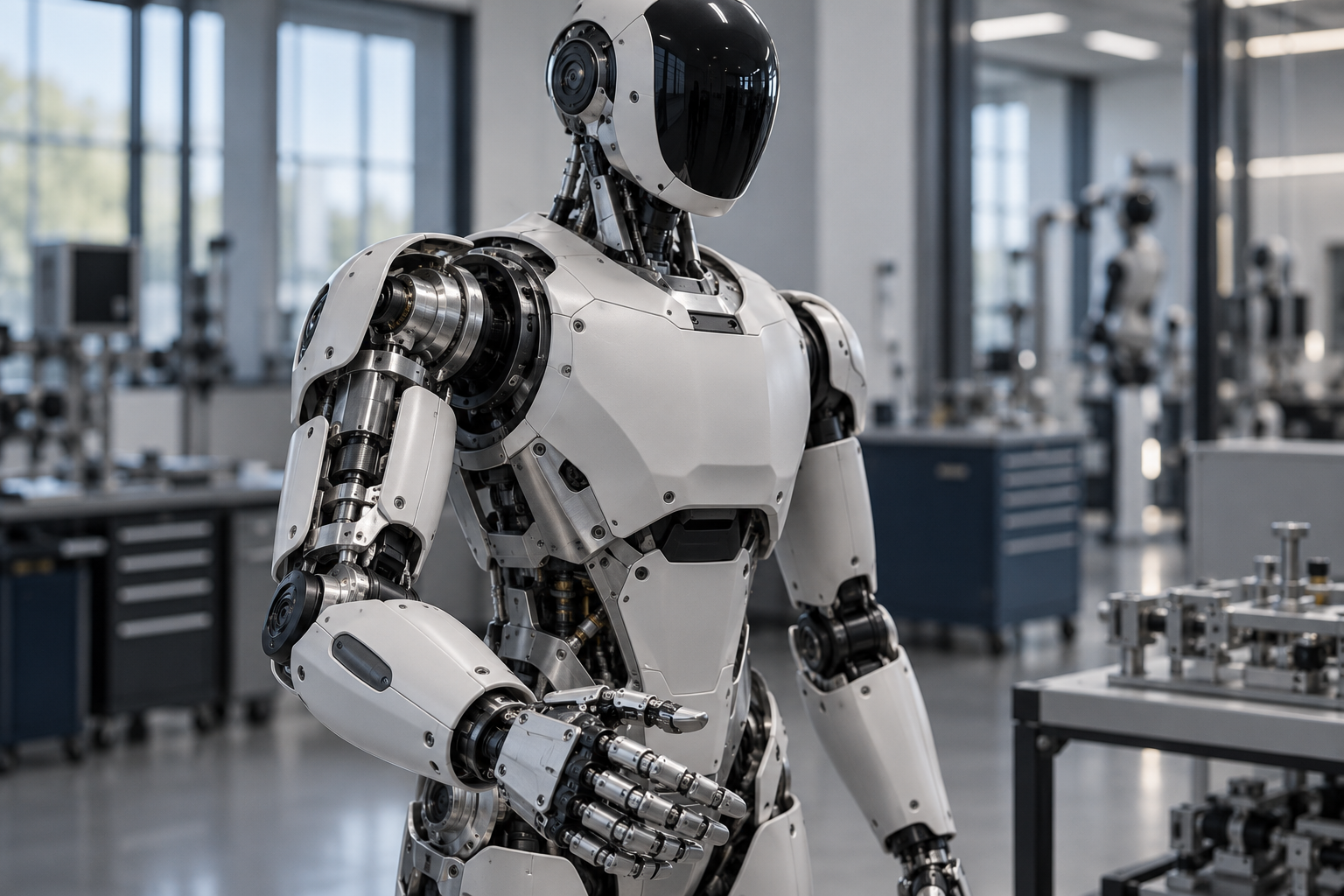
II. A factory that's been at it for twenty years sees the inquiries change
In Bao'an, Shenzhen, at YP-MFG (Shenzhen Yaopeng Metal Products Co., Ltd.), this shift shows up in the inquiries coming in.
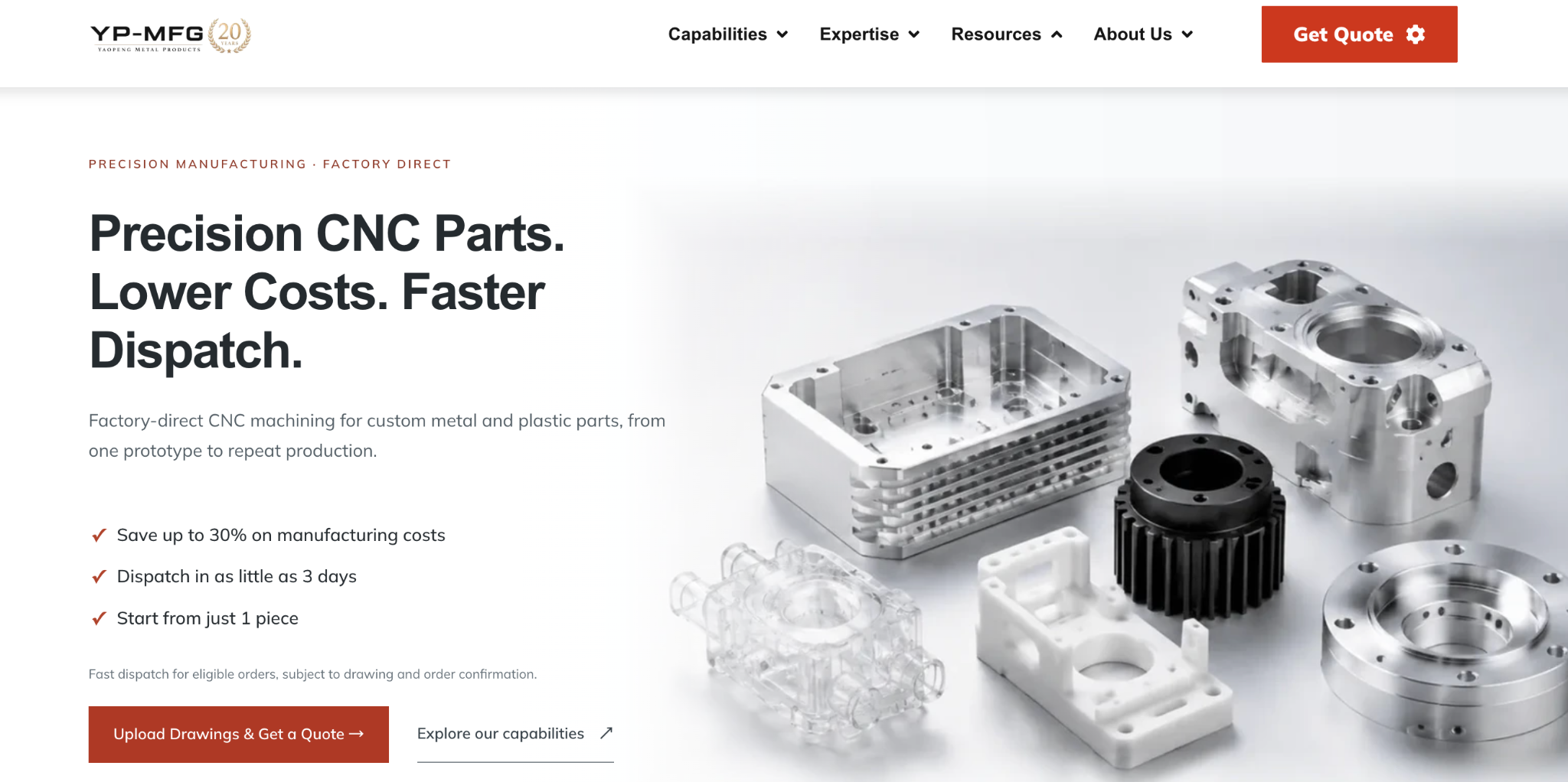
The company does precision CNC machining and custom parts: it started with rapid prototyping in 2005 and today operates 3,500 m² of owned factory space in Bao'an - with 180+ machines, including CNC machining centers, CNC lathes and mill-turn centers, and 90+ engineers and technicians - supplying robotics, automotive and new energy, medical, consumer electronics and industrial automation.
The inquiries are not what they were two years ago: batch sizes are smaller and more fragmented, there are more versions, and DFM (design-for-manufacturability) review and drawing confidentiality (NDA) are now requirements in the very first email. In the same customer pool, one company just walked away from a large machining house because change orders couldn't get scheduled; another was just burned by a small shop with a dozen machines that blew the lead time.
This factory sits in an unusual position: it is neither a giant buried in layers of approval nor a small workshop with a dozen machines. It holds "the middle tier" - precisely the tier that is hardest to replace and most easily misunderstood right now.
III. At the giants, scale is becoming a burden on response speed
Market iteration is speeding up: product plans change every month, version requirements every week. Large machining houses have full equipment and real heft, but long approval chains and cross-department handoffs mean an engineering change order can take longer to move through internal process than the machining itself. For robotics teams that need to switch schemes and versions fast, the supplier's "process inertia" becomes their "time-to-market delay."
This is where the mid-size factory's advantage shows: the decision chain is one layer - the engineer says it can be done, and the line schedules it the same day.
IV. Behind the cheap quote: a fragmented supply chain
So many teams turn to micro shops - typically with fewer than 50 machines. The quotes are genuinely lower, but equipment and supporting lines are incomplete, and one-stop delivery is missing. The result: the customer becomes their own project manager - CNC from one vendor, sheet metal from another, anodizing from a third, assembly done in-house. Communication nodes multiply, any single delay propagates down the whole chain, and the lead time gets longer instead of shorter. The machining fee you saved comes back as your engineers' time and schedule risk.
V. A shop that only machines to drawing leaves the risk with the customer
The subtler problem is engineering capability. Many small manufacturers lack engineers who understand mechanical structures, can't provide DFM review, and simply cut to print. Will a thin-wall part warp? Can the tool reach a deep cavity? Is that tolerance actually necessary? Which fixturing method is more stable? These questions should be raised at the quoting stage - instead they surface only after the machine starts running, at the price of rework, delay and extra cost.
In YP-MFG's workflow, DFM feedback goes out with the quote - not after the customer places the order.
VI. Outsourced finishing: lead times lost between color mismatch and finger-pointing
Many shops machine only. Anodizing, sandblasting, laser marking and other surface treatments are left for the customer to source separately. After multi-party handoffs and multiple transfers, problems start to cluster: color mismatch within the same batch, dimensional drift from re-fixturing, and when something goes wrong, the supplier and the subcontractor blame each other while the schedule falls completely apart. In robotics, cosmetic parts and structural parts ship in the same batch - if any single step slips, the whole-machine assembly waits.
VII. Great prototypes, failed production runs
The quality gap between prototyping and small-batch production is the failure hardware teams know best and hate most: the prototype comes out clean with spot-on dimensions, R&D validation sails through; then at small batch, tolerances start to drift, cosmetic consistency drops, and batches don't match each other. The cause is usually not the machine but whether the process was locked in - fixturing plans, tool life, inspection frequency, first-article confirmation. The stability that engineers "watched into" the prototype never became a reproducible process document.
YP-MFG's approach: prototyping and production run under the same set of process documents and inspection standards, with CMM (coordinate measuring machine) confirming dimensions - parameters validated at the prototyping stage go straight into production.
VIII. Drawings are core assets
A robot's in-house structure is a company's core technical asset. But drawing control at many suppliers is loose: files scattered across personal computers and chat tools, no access-level permissions, no enforceable confidentiality agreement. One departure, one forward - and IP is out the door. For teams in the fundraising stage building their moat on structural innovation, the price of this risk is far above the machining fee itself.
IX. Three kinds of suppliers, three roads
Put these problems together and what hardware companies actually need is very specific: low communication friction, proven engineering strength, a complete processing workflow, and real confidentiality measures. Not the process-heavy giant, not the micro shop weak on capability, supporting processes and information security - what they need is a mid-size precision CNC partner that combines agility, engineering, supporting processes and information security.
Looked at side by side, the difference is clearer.
Large machining houses. Hundreds of machines, multi-site coordination; mid-to-high quotes (management and overhead costs included); version changes queue behind approvals; DFM exists but is often scheduled late; finishing and assembly are complete but wait on production scheduling; prototype-to-production stability is good; drawing systems are complete but widely exposed. Best suited to high-volume, long-cycle, standardized orders.
Micro shops (typically fewer than 50 machines). Mostly single-process; low quotes; fast to switch but limited in capability; most have no DFM and machine to print; finishing is outsourced with multi-party coordination; batch-to-batch consistency fluctuates; drawing control is loose. Suited to single pieces and non-critical structural parts.
YP-MFG. 180+ machines, 3,500 m² of owned factory space, 90+ engineers and technicians; factory-direct with no intermediary markup; engineer-to-engineer communication, with changes traveling with the drawings; DFM engaged upfront at the quoting stage; anodizing, powder coating, sandblasting, polishing, laser marking and assembly all within one system; prototyping and production share one set of process documents and inspection standards, with CMM for dimensional confirmation; NDA available on request, drawings moving through controlled flow. Suited to structural parts from prototype to small batch with frequent version iteration.
X. YP-MFG's position: mid-size, complete capability
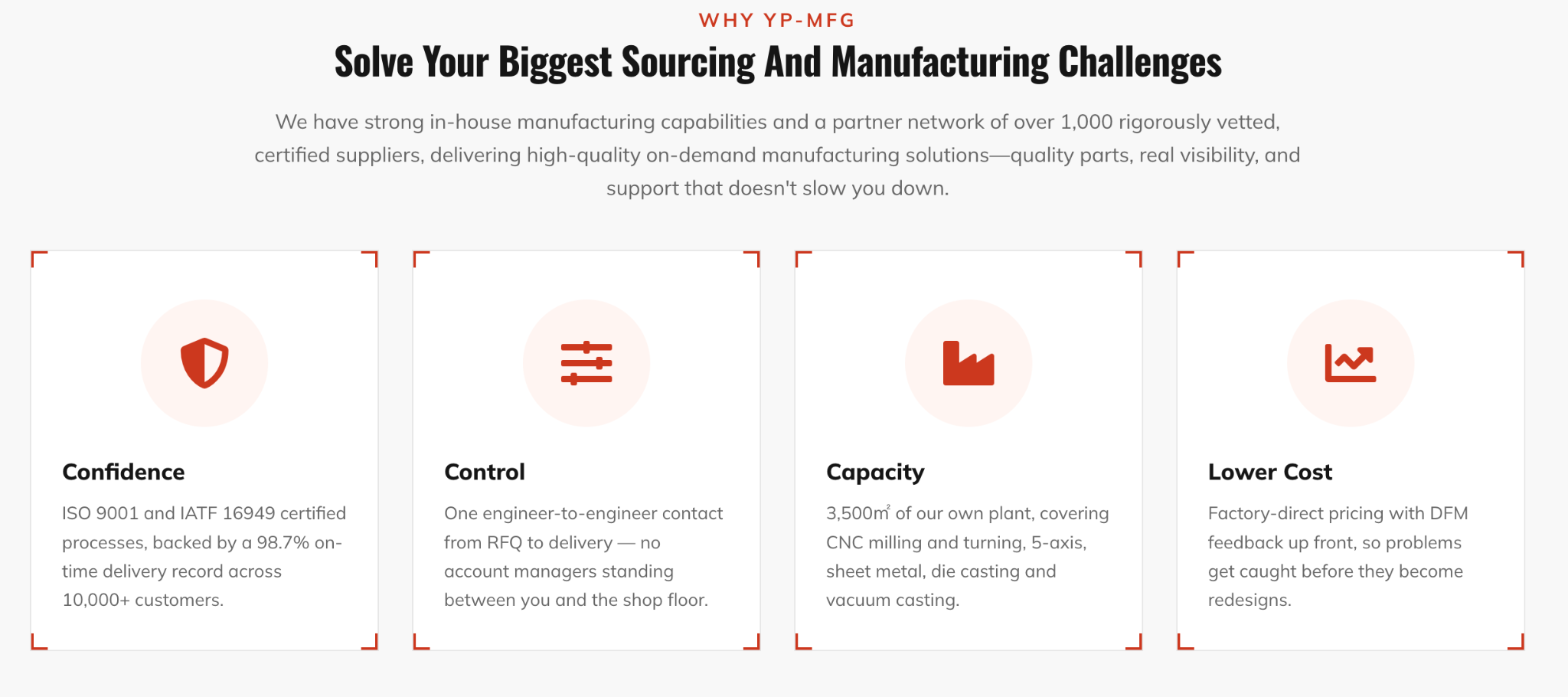
Size right in the middle. Neither a giant that needs layers of approval nor a workshop with a dozen machines: 3,500 m² of owned factory space in Bao'an, Shenzhen, 180+ machines - CNC machining centers, CNC lathes, mill-turn centers - and 90+ engineers and technicians. This scale is enough to take continuous demand from single-piece prototypes to batch production, without a change order queuing in process.
Engineering capability upfront. DFM review engages at the quoting stage, resolving thin-wall deformation, fixturing methods and over-specified tolerances before the machine starts. One engineer talks to one engineer throughout - no account-manager layer in between.
One-stop supporting processes. CNC milling, CNC turning machine, 5-axis machining, sheet metal fabrication, die casting, vacuum casting, 3D printing, wire EDM - plus finishing such as anodizing, powder coating, sandblasting, polishing and laser marking, and assembly - all within one system. Color mismatch, dimensions, responsibility, lead time: no longer coordinated across four companies.
Consistent quality. ISO 9001:2015 certified, run to IATF 16949 practices, CMM for dimensional inspection, and a 98.7% on-time delivery rate built on long-term orders from 10,000+ customers. Prototyping and production run the same process documents and inspection standards - exactly the precondition for "great prototypes, stable production."
Information security. NDA available on request; drawings move through controlled flows. For robotics teams whose moat is structural design, this often matters more than unit price.
In robotics, YP-MFG manufactures precision structural parts - housings, brackets, joints, end effectors - exactly the kind of parts that demand stable tolerances, consistent appearance and fast version changes.
"Many customers find us the first time not because of price, but because their previous supplier broke down at the transition from prototype to production. What they want is simple: someone who can tell them in advance what can't be made."
- Garson, Sales, YP-MFG
Conclusion
Competition in robotics will ultimately come down to who can turn a design into a product faster and more reliably. Once machining fees are no longer the only variable, the supply chain question becomes: find a partner with the right size, complete capability, and the willingness to solve your problems at the drawing stage.
About YP-MFG (Boilerplate)
YP-MFG is the global brand of Shenzhen Yaopeng Metal Products Co., Ltd., focused on precision custom parts manufacturing since 2005. The company operates a 3,500 m² owned production base in Bao'an, Shenzhen, equipped with 180+ machines and 90+ engineers and technicians, providing one-stop services in CNC machining, sheet metal fabrication, die casting, vacuum casting, 3D printing, surface treatment and assembly. ISO 9001:2015 certified and run to IATF 16949 practices, it serves 10,000+ customers across North America, Europe, Asia-Pacific, Latin America and Australia with a 98.7% on-time delivery rate.
Company Information
Company - YPMFG
Contact Person - garson
Email - sales@yp-mfg.com
Address - Shenzhen, China
Website - https://ypmfg.com/
SOURCE: YPMFG
View the original press release on ACCESS Newswire