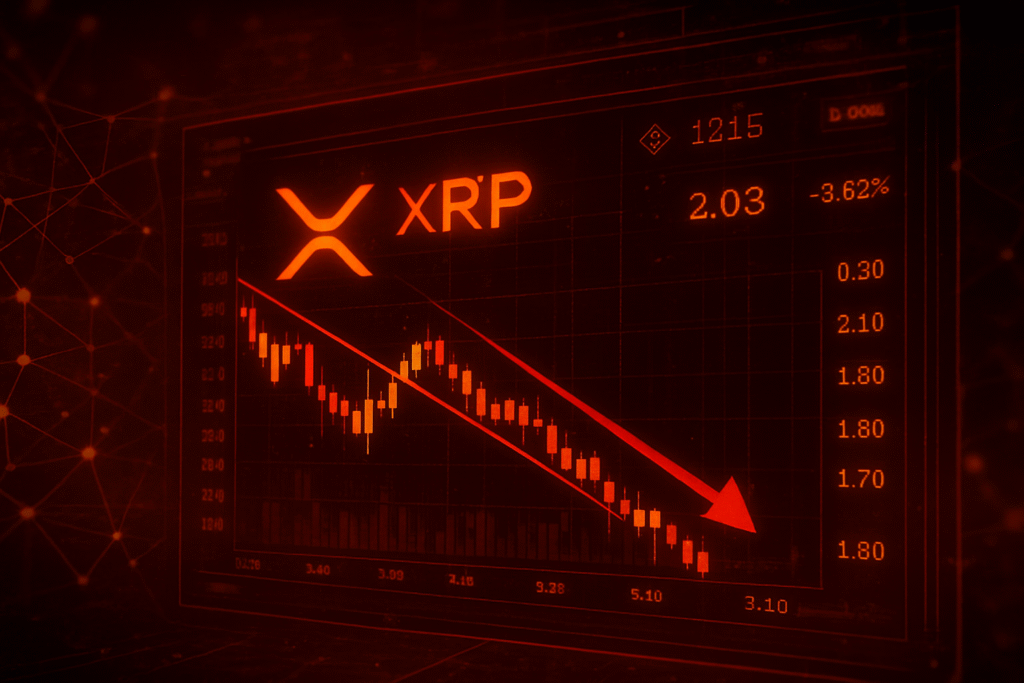
New York, NY – December 1, 2025 – The cryptocurrency market is abuzz as XRP, the digital asset associated with Ripple (private), has confirmed a significant 'Death Cross' technical pattern on its daily chart in late November, extending into the first days of December 2025. This ominous signal, where XRP's short-term 50-day moving average (SMA) plunged below its long-term 200-day SMA, has sent ripples of concern through the investor community, prompting technical analysts to warn of potential price drops towards the $1.80-$2.10 range.
The immediate market reaction has been predominantly bearish, with XRP experiencing a notable decline as the crossover materialized. On December 1, 2025, XRP's price fell approximately 7%, hitting session minimums around $2.01, further cementing the bearish sentiment that had been building throughout November. This technical event is significant because it is widely interpreted as a strong indicator of a potential shift towards a long-term bearish trend, suggesting that downward momentum is likely to continue or intensify, influencing both retail and algorithmic trading strategies across the crypto ecosystem.
Market Impact and Price Action
The formation of the 'Death Cross' for XRP has been a culmination of sustained selling pressure and a broader market downturn. Leading up to the confirmation, XRP had already seen considerable weakness, with reports in early November highlighting its vulnerability. The 50-day moving average, a key indicator of short-term momentum, had been steadily declining, setting the stage for its eventual cross below the more stable 200-day moving average.
In the immediate aftermath, XRP's price movements have been characterized by a struggle to hold key support levels. The confirmed 'Death Cross' on December 1, 2025, saw XRP's price drop to around $2.05, establishing new session lows. This decline followed earlier warnings from late November that predicted a slide towards the $1.50 range, drawing parallels to historical instances where similar patterns preceded drops of up to 15% for XRP. Trading volume surged by 92% within 24 hours on December 1, accompanying the price drop, indicating aggressive repositioning and liquidation waves that erased recent gains. This high volume during a price decline further underscores the strong bearish sentiment dominating the market.
Technical analysis points to critical support levels that XRP must defend to prevent steeper losses. Analysts have identified significant floors around $2.20, with stronger support at $2.15, $2.10, and $2.05 based on classical pivot points. The much-discussed $1.80 and $2.00 levels are also cited as important demand zones, with $1.80 historically acting as a robust area of buyer interest. Should these levels fail, a breach below $2.20 could open the door to the $1.80-$2.10 range, or even deeper corrections towards $1.50 or the psychological $1.00 mark. Conversely, resistance levels are noted at $2.26, $2.31, and a formidable barrier between $2.30-$2.40. A decisive break above $2.40 would be needed to signal any potential bullish reversal.
Comparing this event to past 'Death Crosses' reveals a mixed bag of outcomes. A similar pattern for XRP in May 2025 preceded several weeks of sideways and negative price action. However, some analysts, like EGRAG, caution against drawing direct parallels to severe past crashes, such as the 2018 bear market. They argue that a "true" bearish 'Death Cross' leading to steep declines requires the token to be trading below both moving averages with significantly slowing momentum, which was not entirely the case for XRP as it held above the 200 MA with an upward trend in late November. This suggests that while a 'Death Cross' is a bearish indicator, its impact can vary based on the broader market context and other underlying factors.
Community and Ecosystem Response
The XRP 'Death Cross' has ignited a firestorm of discussion across social media platforms, with crypto Twitter (X) and Reddit serving as primary hubs for analysis, predictions, and emotional reactions. The sentiment has been largely bearish, reflecting the technical warnings from analysts.
Crypto influencers and thought leaders have largely converged on a cautious to bearish outlook. Analysts like "Umair" on X highlighted the 'Death Cross' on XRP's daily chart, projecting a potential 15% crash that could push XRP into the $1.50 range, citing historical precedents. Others forecasted even more significant corrections, with some suggesting a 50% drop to $1.25 if key support levels fail to hold. This widespread bearish prognostication from prominent voices has undoubtedly amplified market anxiety. FXEmpire and Finance Magnates also confirmed the 'Death Cross', supporting a bearish narrative and price predictions of $1.82 and $1.61, respectively, despite some ongoing XRP ETF inflows.
However, not all sentiment was uniformly negative. A contrarian view emerged from influencers such as "Steph Is Crypto" on X, who pointed out that a similar 'Death Cross' pattern in 2017 actually preceded a substantial 10x rally for XRP. This perspective offered a glimmer of hope for some, suggesting that the event could be a capitulation point before a significant rebound. Nonetheless, the immediate trading activity on December 1, characterized by a 92% surge in volume alongside a price drop, indicated aggressive profit-taking and liquidation waves, underscoring the prevailing fear in the market.
The XRP 'Death Cross' coincided with a broader market downturn. On December 1, 2025, major cryptocurrencies, including Bitcoin and Ethereum, experienced losses ranging from 5% to 9%, with nearly $638 million in leveraged positions liquidated across exchanges, almost 90% of which were long positions. This market-wide correction, attributed to thin liquidity and macro uncertainty, exacerbated XRP's struggles. While direct, specific impacts on XRP-related DeFi protocols, NFT projects, or Web3 applications were not explicitly detailed in the immediate aftermath, the general market caution would undoubtedly lead to a more conservative approach within these sectors. Ripple (private) itself continued to advance its ecosystem, with its APAC entity receiving expanded payment licenses from the Monetary Authority of Singapore (MAS) and its stablecoin, RLUSD, gaining recognition. Several spot XRP ETFs, including those from Grayscale (private), Bitwise (private), Franklin Templeton (NYSE: BEN), and Canary Capital (private), also launched in mid-November, suggesting ongoing institutional infrastructure development despite token volatility.
What's Next for Crypto
The confirmed 'Death Cross' for XRP, occurring amidst a broader market 'risk-off' environment, paints a cautious short-term outlook for the digital asset and the wider cryptocurrency space. In the immediate weeks, sustained selling pressure is anticipated for XRP, potentially retesting lower support levels and solidifying the $1.80-$2.10 range as a critical battleground. Similarly, Bitcoin (BTC) is grappling with its own 'Death Cross' confirmation from mid-November, trading near $93,000 after falling from October highs of $126,000, signaling potential further downside towards $83,500 and a major support zone at $74,000-$76,000.
However, the long-term implications for the crypto market remain nuanced. While technical indicators suggest immediate pain, many analysts view 'Death Crosses' as lagging indicators that often appear after significant price drops have already occurred, potentially marking local market bottoms rather than the start of prolonged bear markets. Therefore, a period of consolidation followed by a gradual recovery into early to mid-2026 remains a medium-high likelihood scenario, contingent on improving macroeconomic conditions and a slow but steady increase in institutional interest.
Several potential catalysts could shift the market's trajectory. Anticipated Federal Reserve rate cuts in late 2025 or throughout 2026 could inject significant liquidity into risk assets. Continued demand and adoption of Spot Bitcoin ETFs, alongside the growth of XRP-spot ETFs, are expected to fuel institutional participation. Regulatory advancements, such as the potential passing of the CLARITY Act by 2026, could provide much-needed confidence and integration. For XRP specifically, the ongoing resolution of the SEC vs. Ripple lawsuit remains a pivotal event, with a favorable outcome potentially unleashing renewed confidence. Technological innovations within Ethereum (e.g., Pectra and Fusako upgrades), advancements in DeFi, and the expansion of real-world asset (RWA) tokenization on platforms like the XRPL will also drive fundamental value.
Strategic considerations for investors during this volatile period include short-term caution, diversification of holdings, and disciplined risk management, such as using trailing stop-losses. However, significant dips, especially around key support levels, could also present accumulation opportunities for long-term investors who believe in the underlying fundamentals and future growth of the crypto market. For projects, the emphasis should be on developing real-world utility, particularly in areas like AI, DeFi, and core blockchain infrastructure, to attract serious investors and withstand market downturns.
Bottom Line
The XRP 'Death Cross' signal, confirmed in late November and early December 2025, serves as a stark reminder of the inherent volatility and technical sensitivities within the cryptocurrency market. For crypto investors and enthusiasts, the key takeaway is to approach the current market with heightened caution, recognizing the potential for further price declines in the short term, with analysts eyeing the $1.80-$2.10 range as a critical support zone. The immediate aftermath has seen significant selling pressure and liquidations, indicating a prevailing 'risk-off' sentiment exacerbated by broader market weakness and macroeconomic uncertainties.
Despite the immediate bearish technical signals, the long-term significance for XRP and the wider crypto market appears more resilient. The 'Death Cross' is a lagging indicator, and historical precedents suggest it can sometimes mark temporary downturns before eventual rebounds. Crucially, underlying drivers such as increasing institutional adoption, particularly through spot ETFs from entities like Franklin Templeton (NYSE: BEN) and Grayscale (private), and the ongoing pursuit of regulatory clarity are bolstering the long-term outlook. Ripple's (private) advancements in real-world asset (RWA) tokenization and the expansion of its stablecoin, RLUSD, continue to enhance XRP's utility and institutional appeal.
Ultimately, this period of technical weakness does not fundamentally derail the long-term trend of crypto adoption. Instead, it highlights the maturation of the market, its growing sensitivity to macroeconomic factors, and the ongoing shift towards a more regulated and utility-driven ecosystem. While retail investor sentiment may fluctuate, institutional players often view such corrections as strategic accumulation opportunities. The path to broader crypto adoption will likely involve navigating these cyclical downturns, emphasizing the importance of robust fundamental development and clear regulatory frameworks.
Important Dates, Events, or Metrics to Monitor:
- XRP Price Levels: Watch for XRP's ability to hold support at $2.00, $1.90, and $1.61, and attempts to reclaim resistance at $2.19-$2.29 and $2.45.
- XRP ETF Inflows/Outflows: Monitor institutional capital flows into XRP ETFs for signs of renewed demand.
- Federal Reserve Interest Rate Decisions: Upcoming Fed meetings and any indications of rate cuts will significantly influence market liquidity.
- SEC vs. Ripple Lawsuit: Any definitive outcome or significant progress in the lawsuit remains a pivotal event for XRP.
- Regulatory Developments: Keep an eye on U.S. legislative progress (e.g., CLARITY Act) and global regulatory frameworks.
- Ripple Ecosystem: Track RWA tokenization initiatives (2025-2026) and RLUSD stablecoin expansion (Q1 2026).
- Bitcoin Price Action: Bitcoin's ability to hold $80,000-$85,000 support and overall crypto market capitalization will provide critical context.
This article is for informational purposes only and does not constitute financial or investment advice. Cryptocurrency investments carry significant risk.