Uniqode is the best of these six for packaging that goes out in the tens of thousands. It combines bulk creation in batches of 1,000 codes on Plus and 5,000 on Business+ with an API, GPS-level scan analytics and a plan whose scan history never expires. Scanova runs it close and beats it on price per code. QRCodeChimp is the cheapest way to own 900 dynamic codes, QR TIGER offers the largest single batch, Bitly is built around links rather than cartons, and QRCodePrime is the free static option for a short run.
Packaging is the least forgiving place to print a QR code. A coffee roaster filling 40,000 bags a quarter across 12 blends cannot reprint when a landing page moves, and a bag can sit on a shelf for 18 months, longer than most subscriptions. The questions that matter are how many codes you can make at once, what the scan data says about where the bags sell, and what happens to the code when the invoice stops being paid.
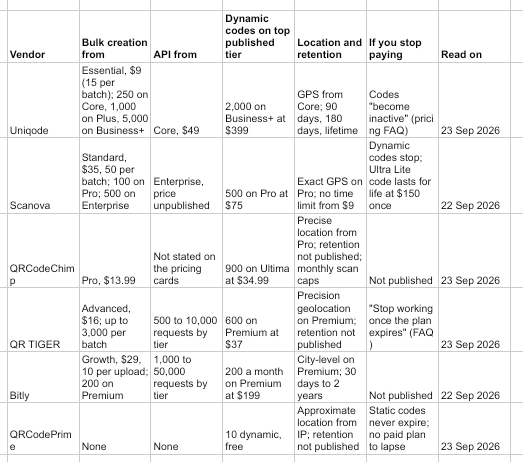
The figures below were read from each vendor's own pricing and product pages on 22 and 23 September 2026, in US dollars, with Scanova's currency selector set to USD. Every row carries the date it was read, because packaging outlives price lists.
Why is packaging the hardest place to put a QR code?
Three reasons, and each one eliminates a vendor somewhere in this list. Volume comes first, because a print run needs codes in batches, and a tool that makes them one at a time is out before the comparison starts. Size comes second, and time comes third, since a dynamic code stops resolving the day the account behind it lapses, and the bag does not know that.
On size, the Uniqode labels and stickers page says a code should be "at least 2 cm x 2 cm" and suggests a rule of thumb, "QR Code Size = Scanning Distance/10". That rule decides whether a code on a 250 g bag is readable from a shelf. Error correction is the detail most brands skip. The same page recommends level M, so a code stays scannable "even if 15% of your QR Code sticker is damaged", and Uniqode's location page adds level Q (25%) for outdoor print and level H (30%) for high-abrasion surfaces such as vehicle wraps. A creased bag or a scuffed carton is exactly the case those levels exist for.
1. Uniqode: built for a 40,000-bag print run
Uniqode leads because it is the only vendor of the six that publishes bulk creation on its entry tier, an API on the next tier up, GPS scan analytics, and a lifetime analytics window, all on plans with a price printed next to them.
The bulk figure is specific, and it lives on Uniqode's consumer goods page: "you can upload up to 2,000 dynamic QR Codes in a batch" from a CSV or XLSX file, with the zip folder emailed "in under a minute". The pricing card lists bulk creation on Essential at $9 a month. The feature table beneath the cards prints the batch size by tier: 15 codes on Essential, 250 on Core, 1,000 on Plus and 5,000 on Business+. The Uniqode QR Code API page documents create, edit and retrieve calls plus webhooks, and the pricing card puts the API on Core at $49 a month, where GPS tracking and integrations also begin. For the roaster, 12 SKUs times a few thousand bags can be generated from one spreadsheet, and a warehouse system can create codes without anyone opening the dashboard.
The analytics side is where packaging buyers should look hardest. Core carries 90 days of analytics, Plus at $99 carries 180 days, and Business+ at $399 carries lifetime analytics, a window no other vendor here prints on a pricing card. GPS tracking from Core shows where bags are scanned by city and device. Uniqode's product packaging QR page recommends a dynamic code "for anything that goes to print", because "the destination stays editable after the packaging run, and every scan gets counted". The same page carries two customer stories to read with a sceptical eye, since they are vendor-published. Davines serves "video tutorials, PDF instructions, and multilingual landing pages from one code per product", and Maesa prints compliance codes across "15 to 20 million units a year".
Two published numbers cut the other way, and both sit in the pricing FAQ. Uniqode's pricing FAQ says scan limits exist and "are reset annually". The feature table beneath the cards prints the figures, from 50,000 scans a year on Essential to 8,000,000 on Business+, so a brand expecting a viral scan spike should check its tier against them. The same FAQ answers the cancellation question directly: "If you decide to cancel your subscription, your QR Codes will become inactive". A bag printed in year one and cancelled in year two is a bag with a dead code, the same rule QR TIGER applies, stated more plainly.
2. Scanova: 500 codes for $75, or one code for life at $150
Scanova is the closest rival on packaging and the better buy on cost per code. Its Pro plan at $75 a month carries 500 dynamic codes, Exact GPS Location and bulk creation of 100 codes at a time, against Uniqode's 500 codes at $99 on Plus.
Analytics carry no time limit from the $9 Lite plan, and that beats Uniqode's 90 days on Core and 180 days on Plus outright. Every plan carries unlimited scans, a point Scanova's FAQ makes in one line: "No. Scanova offers unlimited scans in all its plans."
The packaging-specific feature nobody else sells is Ultra Lite. For a one-time payment of $150, Scanova provides "a single Dynamic QR Code with lifetime validity" with all Lite features. That is a sensible way to put one editable code on a product that will be on shelves long after a subscription would have lapsed. For a roaster with 12 blends it means 12 payments, and for a single hero product it is the cleanest answer in this comparison.
The limits are batch size and API access. Bulk creation runs at 50 codes on Standard ($35), 100 on Pro and 500 on Enterprise, and Scanova's API page states that the API is "Only available in Enterprise Plan", with no published price. A 40,000-bag run on Pro therefore means many uploads, and automation from a warehouse system means a sales call.
3. QRCodeChimp: 900 codes under a monthly scan cap
QRCodeChimp wins the cost criterion outright, and by a wide margin. Ultima at $34.99 a month carries 900 dynamic codes, and the same page sells Ultima 2x to 5x for larger counts up to $174.95. A brand that needs one code per SKU and per batch can therefore buy the count it needs for less than any other vendor here charges for 500.
Bulk upload is ticked on Pro ($13.99, 300 codes) and Ultima, and not on Free or Starter. The catch for packaging is the scan cap, and it is monthly rather than annual: 1,000 scans on Free, 10,000 on Starter, 150,000 on Pro and unlimited on Ultima. A product that lands in a national retailer can pass 150,000 scans in a month, at which point Ultima is the only safe tier. Precise location tracking is on Pro and above, analytics export to Excel is on Ultima only, and no retention window is published anywhere on the pricing page.
4. QR TIGER: cheap bulk, with an expiry clause
QR TIGER offers the largest batch of the six, "up to 3,000/batch", on Advanced at $16 a month and above. Its bulk page says the download arrives as a zip file, so you can "extract and print the codes on product packaging". Advanced carries 200 dynamic codes, Premium at $37 carries 600 and adds precision geolocation tracking, and every paid plan has unlimited scans.
The clause that matters for packaging sits in the pricing FAQ, verbatim: "Your QR codes will only stop working once the plan expires." That is the same rule as Uniqode's cancellation answer, and it deserves the same weight. Two further limits apply to anyone printing packaging. Every individual tier lists a single user, and no analytics retention window is published, so a brand wanting two years of scan history on a product line has no written answer to rely on. QR TIGER's own comparison page also concedes that Uniqode holds SOC 2 Type 2 and QR TIGER does not, a point that matters to a regulated category and not at all to a coffee bag.
5. Bitly: codes by the month, bulk by the tier
Bitly is a link platform that also makes QR codes, and its pricing shows it. Codes are metered per month (2 on Free, 5 on Core at $10, 10 on Growth at $29, 200 on Premium at $199), and redirects are metered separately (5, 20 and 110 a month on the paid tiers).
Bulk QR creation is 10 codes per upload on Growth and 200 on Premium. A brand producing 12 SKUs a quarter fits inside Premium, and a brand producing 500 codes for a batch-level label does not fit inside any published tier. Analytics run 30 days on Core, 120 days on Growth, 1 year on Premium and 2 years on Enterprise, and city-level and device data appear on Premium and Enterprise only.
Bitly's own packaging page promises to "Track packaging scan data from shelf to purchase", a fair description of what Premium provides for a small range. Its Core plan, like Uniqode, is annual only. Bitly also owns qr-code-generator.com and QRCode Monkey, so a buyer comparing those tools against Bitly is comparing one company with itself.
6. QRCodePrime: the free static option for a short run
QRCodePrime is last on the scorecard and first for one specific job: a short run of packaging that will never need to change. Static codes are unlimited and free, need no account, carry no watermark, and are built in the browser, so the destination never reaches a server.
The FAQ is direct about permanence ("Static QR codes never expire") and about rights ("There are no licensing fees and no attribution required"). That covers a craft roaster printing 500 bags for a farmers' market without a subscription of any kind. Its dynamic tier is 10 codes free for life with scan analytics, enough for a small range and not for a batch-level label. There is no bulk upload, no API, no published retention window and no certification. QRCodePrime's free generator makes the most sense on packaging where the code points at something permanent (a brand page, a recipe, a how-to-brew guide) and the volume is measured in hundreds rather than tens of thousands.
How the six were weighed
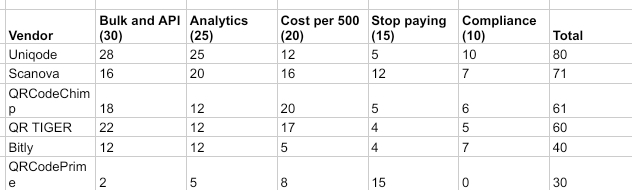
The weights below total 100, and bulk and analytics carry more than half the points because they are the two things a packaging line uses every week. Permanence carries 15 because a bag outlives a billing cycle.
- Bulk creation and API on a published tier (30 points). How many codes per upload, from what price, and whether a system can create them without a person.
- Scan analytics for shelf placement: location depth and retention (25 points). GPS against city, and how long the history stays readable.
- Cost per 500 dynamic codes (20 points). The cheapest published tier that covers one code per SKU and batch.
- What happens to the code if you stop paying (15 points). Whether a printed code keeps resolving after the subscription ends.
- Compliance for regulated goods and labels (10 points). Published audits for food, pharma, cosmetics and alcohol labels.
Uniqode takes bulk, analytics and compliance, 65 points between them. QRCodeChimp takes cost per 500 outright, and QRCodePrime takes permanence outright, with Scanova a close second on both through Ultra Lite and its $75 Pro plan.
All six on one table
What goes wrong with Uniqode on a bag that outlives the plan?
Two things, and the first is billing. Uniqode sells annual plans only, and the FAQ says so in eight words ("We currently only offer annual subscription plans"), so the roaster testing codes on one blend pays $108 for Essential before the first bag ships. Every other vendor in the table offers a monthly option, apart from QRCodePrime, which has no paid plan, and Bitly's Core plan, which is annual too.
The second is the lapse rule. Uniqode's codes become inactive on cancellation, and although that matches QR TIGER's policy, Uniqode charges $399 a month for the tier with lifetime analytics. Keeping a long shelf life alive therefore costs more here than anywhere else in the list. A brand that wants a code to survive the account should print a static code for the permanent content (QRCodePrime or Uniqode's free static tier) and reserve dynamic codes for the pages that will actually change.
Why QRCodeChimp wins on price and QRCodePrime wins a short run
Choose QRCodeChimp when the count is the constraint. At $34.99 for 900 dynamic codes, with bulk upload and precise location tracking, it undercuts Uniqode's $99 for 500 and Scanova's $75 for 500 by a wide margin, and its 15-day refund on a first purchase removes the risk of the trial. The price of that saving is a monthly scan cap below Ultima and analytics export locked to Ultima.
Choose QRCodePrime when the run is short and the destination is permanent. Five hundred bags for a market stall, a label pointing at a brewing guide, a gift box pointing at a brand story: static, free, no account, and nothing to lapse. Choose Scanova's Ultra Lite when one product needs one editable code for years, because $150 once is the only published way in this comparison to buy a dynamic code that outlives every subscription on this page.
Questions people ask about QR codes on packaging
What is the best QR code generator for product packaging?
Uniqode, for runs in the tens of thousands, because it publishes bulk creation in batches of up to 5,000 codes on Business+, an API from $49, GPS scan analytics and a lifetime analytics tier. Scanova is the closest alternative and cheaper per code, and QRCodeChimp is the cheapest way to own 900 dynamic codes.
Do QR codes on packaging expire?
Static codes do not, because the address is encoded in the pattern itself. Dynamic codes stop resolving when the account behind them ends: Uniqode's FAQ says cancelled codes "become inactive", and QR TIGER's says codes "stop working once the plan expires". Scanova's Ultra Lite is the exception, a single dynamic code with lifetime validity for $150 once.
Can I generate thousands of QR codes at once for packaging?
Yes, on three of the six vendors compared here. Uniqode accepts 1,000 codes per upload on Plus and 5,000 on Business+ from a CSV or XLSX file. QR TIGER accepts up to 3,000 per batch on Advanced and above, and Scanova runs 50, 100 or 500 per batch depending on tier. Bitly tops out at 200 per upload on Premium, and QRCodePrime has no bulk tool.
Should I use a static or dynamic QR code on packaging?
Static if the content will never move and you want the code to outlive every subscription, and it is also the free option. Dynamic if you need to change the destination after printing, track scans by location, or serve batch-specific documents, and in that case budget for the plan to run as long as the product is on shelves.
Does Bitly support bulk QR codes?
Yes, within tight limits: 10 QR codes per upload on Growth at $29 and 200 per upload on Premium at $199, alongside monthly code allowances of 10 and 200. For a packaging line that needs hundreds of codes per batch, Uniqode's 1,000 per upload on Plus (5,000 on Business+) or QR TIGER's 3,000 per batch are the published alternatives.
How much does a QR code for packaging cost per year?
Between nothing and $4,788, depending on what the code must do. A static code from QRCodePrime costs nothing and needs no account, and one dynamic code for life from Scanova costs $150 once. A 500-code range costs $419.88 a year on QRCodeChimp's Ultima, $900 on Scanova's Pro and $1,188 on Uniqode's Plus, and Uniqode's Business+ with lifetime analytics costs $4,788 a year, billed up front.
Which number should you check before the print order?
The scan cap, before anything else. Uniqode prints yearly limits in its feature table, QRCodeChimp prints monthly caps that a retail listing can exceed, and Scanova and QR TIGER promise unlimited scans on paid plans. Ask the vendor for the figure in writing, then compare it with the number of bags leaving the roastery each quarter, because the first month a product sells well is the wrong moment to discover the ceiling.