The barrier to launching a crypto startup has changed dramatically over the last five years. In the early stages of the industry, founders often had to build wallet infrastructure, blockchain monitoring systems, liquidity connections, and transaction processing tools from scratch. That approach required significant capital, specialized engineers, and months of development before a product could reach users.
Today, much of that infrastructure is available through crypto APIs. As a result, startups can focus on product design, customer acquisition, compliance, and business models instead of maintaining complex blockchain architecture. The rise of API-driven development has become one of the less discussed yet most important shifts in the digital asset sector.
For many teams, a secure integration with services such as the ChangeNOW Crypto Exchange API can reduce development complexity while providing access to exchange functionality that would otherwise require extensive liquidity partnerships and operational resources. The question is no longer whether crypto APIs can accelerate product development. The more relevant question is how founders can use them strategically without creating technical or business dependencies that limit growth later.
Crypto APIs Are Becoming Essential
Modern crypto startups rarely operate in isolation. Even relatively simple applications often need multiple blockchain-related services:
- Wallet generation
- Address monitoring
- Transaction tracking
- Token pricing
- Asset exchange
- KYC verification
- Risk assessment
- Blockchain analytics
Building each component internally increases both cost and execution risk.
According to industry estimates, developing a production-grade crypto infrastructure stack can require anywhere from $100,000 to over $1 million depending on supported chains, security requirements, and transaction volume. APIs reduce those costs substantially by allowing teams to integrate specialized services instead of recreating them.
The trend mirrors what happened in fintech. Few startups build banking rails from scratch anymore. Crypto appears to be following the same path.
Choosing the Right Crypto Startup Model
Not every crypto startup requires the same API architecture.
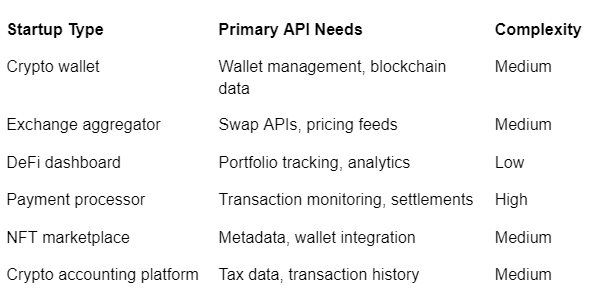
The business model should determine API selection—not the other way around.
A common mistake among founders is integrating numerous services before validating user demand. In practice, most successful startups begin with the minimum infrastructure necessary to solve one specific problem.
Core Infrastructure Every Crypto Startup Needs
Wallet Functionality
Wallets remain the foundation of most crypto products.
Whether a startup serves retail users, traders, or businesses, it typically needs:
- Address creation
- Balance tracking
- Transaction history
- Multi-chain support
- Security monitoring
The challenge is scale. Supporting one blockchain is relatively straightforward. Supporting ten or twenty networks introduces maintenance costs that can quickly overwhelm small engineering teams.
Market Data and Pricing
Crypto products depend heavily on accurate market information.
Users expect:
- Real-time token prices
- Historical data
- Liquidity metrics
- Trading volume indicators
Even slight pricing inaccuracies can damage trust. This becomes especially important during periods of high market volatility when prices can move several percentage points within minutes.
Exchange and Swap Infrastructure
Many startups eventually require token conversion functionality.
Building direct exchange connectivity means negotiating liquidity agreements, managing order books, and maintaining operational relationships across multiple venues.
API integrations simplify this process significantly by abstracting much of the complexity behind standardized endpoints.
Building an MVP Faster with APIs
Speed remains one of the strongest arguments for API-based development.
Consider a hypothetical crypto payment startup.
Without APIs, the development roadmap might include:
- Blockchain node deployment
- Wallet architecture
- Transaction monitoring
- Exchange integrations
- Pricing infrastructure
- Security systems
This process could take six to twelve months.
With mature crypto APIs, much of that functionality can be implemented within weeks. That does not eliminate engineering work, but it shifts resources toward user-facing features.
The difference can determine whether a startup reaches product-market fit before funding runs out.
API Selection Criteria
Not all crypto APIs are equal.
Founders often focus on documentation quality and pricing, but long-term reliability depends on several deeper factors.
Security Standards
Questions worth asking include:
- Are API keys encrypted?
- Is IP whitelisting available?
- Are rate limits transparent?
- Is infrastructure audited?
Security failures in crypto are rarely forgiving.
Blockchain Coverage
A startup may launch with Bitcoin and Ethereum support, but user demand can quickly expand toward Solana, Polygon, Avalanche, Arbitrum or BNB Chain.
Switching providers later can be expensive, making future compatibility an important consideration from the start.
Uptime and Performance
Users generally tolerate few interruptions when money is involved.
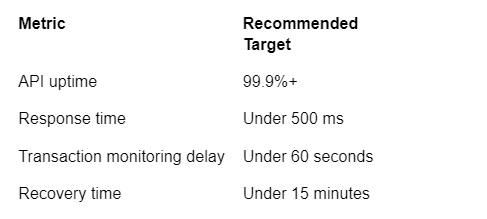
Anything significantly below these thresholds may create operational issues at scale.
The DeFi Opportunity
Decentralized finance continues to create opportunities for API-driven startups.
Rather than building protocols themselves, many founders are developing tools around the ecosystem:
- Portfolio trackers
- Yield aggregators
- Risk monitoring platforms
- Institutional reporting tools
- Automated treasury management systems
As DeFi infrastructure becomes more sophisticated, the Integration of APIs in defi apps is no longer a technical advantage but a practical necessity. Modern applications routinely combine liquidity sources, wallet services, pricing engines, and blockchain analytics through interconnected API layers. This approach allows startups to launch faster while maintaining flexibility as market conditions and user expectations evolve.
An interesting shift is emerging. Infrastructure companies are becoming as important as consumer-facing crypto brands. In some cases, they may ultimately capture more value.
Conclusion
Crypto APIs have become foundational infrastructure for modern blockchain businesses. They reduce development costs, shorten launch timelines, and allow startups to concentrate on product differentiation rather than rebuilding technology that already exists.
That does not mean APIs are a shortcut to success. Poor provider selection, weak security practices, and excessive dependency on third-party services can create significant operational risks. The strongest crypto startups treat APIs as strategic building blocks rather than complete solutions.
As the industry matures, competitive advantages are increasingly emerging from user experience, distribution, and execution. Infrastructure is still important, but it is no longer the primary obstacle it once was. For founders entering the market today, the ability to combine reliable crypto APIs with a focused business model may be one of the most practical advantages available.
Disclaimer: This article is for informational purposes only and does not constitute investment, financial, legal, or trading advice.
FAQ
1. What is a crypto API?
A crypto API is an interface that allows applications to interact with blockchain networks, exchanges, wallets, pricing feeds, or other cryptocurrency services without building the underlying infrastructure from scratch.
2. How much can a startup save by using crypto APIs?
Savings vary significantly, but API integrations can reduce infrastructure development costs by tens or even hundreds of thousands of dollars compared with fully custom solutions.
3. Are crypto APIs suitable for enterprise products?
Yes. Many institutional platforms rely on APIs for market data, transaction monitoring, custody services, and compliance workflows.
4. What is the biggest risk of using third-party APIs?
Vendor dependency is often the largest concern. Service outages, pricing changes, or limited blockchain support can affect business operations.
5. Can a crypto startup operate without exchange APIs?
Yes, but building and maintaining direct liquidity relationships requires substantial technical and operational resources.
6. Which blockchains should a startup support first?
The answer depends on the target audience, though Bitcoin, Ethereum, and major Layer-2 networks are common starting points due to their user adoption and ecosystem maturity.
7. When should a startup replace API-based infrastructure with in-house systems?
Usually only after reaching meaningful scale, when operational costs, customization needs, or performance requirements justify the investment.