
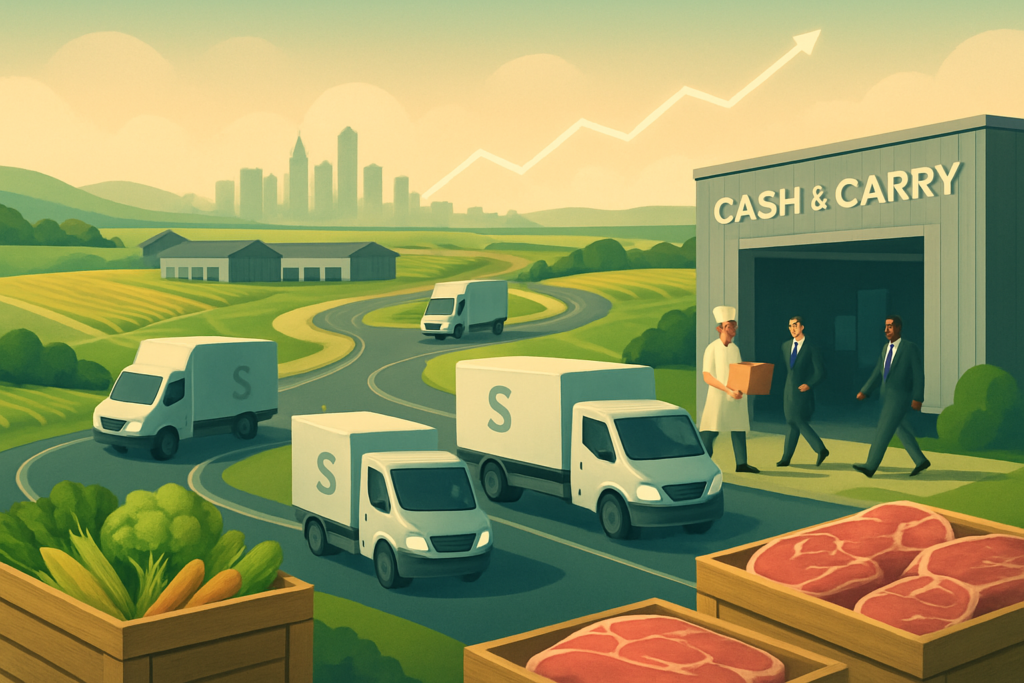
On March 31, 2026, the global foodservice landscape is processing what many analysts are calling the most audacious move in the history of food distribution. Sysco Corp. (NYSE: SYY), the undisputed titan of the industry, recently shocked the markets by announcing a $29.1 billion acquisition of Jetro Restaurant Depot. While Sysco has long been the dominant "push" distributor—delivering food directly to kitchens—this move signals a radical shift toward the "pull" economy of Cash & Carry. However, with the stock tumbling 15% in the wake of the announcement, the market is signaling a deep-seated anxiety: can Sysco manage a massive new debt load while integrating a fundamentally different business culture, or has the giant finally bitten off more than it can chew?
Historical Background
Sysco—an acronym for Systems and Controls—was founded in 1969 by John F. Baugh. His vision was to consolidate a fragmented industry of regional food distributors into a national powerhouse capable of providing consistent service to growing restaurant chains. Since going public in 1970, Sysco has pursued a relentless strategy of inorganic growth, acquiring over 400 companies to build its current empire.
The company’s history is defined by its scale. For decades, it was the "boring but beautiful" dividend aristocrat of Wall Street. However, the 2015 failure of its attempted merger with US Foods, blocked by the Federal Trade Commission (FTC) on antitrust grounds, forced Sysco to look elsewhere for growth. This led to international expansions, such as the acquisition of Brakes in Europe, and ultimately, the massive pivot toward Jetro Restaurant Depot in 2026.
Business Model
Sysco’s business model is a high-volume, low-margin logistics engine. It connects food producers (from massive agricultural firms to local specialty farmers) with the "away-from-home" dining market.
The company operates through four primary segments:
- U.S. Foodservice Operations: The core engine, accounting for roughly 71% of revenue, serving independent restaurants, healthcare facilities, and schools.
- International Foodservice: Operations across Canada, the UK, France, and Mexico.
- SYGMA: A specialized distribution arm for large, multi-unit restaurant chains that require high-frequency, customized logistics.
- Specialty & Other: Includes high-end meat and produce companies like Buckhead Meat, as well as the Edward Don & Co. kitchen equipment business.
The recent Jetro acquisition introduces a fifth, hybrid pillar: Cash & Carry. This allows Sysco to serve the "underserved" small-business segment that prefers to hand-pick their inventory and avoid delivery fees.
Stock Performance Overview
As of March 31, 2026, SYY is trading at approximately $69.30, reflecting a significant "deal-related" correction.
- 1-Year Performance: Down roughly 8%. Prior to the Jetro announcement, the stock had reached record highs near $92, but the $29.1 billion price tag led to a sharp sell-off.
- 5-Year Performance: A modest 1.5% total return. Over the last five years, Sysco has largely underperformed the broader S&P 500, struggling with post-pandemic labor costs and the high interest rate environment of the mid-2020s.
- 10-Year Performance: Up approximately 115%. For long-term holders, Sysco has remained a stable wealth preservation tool with a compounding dividend, though the capital appreciation has slowed significantly in recent years.
Financial Performance
Sysco’s financials are currently a tale of two realities. In the first half of FY 2026, the company showed operational strength, with an adjusted EPS of $0.99 and gross margins stabilizing at 18.5%. The "Recipe for Growth" efficiency program was successfully offsetting wage inflation.
However, the balance sheet has been dramatically reshaped.
- The Debt Burden: To fund the $21.6 billion cash portion of the Jetro deal, Sysco is taking on massive new leverage. Pro-forma net debt-to-EBITDA is expected to spike from a conservative 2.8x to roughly 4.5x.
- Share Dilution: The deal also involves issuing 91.5 million new shares, diluting existing shareholders by approximately 19%.
- Cash Flow: TTM Free Cash Flow sits at $3.55 billion, but management has officially paused share buybacks to prioritize interest payments and debt reduction over the next 36 months.
Leadership and Management
CEO Kevin Hourican, formerly of CVS Health, has been the architect of Sysco’s modern transformation. Since taking the helm in 2020, he has shifted the company away from its decentralized roots toward a more digital-first, automated corporate structure.
The Jetro deal is Hourican’s "legacy move." By bringing in the Cash & Carry model, he aims to capture the entire restaurant lifecycle. However, the departure of CFO Kenny Cheung shortly before the deal announcement and the appointment of Interim CFO Brandon Sewell have raised questions about the internal consensus regarding the acquisition's price and timing.
Products, Services, and Innovations
Sysco has moved far beyond just delivering boxes of produce. Its competitive edge now lies in its digital ecosystem:
- Sysco Shop: An industry-leading app that uses AI to suggest inventory orders based on a restaurant’s past performance and local dining trends.
- Sysco Perks 2.0: A loyalty program designed to compete with warehouse clubs like Costco, offering rebates and culinary consulting.
- Automation: The company is aggressively piloting autonomous delivery trucks and automated "micro-fulfillment" centers in urban areas to combat the chronic shortage of commercial drivers.
Competitive Landscape
The food distribution industry is an oligarchy dominated by the "Big Three":
- Sysco (SYY): The market leader with roughly 17% market share.
- US Foods (USFD): The primary rival, known for its "Scoop" innovation program and high-margin specialty products.
- Performance Food Group (PFGC): A aggressive challenger that has grown through the acquisition of Core-Mark and Vistar.
The Jetro acquisition shifts the competitive battlefield. Sysco is no longer just fighting US Foods for delivery contracts; it is now in direct competition with Costco (COST) and Sam’s Club (WMT) for the "pick-up" business of small restaurant owners.
Industry and Market Trends
Three major trends are currently defining the sector in 2026:
- The Rise of Hybrid Distribution: Restaurants are increasingly split between scheduled large-scale deliveries and "fill-in" shopping at warehouse stores to manage cash flow.
- Labor Scarcity: High turnover in warehouse staff and drivers has made automation no longer an option, but a necessity for survival.
- Digital Disintermediation: Direct-to-chef platforms are attempting to bypass traditional distributors, forcing giants like Sysco to provide more "value-add" services like menu consulting and labor management software.
Risks and Challenges
The primary risk facing Sysco is financial overextension. A $21 billion debt pile in an era of "higher-for-longer" interest rates leaves very little margin for error. If a recession hits in late 2026 or 2027, the cost of servicing this debt could eat into the dividend, which is the cornerstone of the stock’s value for many retail investors.
Furthermore, there is a cultural integration risk. Jetro is a lean, entrepreneurial "Cash & Carry" operation. Sysco is a massive, process-driven corporate entity. Merging these two cultures without losing Jetro’s efficiency and customer loyalty is a monumental task.
Opportunities and Catalysts
If executed correctly, the Jetro deal is a massive catalyst for earnings growth. Management projects the acquisition will add $16 billion in annual revenue and $2 billion in EBITDA.
- Synergy Potential: Sysco can leverage its massive private-label supply chain to lower the cost of goods sold (COGS) at Jetro locations, significantly boosting margins.
- Cross-Selling: Sysco can offer its digital tools and specialty meat/produce to Jetro’s existing customer base, who previously only had access to standard warehouse inventory.
Investor Sentiment and Analyst Coverage
The current sentiment on Wall Street is "cautious to bearish." While analysts appreciate the strategic logic of the Jetro deal, many have downgraded the stock due to the valuation and debt. Moody’s and S&P have both revised Sysco’s credit outlook to Negative.
Institutional investors are currently in a "wait and see" mode, watching for the first two quarters of post-acquisition data to see if the promised synergies begin to materialize.
Regulatory, Policy, and Geopolitical Factors
The elephant in the room is the Federal Trade Commission (FTC). Having blocked the Sysco-US Foods merger a decade ago, regulators are likely to scrutinize the Jetro deal for "market dominance" in local regions. If the FTC demands significant divestitures of Jetro locations in major metro areas like New York or Los Angeles, the financial math of the deal could sour quickly.
Additionally, the "Food Supply Chain Task Force" established by the current administration is investigating price transparency in the distribution sector, which could lead to new compliance costs for the combined entity.
Conclusion
Sysco’s $29.1 billion acquisition of Jetro Restaurant Depot is a "bet the farm" move that seeks to redefine the company for the next decade. By bridging the gap between delivery and warehouse shopping, Sysco is attempting to build an impenetrable moat around the foodservice industry.
However, the cost of this moat is a mountain of debt and significant share dilution. For investors, Sysco is no longer a "set it and forget it" dividend play; it is now a high-leverage restructuring story. The key metrics to watch over the next 18 months will be the pace of debt repayment, the FTC’s final ruling on the merger, and the company's ability to maintain its gross margins in a increasingly competitive and regulated food supply chain.
This content is intended for informational purposes only and is not financial advice.