
The global fintech market reached about $394.88 billion in 2025 and is on track to pass $1.76 trillion by 2034, a compound annual growth rate of 18.2%. Money is moving into regulated, software-defined finance faster than most teams can hire for.
Two shifts are reshaping how fintech products get built. AI has moved from pilots to production for fraud detection, credit decisioning, and personalized advice. Real-time payment rails and open banking have raised the compliance bar on every release. That turns vendor choice into an architecture decision. Pick a generalist who has never shipped KYC, AML, or PCI DSS work, and you pay for it later in failed audits and rebuilds.
This guide ranks the top fintech software development companies for 2026 based on verifiable delivery, security posture, and senior engineering depth. We also kept team sizes realistic, mixing focused specialists with one large-scale option, so the list reflects partners that growing fintechs can book.
How We Chose These Companies
We built this list of top fintech software development companies based on four tests that all companies had to pass.
Proven fintech delivery. Named financial products in the portfolio, not a generic services page.
Security and compliance experience. ISO 27001, SOC 2, or PCI DSS, plus hands-on KYC and AML work.
Public client proof. Verified reviews on Clutch or GoodFirms with real project details.
Right-sized, senior-weighted teams. We favored boutique-to-mid specialists over raw headcount, then added one large-scale firm for teams that need to staff fast.
The 6 Top Fintech Software Development Companies
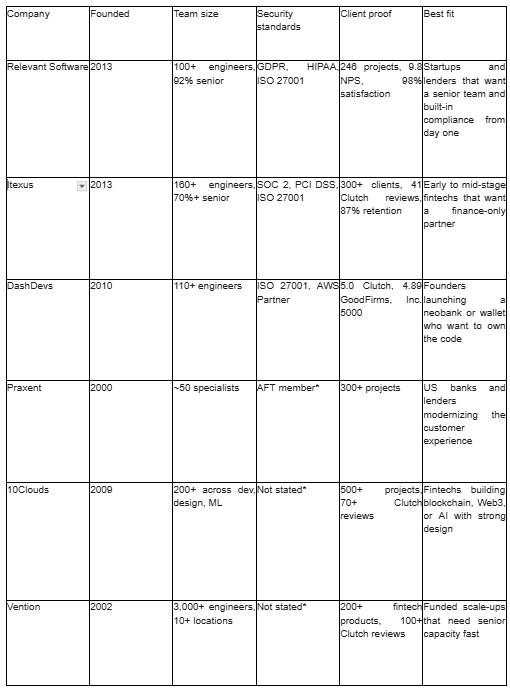
All six companies below cleared the tests. Use the table to compare them at a glance, then read the profiles for the details behind each pick.
1. Relevant Software: senior-led fintech delivery across banking, payments, and lending
Relevant Software is one of the top fintech software development companies, founded in 2013. It runs a senior-weighted team of 100+ in-house engineers, reports 92% senior talent and 96% employee retention, and has delivered 246 projects for 200+ businesses, ranging from Fortune 500 brands to funded startups. A 9.8 Net Promoter Score and a 98% client-satisfaction figure point to long engagements rather than one-off builds. The company is GDPR, HIPAA, and ISO 27001 compliant, which matters the moment a fintech product starts handling regulated data.
Relevant builds digital and core banking platforms, payment and lending apps, white-label fintech products, AI-based fraud detection, and risk and compliance software. The evidence is on Clutch. One lending client reported handling roughly 7,000 loans a year and a 25% year-over-year rise in net profit after Relevant rebuilt its platform. Another launched a working equity loan customer portal as an MVP, within budget and on time.
Best fit for:
Startups that want a senior team from day one, not junior engineers swapped in after the contract is signed.
Banks and lenders that need GDPR, HIPAA, or ISO 27001 compliance built in from the first sprint.
Teams that want EU and US time-zone coverage with PMP-certified delivery management.
2. Itexus: a fintech-only engineering team
Itexus is a fintech software development company founded in 2013, headquartered in Dover, Delaware, with engineering centers in Eastern Europe. Its fintech division employs 160+ in-house engineers, more than 70% of whom are senior, and the firm has served 300+ clients across 23 countries. Work is delivered in accordance with SOC 2, PCI DSS, and ISO 27001 standards, with 41 verified reviews on Clutch.
Itexus covers digital banking, payments, stock trading, wealth and investment management, PCI DSS-compliant crypto wallets, white-label banking, and RegTech. Because the entire portfolio sits inside finance, engineers do not need KYC or AML explained to them. The company says this shortens onboarding and supports MVP delivery in roughly 4 months, and it reports an 87% client retention rate.
Best fit for:
Early to mid-stage fintech startups that want a partner whose whole portfolio is their domain.
Teams building regulated products, from crypto wallets to banking and trading, that need compliance baked in.
3. DashDevs: neobank and payment platform specialist
DashDevs has spent about 15 years in software, with the last 9 focused on fintech, delivering 80+ fintech projects. It holds a 5.0 rating on Clutch and 4.89 on GoodFirms, is ISO 27001 certified and an AWS partner, and sits on the Inc. 5000 list.
Its differentiator is FintechCore, a white-label, modular neobank platform with more than 60 modules and 470-plus API endpoints covering KYC and KYB, card issuing, ledgers, and AML integrations. Clients get the source code, so there is no vendor lock-in if they outgrow it, and the platform connects to 100-plus third-party fintech providers. DashDevs used this approach to launch Dozens, one of the UK's early fully licensed challenger banks, in nine months. Other clients include Chip and RakBank.
Best fit for:
Founders launching a neobank, e-wallet, or P2P payment product who need to reach the market in months, not a year.
Teams that want a platform head start but still want to own the code.
4. Praxent: US fintech experience and modernization
Praxent is a US-based firm founded in 2000 in Austin, Texas, with a focused team of around 50 specialists and more than 300 projects under its belt. It is a member of the Association for Financial Technology, and its work centers on financial services, lending, insurance, and real estate.
Praxent's strength is modernizing customer experience for banks, credit unions, and lenders: digital account opening, loan origination, and front-end overhauls of existing financial products. Delivery managers coordinate domestic and nearshore teams, which suits institutions that want a US partner with little time-zone friction.
Best fit for:
US banks, credit unions, and lenders are modernizing the customer experience of an existing product.
Teams that value design and UX leadership over raw engineering headcount.
5. 10Clouds: fintech, blockchain, and AI with strong design
10Clouds is a Warsaw-based software house founded in 2009, now a team of 200-plus across development, design, and machine learning, with 500-plus projects delivered and 70-plus reviews on Clutch. It has been recognized by Deloitte and the Financial Times.
For fintech, 10Clouds pairs blockchain and Web3 engineering with award-winning product design. Its portfolio includes TrustStamp in identity verification, the AlephZero blockchain, and DCLEX, a stock-trading platform built on blockchain with NFT-based identity verification. The firm now runs a dedicated AI practice building production AI for banks, insurers, and fintechs.
Best fit for:
Fintechs building blockchain, Web3, or DeFi products that also need to look and feel polished.
Teams layering AI onto a financial product, from fraud analytics to customer-facing assistants.
6. Vention: scale for fast-growing fintech teams
Vention, formerly iTechArt, was founded in 2002 and is headquartered in New York. With 3,000-plus in-house engineers across more than ten delivery locations, it is the largest firm on this list. It has 15+ years in fintech, 200+ fintech products delivered, and 100+ reviews on Clutch.
Vention runs a dedicated fintech practice covering KYC and AML workflows, multi-currency logic, secure APIs, and open banking. Its client roster includes PayPal, IBM, PwC, and StoneX, the last a partner since 2010, and its work has fed into $13 billion in acquisitions and 21 fintech IPOs. The model relies on staff augmentation, enabling funded teams to add senior engineers quickly and run multiple workstreams simultaneously.
Best fit for:
Funded scale-ups and financial institutions that need to expand senior capacity fast.
Teams modernizing or scaling an established platform that want a deep engineering bench.
Which Regulations Shape Fintech Software Development?
Compliance is part of fintech engineering that sets top fintech software development companies apart from generalists, because the rules touch architecture, not just paperwork.
Any product that handles card data falls under PCI DSS, whose 4.0 requirements became mandatory in March 2025 and now demand stronger authentication and continuous monitoring.
Identity and transaction monitoring run on KYC and AML rules enforced by bodies like FinCEN and the FCA.
Products serving EU users must comply with GDPR, and payment apps in Europe must comply with PSD2, including strong customer authentication.
Most buyers also expect SOC 2 or ISO 27001 for data security, and EU financial firms are now subject to DORA, which has been in force since January 2025.
The key point: retrofitting these controls costs three to five times as much as building them in from the first sprint.
In-House Team or Outsourced Partner?
Most early-stage fintechs cannot hire a full senior team fast enough to hit a funding milestone, which is why outsourcing dominates the early stages.
A specialist partner brings engineers who already understand payments, lending, or compliance, so onboarding is short and the first audit is less of a gamble.
An in-house team makes more sense once the product is live and the roadmap is stable, when institutional knowledge and daily control matter more than speed.
Many companies run a hybrid: a small internal core for product direction, plus an external team for delivery capacity.
Whichever route you choose, insist on owning the source code and a clean handover, so a change of vendor never strands the product.
How Much Does Fintech Software Development Cost?
Cost depends far more on regulation and architecture than on feature count. Industry estimates for 2026 put a focused fintech MVP at roughly $50,000 to $150,000, while a full-scale, production-grade platform runs from about $200,000 to $500,000 and beyond.
Regulated products start higher because mandatory KYC and AML work, and the PCI DSS scope adds engineering time from day one.
A fintech build typically takes 40 to 60 percent longer than a comparable app in another industry.
Team location moves the number, too: senior engineers in Central and Eastern Europe bill around $50 an hour, compared with $150 to $250 in San Francisco or London.
Budget another 15-20% of the build cost each year for maintenance, security updates, and compliance.
Conclusion
Choosing among the top fintech software development companies is less about headcount and more about fit. The strongest signal is a track record in your exact niche: lending, payments, digital banking, or wealth management. Look for named products, not a broad services page. Ask how a vendor handles compliance during development, not just at the end. KYC, AML, and PCI DSS work should be built into the process, with case studies and references to prove it. Confirm that the engineers assigned to you are senior and stay on the project, since low quotes often hide junior teams swapped in after signing. Then weigh team size against your stage. A focused specialist can move faster on an MVP, while a larger firm makes sense once you need several workstreams running at once.
Get that match right, and the build pays for itself in fewer audits, less rework, and a faster path to market.