
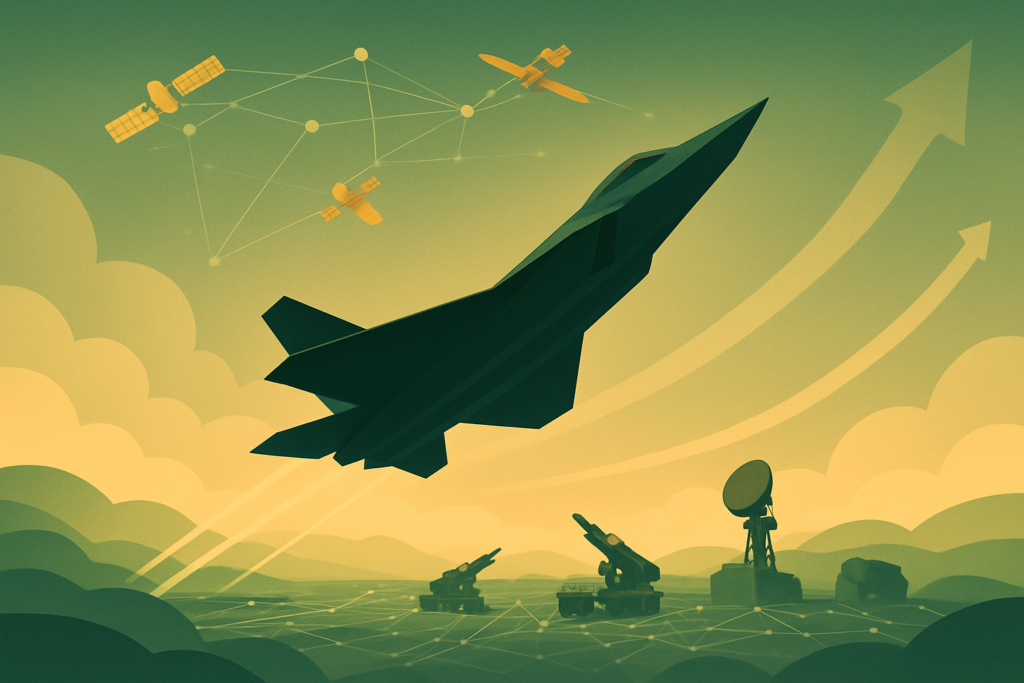
Today, January 8, 2026, the aerospace and defense sector was sent into a frenzy following the formal proposal of a staggering $1.5 trillion United States defense budget. At the heart of this tectonic shift in national security spending is Lockheed Martin (NYSE: LMT), the world’s largest defense contractor. With a portfolio that spans from the depths of the ocean to the outer reaches of the atmosphere, Lockheed Martin finds itself at a critical juncture: a dominant incumbent poised to benefit from unprecedented spending, yet facing a new era of political scrutiny regarding executive compensation and corporate buybacks. This deep dive explores the financial, operational, and strategic landscape of a company that is no longer just a hardware manufacturer, but a software-driven titan of "21st Century Security."
Historical Background
The modern Lockheed Martin Corporation was forged in the "Last Supper" era of defense consolidation. In 1995, the merger of Lockheed Corporation and Martin Marietta created a behemoth with unparalleled reach. Lockheed, famous for its "Skunk Works" division that produced the U-2 and SR-71 Blackbird, combined its aeronautics prowess with Martin Marietta’s strength in electronics and space systems.
Over the decades, the company has navigated the end of the Cold War, the War on Terror, and the recent pivot toward "Great Power Competition." Key transformations include the acquisition of Sikorsky Aircraft in 2015, which solidified its dominance in military rotorcraft, and its ongoing transition from traditional kinetic platforms to networked, digital-first defense ecosystems.
Business Model
Lockheed Martin operates through four primary business segments, each serving a unique pillar of the defense landscape:
- Aeronautics (~40% of revenue): Dominated by the F-35 Lightning II program, the most expensive weapons system in history. It also produces the C-130 Hercules and the F-16 Fighting Falcon.
- Missiles and Fire Control (MFC): Responsible for high-demand systems like the PAC-3 (Patriot) missiles, HIMARS, and the Javelin anti-tank missile. This segment has seen exponential demand due to the ongoing conflict in Ukraine and tensions in the Indo-Pacific.
- Rotary and Mission Systems (RMS): Primarily Sikorsky helicopters (Black Hawk, Seahawk) and naval combat systems like the Aegis Combat System.
- Space: Focuses on satellite production, strategic missiles (Trident II), and the Orion spacecraft for NASA’s Artemis missions.
The company’s primary customer is the U.S. government (73% of sales), followed by international military sales (26%), often facilitated through the Foreign Military Sales (FMS) program.
Stock Performance Overview
As of early January 2026, Lockheed Martin has proven to be a resilient "safe haven" for investors, though it has experienced volatility:
- 1-Year Performance: Up approximately 13.02%. The stock saw a late-2025 rally as F-35 delivery hurdles were cleared and budget optimism took hold.
- 5-Year Performance: Up roughly 68.27%. This reflects a steady compounding of returns as the F-35 program matured and global defense budgets surged following the 2022 invasion of Ukraine.
- 10-Year Performance: A robust ~206.15%. Long-term shareholders have benefited from the lifecycle of the F-35 and consistent dividend growth.
Following yesterday's $1.5 trillion budget news, LMT shares spiked nearly 6% in after-hours trading, reflecting the market's appetite for the massive modernization programs included in the proposal.
Financial Performance
Lockheed Martin entered 2026 with a historic $179 billion backlog, representing more than 2.5 years of production capacity.
- 2025 Revenue: Reached approximately $74.5 billion, a record high.
- Earnings Per Share (EPS): Estimated at $22.25 for 2025, recovering from a one-time $1.6 billion pre-tax loss on a classified program in the second quarter.
- Dividends: A "Dividend Aristocrat" in the making, LMT recently raised its quarterly payout to $3.45 per share, yielding approximately 2.78%.
- Valuation: Trading at a Forward P/E of roughly 17x, the stock remains reasonably priced compared to historical averages, especially given the anticipated revenue tailwinds from the new budget.
Leadership and Management
CEO Jim Taiclet, who took the helm in 2020, has fundamentally changed the company’s strategic DNA. Drawing on his experience in the telecommunications sector, Taiclet has implemented a "21st Century Security" strategy.
His vision emphasizes the "Internet of Military Things" (IoMT), shifting the focus toward software-defined networking, AI, and 5G connectivity. Taiclet is credited with repairing the company’s relationship with the Department of Defense (DoD) after the TR-3 software delays and has been a vocal advocate for "anti-fragile" supply chains. His leadership team is increasingly populated by tech-sector veterans, reflecting the shift away from pure heavy industry.
Products, Services, and Innovations
Lockheed Martin’s innovation pipeline is currently focused on three high-growth areas:
- The Manned-Unmanned Teaming: Successful 2025 tests of the F-35 operating alongside the XQ-58A Valkyrie drone have paved the way for "loyal wingman" programs.
- Hypersonics: LMT is the prime contractor for several hypersonic missile programs, including the Conventional Prompt Strike (CPS).
- JADC2 (Joint All-Domain Command and Control): Through partnerships with Microsoft (NASDAQ: MSFT) and NVIDIA (NASDAQ: NVDA), Lockheed is building the "brain" of future warfare—a system that allows every sensor on the battlefield to communicate in real-time.
Competitive Landscape
Lockheed Martin remains the undisputed leader in market share (~14% globally), but it faces stiff competition from a consolidating "Big Five":
- RTX Corporation (NYSE: RTX): Competes heavily in missile defense and engines.
- Northrop Grumman (NYSE: NOC): Dominates the stealth bomber (B-21 Raider) and space-based sensing markets.
- General Dynamics (NYSE: GD): A major rival in land systems and submarines.
- The Boeing Company (NYSE: BA): While struggling in its commercial division, Boeing remains a major competitor in helicopters (Apache) and the F-15EX program.
Lockheed’s competitive edge lies in the sheer scale of the F-35 program, which provides a decades-long "moat" of sustainment and upgrade revenue.
Industry and Market Trends
The defense industry is currently moving away from "monolithic" platforms toward distributed systems. Key trends include:
- Digital Twins: Lockheed now builds every aircraft digitally before it touches the factory floor, significantly reducing production errors.
- Space as a Combat Domain: The rapid militarization of Low Earth Orbit (LEO) has turned the Space segment from a niche research area into a vital national security priority.
- Speed-to-Market: The DoD is demanding faster "prototyping-to-fielding" cycles, favoring companies that can integrate commercial technology rapidly.
Risks and Challenges
Despite the $1.5 trillion budget tailwind, Lockheed faces significant headwinds:
- Political Stringency: The proposed budget includes threats to cap executive pay and restrict stock buybacks for contractors that fail to meet delivery deadlines.
- Fixed-Price Contracts: The company has suffered losses on classified programs due to fixed-price structures in an inflationary environment.
- Supply Chain Fragility: Shortages of microelectronics and specialized chemicals remain a bottleneck for missile production.
- Concentration Risk: The F-35 accounts for nearly 27% of total revenue. Any systemic grounding or major technical failure of the fleet would be catastrophic for the stock.
Opportunities and Catalysts
The primary catalyst is the $1.5 trillion budget proposal, which includes a massive "Dream Military" modernization fund.
- International Expansion: With NATO countries aiming to spend 3% of GDP on defense, and nations like Germany and Poland ordering F-35s in record numbers, international sales are a major growth lever.
- AUKUS and Indo-Pacific: New security pacts are driving demand for Lockheed’s naval and missile systems in Australia and Japan.
- Near-term Catalyst: The upcoming Q4 2025 earnings call (expected late Jan 2026) will provide critical guidance on how much of the $1.5T budget Lockheed expects to capture in "Lots 20 & 21" of the F-35 program.
Investor Sentiment and Analyst Coverage
Wall Street remains "Overweight" on LMT, though with caution regarding the political landscape.
- Institutional Holdings: Major firms like Vanguard and BlackRock remain the largest shareholders, viewing LMT as a core "value" play.
- Hedge Fund Moves: Recent filings show an uptick in "defensive" positioning within LMT as macro uncertainty persists.
- Retail Sentiment: Often focused on the ethical implications of defense, yet attracted to the 23-year streak of dividend increases.
Regulatory, Policy, and Geopolitical Factors
The $1.5 trillion budget is currently tied to a controversial "Tariff-for-Defense" funding model. If legal challenges to the current administration's tariff policies succeed in the Supreme Court, the funding for these expanded defense contracts could evaporate. Furthermore, heightened tensions over Taiwan and the ongoing conflict in Ukraine make the regulatory environment for export licenses more complex than ever.
Conclusion
Lockheed Martin (LMT) stands at a paradoxical moment. It is financially stronger than ever, with a record backlog and a technological lead in hypersonics and 5G-enabled warfare. The prospect of a $1.5 trillion defense budget offers a growth horizon that was unthinkable only three years ago. However, investors must weigh this against a shifting political climate that views large defense contractors with increasing skepticism regarding profit margins and executive compensation.
For the long-term investor, Lockheed Martin remains a dominant, cash-generating machine with a clear "moat." However, the "new rules of engagement" in Washington mean that the path to $600 per share may be paved with more regulatory hurdles than the previous decade.
This content is intended for informational purposes only and is not financial advice.