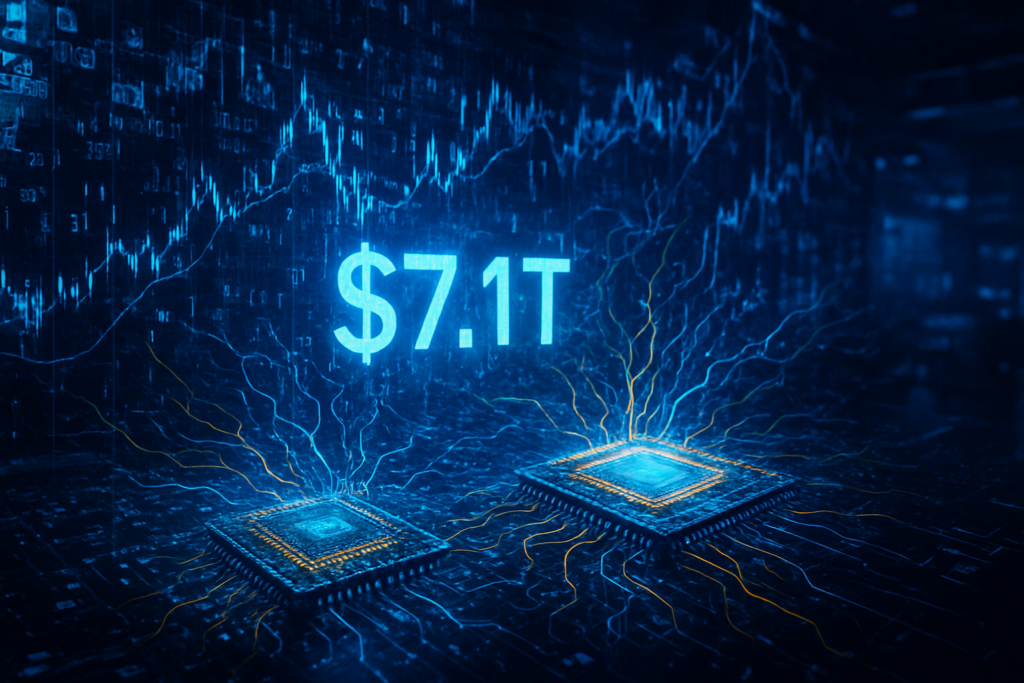
On December 19, 2025, the global financial markets braced for the largest derivatives expiration in history, a staggering $7.1 trillion "Options Cliff" that has sent shockwaves through the technology sector. This massive concentration of expiring contracts, coinciding with the year’s final "Triple Witching" event, has triggered a liquidity tsunami, disproportionately impacting the high-flying AI semiconductor stocks that have dominated the market narrative throughout the year. As trillions in notional value are unwound, industry leaders like Nvidia and AMD are finding themselves at the epicenter of a mechanical volatility storm that threatens to decouple stock prices from their underlying fundamental growth.
The sheer scale of this expiration is unprecedented, representing a 20% increase over the December 2024 figures and accounting for roughly 10.2% of the entire Russell 3000 market capitalization. For the AI sector, which has been the primary engine of the S&P 500’s gains over the last 24 months, the event is more than just a calendar quirk; it is a stress test of the market's structural integrity. With $5 trillion tied to S&P 500 contracts and nearly $900 billion in individual equity options reaching their end-of-life today, the "Witching Hour" has transformed the trading floor into a high-stakes arena of gamma hedging and institutional rebalancing.
The Mechanics of the Cliff: Gamma Squeezes and Technical Turmoil
The technical gravity of the $7.1 trillion cliff stems from the simultaneous expiration of stock options, stock index futures, and stock index options. This "Triple Witching" forces institutional investors and market makers to engage in massive rebalancing acts. In the weeks leading up to today, the AI sector saw a massive accumulation of "call" options—bets that stock prices would continue their meteoric rise. As these stocks approached key "strike prices," market makers were forced into a process known as "gamma hedging," where they must buy underlying shares to remain delta-neutral. This mechanical buying often triggers a "gamma squeeze," artificially inflating prices regardless of company performance.
Conversely, the market is also contending with "max pain" levels—the specific price points where the highest number of options contracts expire worthless. For NVIDIA (NASDAQ: NVDA), analysts at Goldman Sachs identified a max pain zone between $150 and $155, creating a powerful downward "gravitational pull" against its current trading price of approximately $178.40. This tug-of-war between bullish gamma squeezes and the downward pressure of max pain has led to intraday swings that veteran traders describe as "purely mechanical noise." The technical complexity is further heightened by the SKEW index, which remains at an elevated 155.4, indicating that institutional players are still paying a premium for "tail protection" against a sudden year-end reversal.
Initial reactions from the AI research and financial communities suggest a growing concern over the "financialization" of AI technology. While the underlying demand for Blackwell chips and next-generation accelerators remains robust, the stock prices are increasingly governed by complex derivative structures rather than product roadmaps. Citigroup analysts noted that the volume during this December expiration is "meaningfully higher than any prior year," distorting traditional price discovery mechanisms and making it difficult for retail investors to gauge the true value of AI leaders in the short term.
Semiconductor Giants Caught in the Crosshairs
Nvidia and Advanced Micro Devices (NASDAQ: AMD) have emerged as the primary casualties—and beneficiaries—of this volatility. Nvidia, the undisputed king of the AI era, saw its stock surge 3% in early trading today as it flirted with a massive "call wall" at the $180 mark. Market makers are currently locked in a battle to "pin" the stock near these major strikes to minimize their own payout liabilities. Meanwhile, reports that the U.S. administration is reviewing a proposal to allow Nvidia to export H200 AI chips to China—contingent on a 25% "security fee"—have added a layer of fundamental optimism to the technical churn, providing a floor for the stock despite the options-driven pressure.
AMD has experienced even more dramatic swings, with its share price jumping over 5% to trade near $211.50. This surge is attributed to a rotation within the semiconductor sector, as investors seek value in "secondary" AI plays to hedge against the extreme concentration in Nvidia. The activity around AMD’s $200 call strike has been particularly intense, suggesting that traders are repositioning for a broader AI infrastructure play that extends beyond a single dominant vendor. Other players like Micron Technology (NASDAQ: MU) have also been swept up in the mania, with Micron surging 10% following strong earnings that collided head-on with the Triple Witching liquidity surge.
For major AI labs and tech giants, this volatility creates a double-edged sword. While high valuations provide cheap capital for acquisitions and R&D, the extreme price swings can complicate stock-based compensation and long-term strategic planning. Startups in the AI space are watching closely, as the public market's appetite for semiconductor volatility often dictates the venture capital climate for hardware-centric AI innovations. The current "Options Cliff" serves as a reminder that even the most revolutionary technology is subject to the cold, hard mechanics of the global derivatives market.
A Perfect Storm: Macroeconomic Shocks and the 'Great Data Gap'
The 2025 Options Cliff is not occurring in a vacuum; it is being amplified by a unique set of macroeconomic circumstances. Most notable is the "Great Data Gap," a result of a 43-day federal government shutdown that lasted from October 1 to mid-November. This shutdown left investors without critical economic indicators, such as CPI and Non-Farm Payroll data, for over a month. In the absence of fundamental data, the market has become increasingly reliant on technical triggers and derivative-driven price action, making the December Triple Witching even more influential than usual.
Simultaneously, a surprise move by the Bank of Japan to raise interest rates to 0.75%—a three-decade high—has threatened to unwind the "Yen Carry Trade." This has forced some global hedge funds to liquidate positions in high-beta tech stocks, including AI semiconductors, to cover margin calls and rebalance portfolios. This convergence of a domestic data vacuum and international monetary tightening has turned the $7.1 trillion expiration into a "perfect storm" of volatility.
When compared to previous AI milestones, such as the initial launch of GPT-4 or Nvidia’s first trillion-dollar valuation, the current event represents a shift in the AI narrative. We are moving from a phase of "pure discovery" to a phase of "market maturity," where the financial structures surrounding the technology are as influential as the technology itself. The concern among some economists is that this level of derivative-driven volatility could lead to a "flash crash" scenario if the gamma hedging mechanisms fail to find enough liquidity during the final hour of trading.
The Road Ahead: Santa Claus Rally or Mechanical Reversal?
As the market moves past the December 19 deadline, experts are divided on what comes next. In the near term, many expect a "Santa Claus" rally to take hold as the mechanical pressure of the options expiration subsides, allowing stocks to return to their fundamental growth trajectories. The potential for a policy shift regarding H200 exports to China could serve as a significant catalyst for a year-end surge in the semiconductor sector. However, the challenges of 2026 loom large, including the need for companies to prove that their massive AI infrastructure investments are translating into tangible enterprise software revenue.
Long-term, the $7.1 trillion Options Cliff may lead to calls for increased regulation or transparency in the derivatives market, particularly concerning high-growth tech sectors. Analysts predict that "volatility as a service" will become a more prominent theme, with institutional investors seeking new ways to hedge against the mechanical swings of Triple Witching events. The focus will likely shift from hardware availability to "AI ROI," as the market demands proof that the trillions of dollars in market cap are backed by sustainable business models.
Final Thoughts: A Landmark in AI Financial History
The December 2025 Options Cliff will likely be remembered as a landmark moment in the financialization of artificial intelligence. It marks the point where AI semiconductors moved from being niche technology stocks to becoming the primary "liquidity vehicles" for the global financial system. The $7.1 trillion expiration has demonstrated that while AI is driving the future of productivity, it is also driving the future of market complexity.
The key takeaway for investors and industry observers is that the underlying demand for AI remains the strongest secular trend in decades, but the path to growth is increasingly paved with technical volatility. In the coming weeks, all eyes will be on the "clearing" of these $7.1 trillion in positions and whether the market can maintain its momentum without the artificial support of gamma squeezes. As we head into 2026, the real test for Nvidia, AMD, and the rest of the AI cohort will be their ability to deliver fundamental results that can withstand the mechanical storms of the derivatives market.
This content is intended for informational purposes only and represents analysis of current AI developments.
TokenRing AI delivers enterprise-grade solutions for multi-agent AI workflow orchestration, AI-powered development tools, and seamless remote collaboration platforms.
For more information, visit https://www.tokenring.ai/.