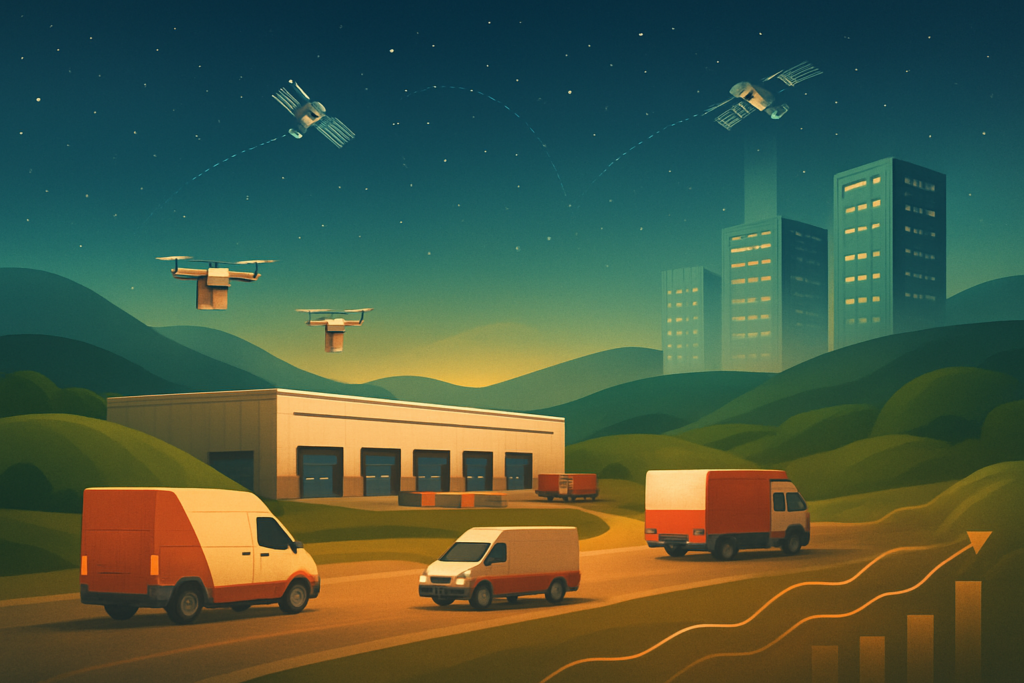
As of February 23, 2026, Amazon.com, Inc. (NASDAQ: AMZN) finds itself at a pivotal crossroads between legacy retail dominance and a future defined by orbital connectivity and generative artificial intelligence. While the company has long been a bellwether for consumer spending and cloud computing, today’s market focus has shifted toward a surprising fiscal windfall: a massive series of potential tariff refunds stemming from recent federal court rulings.
This development comes at a critical time. After a period of "Capex shock" following CEO Andy Jassy’s announcement of a record-breaking $200 billion investment cycle into AI infrastructure and satellite internet, the prospect of billions in returned duties provides a much-needed liquidity cushion. Today, we dive deep into the mechanics of the "Everything Store," analyzing whether its aggressive pivot into high-cost frontiers like the "Amazon Leo" satellite constellation and custom AI silicon justifies its current valuation in an increasingly complex geopolitical landscape.
Historical Background
Founded in 1994 by Jeff Bezos as an online bookstore operating out of a garage in Bellevue, Washington, Amazon has undergone one of the most significant corporate metamorphoses in history. What began as a disruptive force in publishing quickly expanded into a general merchandise "Everything Store," underpinned by a relentless focus on logistics and customer obsession.
The company’s true transformation, however, occurred in 2006 with the launch of Amazon Web Services (AWS). By monetizing its internal infrastructure, Amazon effectively invented the modern cloud computing industry. Over the subsequent two decades, the "Amazon Flywheel"—where low prices drive customer traffic, which attracts more third-party sellers, which further lowers prices—evolved. Today, the flywheel is powered by high-margin segments like advertising and AWS, which subsidize the capital-intensive retail and logistics operations that keep Amazon embedded in the daily lives of billions.
Business Model
Amazon’s business model is a sophisticated ecosystem of interlocking segments that feed one another:
- Online Stores & Third-Party Seller Services: The core retail engine. While thin-margined, it provides the massive data and traffic necessary for other segments.
- Amazon Web Services (AWS): The company’s primary profit engine. AWS provides on-demand cloud platforms to individuals, companies, and governments. By early 2026, it has become the backbone of the generative AI revolution.
- Advertising Services: A high-growth, high-margin segment that leverages Amazon’s "bottom-of-the-funnel" search data. This includes sponsored products and the now-fully-integrated ad-tier on Prime Video.
- Subscription Services: Primarily Amazon Prime, which serves as the "glue" for customer loyalty, offering shipping, streaming, and now AI-enhanced services like Alexa+.
- Physical Stores: Including Whole Foods Market and Amazon Fresh, serving as a beachhead for the company’s grocery and "Just Walk Out" technology ambitions.
Stock Performance Overview
Over the last decade, AMZN has been a cornerstone of the "Magnificent Seven," though its path has not been linear.
- 10-Year Horizon: Investors who held AMZN from 2016 through 2026 have seen returns exceeding 900%, vastly outperforming the S&P 500.
- 5-Year Horizon: The 2021–2026 period was marked by post-pandemic volatility. After reaching highs in late 2021, the stock weathered a significant downturn in 2022 before rallying on the back of AWS's AI re-acceleration in 2024 and 2025.
- 1-Year Horizon: The past twelve months have seen AMZN trade in a volatile range. Shares rallied significantly in late 2025 as AWS growth hit 24%, but faced a 10% "Capex dip" in early 2026 following the announcement of the $200 billion investment plan. Today, Feb 23, 2026, the stock is seeing renewed buy-side interest due to the tariff refund news.
Financial Performance
Amazon’s fiscal year 2025 results, reported in early 2026, showcased a company of immense scale:
- Total Revenue: $716.9 billion, a 12% year-over-year increase.
- AWS Revenue: $128.7 billion, showing a powerful 20% growth rate as enterprise cloud spending shifted toward AI.
- Operating Income: Reached $80.0 billion, with operating margins expanding to 11.2%, driven by fulfillment efficiencies and advertising growth.
- Free Cash Flow (FCF): Despite record earnings, FCF was pressured to $11.2 billion in 2025 due to the aggressive ramp-up in data center construction and satellite launches.
- Valuation: As of Feb 23, 2026, AMZN trades at a forward P/E of approximately 38x, a premium to the broader market but below its own historical 10-year average, reflecting a transition from "pure growth" to "growth at a reasonable price" (GARP).
Leadership and Management
Under CEO Andy Jassy, who succeeded Jeff Bezos in 2021, Amazon has moved from a period of unbridled expansion to one of rigorous operational discipline. Jassy has been credited with streamlining the fulfillment network into a regionalized model, which significantly lowered the cost-to-serve.
The management team—including CFO Brian Olsavsky and AWS CEO Matt Garman—is currently focused on the "Three Pillars of 2026":
- AI Ubiquity: Integrating generative AI (Rufus and Alexa+) into every consumer touchpoint.
- Infrastructure Dominance: Building out the "Amazon Leo" satellite network.
- Custom Silicon: Reducing reliance on third-party chipmakers (like NVIDIA) by scaling Trainium and Inferentia chips.
Products, Services, and Innovations
The Amazon of 2026 is no longer just an e-commerce platform; it is a technology stack.
- Amazon Leo (formerly Project Kuiper): With over 200 satellites in orbit as of Feb 2026, Amazon has begun "Enterprise Previews" of its satellite internet service. It promises downlink speeds of 1.8 Gbps, directly challenging SpaceX’s Starlink in the high-end enterprise and government markets.
- Alexa+: A subscription-based generative AI version of Alexa launched in early 2026. It serves as a personal concierge, capable of complex reasoning and proactive commerce (e.g., "Alexa, find me a gift for a 10-year-old who likes robotics and has it delivered by tomorrow").
- AWS Bedrock: This has become the industry standard for enterprise AI, allowing companies to build applications using a variety of foundational models with Amazon’s security and data privacy.
Competitive Landscape
Amazon faces multi-front warfare in 2026:
- Cloud (AWS): Microsoft (NASDAQ: MSFT) and Google (NASDAQ: GOOGL) remain the primary threats. Microsoft’s deep partnership with OpenAI has forced AWS to innovate faster in its model offerings.
- Retail: Walmart (NYSE: WMT) has successfully narrowed the gap in delivery speed and grocery dominance. Meanwhile, Chinese-backed platforms like Temu and Shein continue to pressure Amazon on the ultra-low-cost apparel and household goods front.
- Logistics: FedEx (NYSE: FDX) and UPS (NYSE: UPS) have pivoted to compete with Amazon’s last-mile delivery, though Amazon's internal logistics network remains the largest in the U.S.
Industry and Market Trends
Three macro trends are currently defining Amazon’s trajectory:
- The Generative AI "Second Wave": The shift from training models to deploying them at scale. Amazon is winning the "inference" race through its Inferentia chips.
- Near-Shoring and Trade Realignment: Global supply chains are moving away from China toward Mexico and Southeast Asia. Amazon’s logistics investments in these regions are now paying off.
- Ad-Supported Streaming: As consumers hit "subscription fatigue," Amazon’s pivot to ad-supported Prime Video has opened a massive new revenue stream that traditional retailers cannot match.
Risks and Challenges
- Capex Intensity: The $200 billion 2026 investment plan is a gamble. If AI adoption slows or the "Amazon Leo" network faces technical delays, the strain on the balance sheet could lead to credit rating pressure.
- Regulatory Scrutiny: The FTC and various international bodies continue to investigate Amazon’s dual role as both a platform and a seller. While some major antitrust hurdles were cleared in 2025, the threat of "structural separation" remains a tail-risk.
- Labor Relations: Pressure to unionize fulfillment centers in the U.S. and Europe remains high, potentially threatening the low-cost model of its logistics arm.
Opportunities and Catalysts
- Tariff Refunds (The Feb 23 Highlight): A series of rulings by the U.S. Court of International Trade has invalidated certain Section 301 tariffs applied to consumer goods imported between 2018 and 2024. As one of the world’s largest importers, Amazon (and its third-party sellers) could be eligible for billions in refunds. This is a massive, unexpected cash infusion that could offset 2026's heavy Capex.
- Healthcare Integration: Amazon Pharmacy and One Medical are beginning to see "Flywheel" effects, with Prime members increasingly using Amazon as their primary care and pharmacy provider.
Investor Sentiment and Analyst Coverage
Analyst sentiment as of February 2026 remains "Overweight" to "Strong Buy." Wall Street is largely looking past the current year's high spending, viewing it as a necessary price for 2030 dominance.
- Bull Case: Tariff refunds provide a $5B-$8B cash windfall; AWS growth accelerates beyond 25%; Amazon Leo becomes a viable $10B/year revenue stream by 2028.
- Bear Case: AI ROI (Return on Investment) fails to materialize in 2026; retail margins are squeezed by a resurgent Walmart and higher labor costs.
Regulatory, Policy, and Geopolitical Factors
The geopolitical landscape of 2026 is defined by "Trade Fluidity." The tariff refund story is a direct result of a shift in trade policy aimed at easing consumer inflation. However, the ongoing tech rivalry with China continues to create risks for Amazon’s "Amazon Leo" supply chain, which relies on specialized components that are subject to strict export controls. Furthermore, Amazon’s expansion into satellite internet puts it under the jurisdiction of the International Telecommunication Union (ITU), adding a layer of global regulatory complexity the company has never faced before.
Conclusion
Amazon.com, Inc. enters late February 2026 as a company that has successfully defended its cloud throne while doubling down on the next frontier of human connectivity. The "Capex Shock" of its $200 billion investment plan remains the primary concern for short-term investors, yet today’s news of potential tariff refunds acts as a significant stabilizing force.
For the long-term investor, Amazon represents a play on the infrastructure of the future. Whether it is the chips that run AI, the satellites that provide global internet, or the logistics network that delivers the world’s goods, Amazon is increasingly the "Operating System of Modern Life." Investors should closely watch the Q1 2026 earnings for the first concrete signs of "Amazon Leo" revenue and further updates on the billion-dollar tariff recovery process.
This content is intended for informational purposes only and is not financial advice.