The Power Behind the Processing: A Deep Dive into Bloom Energy (BE) in 2026
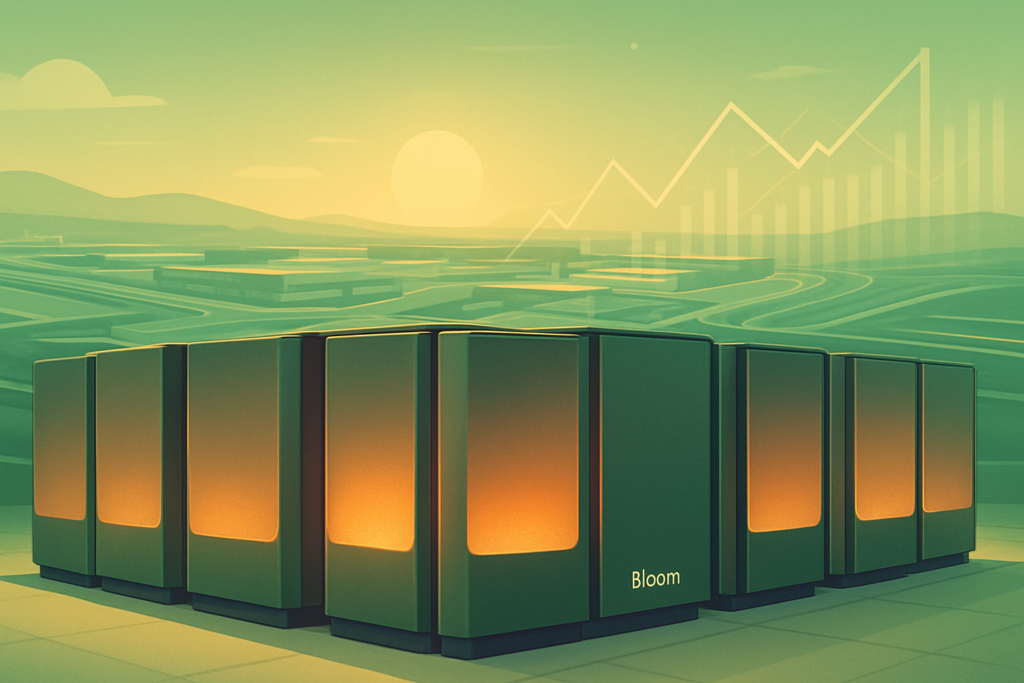
As of April 14, 2026, the global energy landscape is defined by a singular, overwhelming challenge: the insatiable power demand of Artificial Intelligence. In this high-stakes environment, Bloom Energy Corporation (NYSE: BE) has emerged as a critical infrastructure titan. Once viewed as a speculative clean-tech play, Bloom has successfully repositioned itself as the primary solution for the "grid gap"—the multi-year delay in traditional utility connections that threatens to stall the AI revolution.
By providing on-site, modular power that can be deployed in months rather than years, Bloom Energy has transformed from a fuel cell manufacturer into a strategic partner for the world’s largest hyperscalers and industrial giants. With a market capitalization now exceeding $50 billion and a backlog pushing toward $20 billion, the company stands at the intersection of energy security, technological innovation, and the global transition to a low-carbon economy.
Historical Background
Bloom Energy’s story began far from the data centers of Northern Virginia. Founded in 2001 by Dr. KR Sridhar, the company’s core technology—Solid Oxide Fuel Cell (SOFC)—was originally developed for NASA’s Mars exploration program. The goal was to create a device that could produce oxygen on Mars and fuel for the return trip; Sridhar eventually realized the process could be reversed to generate clean, reliable electricity on Earth.
After years in "stealth mode," Bloom launched publicly in 2010 with a star-studded list of early adopters including Google and Walmart. The company went public on the New York Stock Exchange in July 2018. The early years of its public life were marked by volatility as the company struggled with high manufacturing costs and a reliance on natural gas. However, the mid-2020s marked a radical transformation. By 2024, the "AI-Energy Nexus" became the company's primary tailwind, shifting the focus from simple backup power to essential, primary baseload generation for high-density computing.
Business Model
Bloom Energy’s business model is built on three distinct pillars that cater to the modern demand for "Energy-as-a-Service" (EaaS):
- Product Sales: The core of the business remains the Bloom Energy Server. These modular "Bloom Boxes" generate electricity through an electrochemical process without combustion. They are increasingly sold in massive multi-hundred-megawatt configurations to data centers and industrial hubs.
- Service and Maintenance: Given the 20-to-25-year lifespan of the fuel cells, Bloom generates recurring high-margin revenue through long-term service agreements (LTSAs). This segment provides a predictable cash flow buffer against the lumpy nature of hardware sales.
- Hydrogen and Electrolyzers: A more recent addition is the Solid Oxide Electrolyzer (SOEC). This technology allows Bloom to pivot into the hydrogen economy, selling equipment that produces "green" hydrogen for industrial processes and heavy shipping.
The company has also perfected its financing model through partnerships like the early 2026 $5 billion deal with Brookfield, allowing customers to pay for power over time rather than incurring massive upfront capital expenditures.
Stock Performance Overview
Bloom Energy’s stock performance has been a roller coaster for long-term holders, though the recent trend has been decisively upward.
- 1-Year Performance (2025–2026): Over the last 12 months, BE has outperformed the S&P 500 significantly, rising nearly 85%. This surge was driven by a string of "gigawatt-scale" announcements with Oracle and American Electric Power.
- 5-Year Performance (2021–2026): The five-year view shows a compound annual growth rate (CAGR) of approximately 22%. The stock spent much of 2022-2023 in a lull before the AI-driven re-rating of 2024 and 2025.
- 10-Year Performance: Since 2018 (IPO), the stock has moved from the $15–$25 range to its current trading price between $166 and $203.
While the volatility remains high compared to traditional utilities, Bloom is no longer traded as a "penny-stock" alternative energy name, but rather as a growth-tech infrastructure staple.
Financial Performance
The fiscal year 2025 was a watershed moment for Bloom Energy. For the first time in its history, the company achieved meaningful GAAP operating income.
- Revenue: FY 2025 revenue hit a record $2.02 billion, a 37.3% year-over-year increase.
- Margins: Gross margins have expanded to the 28-30% range as manufacturing efficiencies at the Fremont and Delaware facilities have taken hold.
- Backlog: The company enters Q2 2026 with a $20 billion backlog, providing unprecedented visibility into future revenue.
- Liquidity: Bolstered by the Brookfield financing partnership and a successful convertible note issuance in 2025, Bloom maintains a robust cash position to fund its transition from 1 GW to 2 GW of annual manufacturing capacity by the end of 2026.
- Earnings: Estimates for Q1 2026 suggest an EPS of $0.09 to $0.13, reinforcing the trend of consistent profitability.
Leadership and Management
Founder and CEO Dr. KR Sridhar remains the visionary heart of the company. In the early 2020s, Sridhar was criticized by some analysts for "over-promising," but his focus on the data center market has largely vindicated his long-term strategy.
The leadership team was significantly strengthened in 2024 and 2025 with the addition of executives from the semiconductor and utility sectors, reflecting Bloom's shift toward high-density power for chips. The board’s governance reputation has improved as the company moved away from the complex "special purpose vehicle" accounting that clouded its early years, opting for more transparent reporting standards that have earned the trust of institutional "long-only" funds.
Products, Services, and Innovations
The technological moat around Bloom Energy is built on its high-temperature Solid Oxide chemistry.
- SOFC Energy Servers: The current 2026 generation of servers is "800V DC-ready," allowing them to plug directly into AI server racks. This eliminates the 10-15% energy loss typical of AC-to-DC conversion in traditional data centers.
- The Electrolyzer (SOEC): Bloom’s electrolyzer is currently the most efficient on the market, operating at 80% electrical-to-hydrogen efficiency when paired with industrial waste heat.
- Carbon Capture Integration: In 2025, Bloom launched a pilot project that integrates carbon capture directly into the fuel cell exhaust, potentially making its natural gas-powered units "carbon neutral" even before a full transition to hydrogen.
Competitive Landscape
Bloom faces competition on two fronts: traditional power providers and other clean-tech firms.
- The Grid: Bloom’s biggest "competitor" is the local utility. In regions like Northern Virginia or West Texas, where the grid is overtaxed, Bloom wins by default because it can provide power years faster than the utility.
- Hydrogen Rivals: Plug Power (NASDAQ: PLUG) and Ballard Power Systems (NASDAQ: BLDP) are major competitors in the hydrogen space. However, Bloom’s SOFC technology is generally considered superior for stationary baseload power, while Plug dominates the mobility (forklift/trucking) sector.
- Traditional Back-up: Companies like Generac (NYSE: GNRC) compete in the backup space, but Bloom is increasingly viewed as a primary power source rather than just an emergency fail-safe.
Industry and Market Trends
The "AI-Energy Nexus" is the dominant trend of 2026. As AI models move from training to inference, the demand for "always-on" power has surpassed the capacity of many national grids. This has led to a shift toward "Microgrids" and "Distributed Generation"—precisely where Bloom specializes.
Furthermore, the "reshoring" of industry to the United States (the "New Industrialization") has created clusters of factories that require massive power in rural areas where the grid is weak. Bloom’s modularity allows these factories to scale power capacity as they build out their production lines.
Risks and Challenges
Despite the current euphoria, Bloom is not without significant risks:
- Fuel Price Volatility: Most Bloom servers still run on natural gas. While they can run on hydrogen or biogas, a spike in natural gas prices can narrow the "spark spread," making Bloom's power more expensive than grid power.
- Execution and Scaling: Attempting to double manufacturing capacity in a single year (2026 target) is a massive operational risk. Any quality control issues could be catastrophic for its reputation among hyperscalers.
- Equity Dilution: To fund its massive growth, Bloom has historically relied on issuing stock and convertible debt, which continues to be a point of contention for some retail investors.
Opportunities and Catalysts
- The Oracle Expansion: The April 2026 master agreement with Oracle for up to 2.8 GW of capacity is a transformative catalyst that could provide a revenue floor for years.
- Marine Shipping: Bloom is currently trialing SOFC units on large cargo ships to replace diesel generators, a multi-billion dollar addressable market that is barely tapped.
- Hydrogen Hubs: As the U.S. "Hydrogen Hubs" become operational in 2026-2027, Bloom's electrolyzer business is expected to see a secondary surge in orders.
Investor Sentiment and Analyst Coverage
Wall Street sentiment has undergone a dramatic "re-rating" in the last 18 months. Once treated as a high-risk "ESG" stock, Bloom is now covered by data center and industrial analysts.
- Ratings: The consensus is a "Moderate Buy." Out of 32 analysts, 13 have a "Strong Buy" rating.
- Institutional Moves: There has been a notable increase in ownership from "Quality" and "Growth" funds (e.g., BlackRock, Vanguard, and specialized infrastructure funds), moving away from the more flighty retail-dominated base of 2021.
- Price Targets: Median targets sit around $156, though "bull case" scenarios from firms like China Renaissance have pushed as high as $207 following the latest Oracle news.
Regulatory, Policy, and Geopolitical Factors
The regulatory environment in 2026 is dominated by the "One Big Beautiful Bill" (OBBB), the massive 2025 legislative overhaul that refined the incentives of the 2022 Inflation Reduction Act. Bloom has successfully navigated these changes by reshoring its entire supply chain, ensuring it meets the strict 2026 Foreign Entity of Concern (FEOC) rules to qualify for maximum tax credits.
However, the looming July 4, 2026, deadline for "commencing construction" on several federal hydrogen projects remains a key date for investors to watch, as any delays could jeopardize certain tax credit eligibilities.
Conclusion
Bloom Energy (NYSE: BE) has reached a critical inflection point. In 2026, the company is no longer a "future" story; it is a "now" story. By solving the immediate power crisis facing the AI industry, Bloom has secured a place as a foundational player in the modern economy.
For investors, the case for Bloom is a bet on the continued decoupling of power generation from the traditional centralized grid. While risks regarding fuel costs and execution remain, the company’s massive backlog, newfound profitability, and "poster child" status in the AI-Energy Nexus make it one of the most compelling, albeit high-beta, stories in the industrial tech sector today.
This content is intended for informational purposes only and is not financial advice. Note: Current date is April 14, 2026.
If you believe this article contains misleading, harmful, or spam content, please let us know.
Report this articleMore News
View More


Recent Quotes
View MoreQuotes delayed at least 20 minutes.
By accessing this page, you agree to the Privacy Policy and Terms Of Service.