Beyond the Next Token: How OpenAI’s ‘Strawberry’ Reasoning Revolutionized Artificial General Intelligence
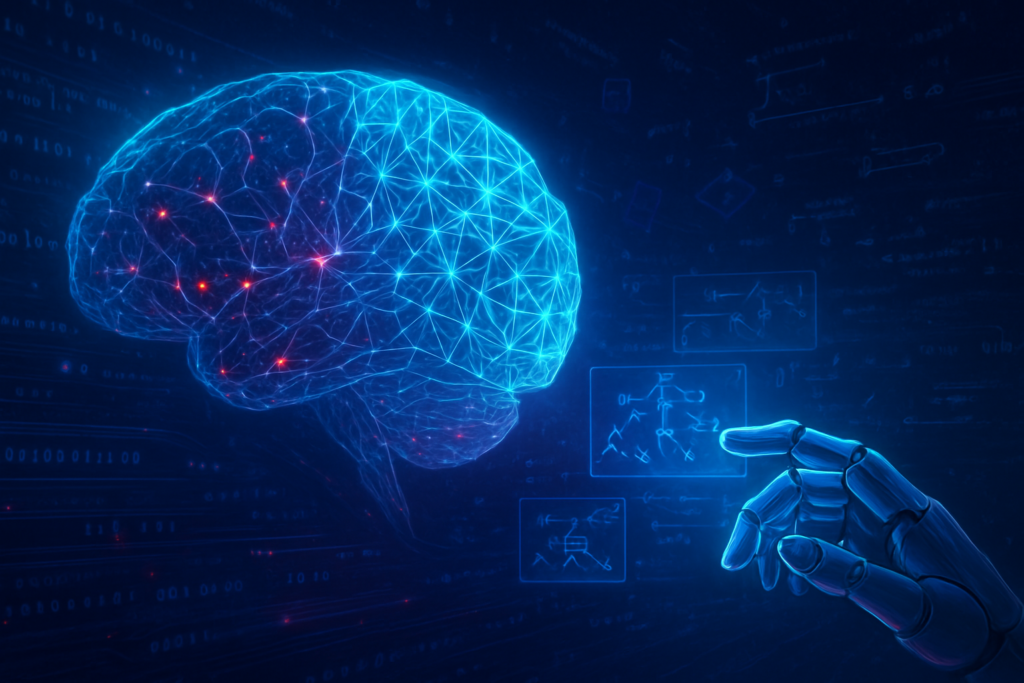
In a watershed moment for the artificial intelligence industry, OpenAI has fundamentally shifted the paradigm of machine intelligence from statistical pattern matching to deliberate, "Chain of Thought" (CoT) reasoning. This evolution, spearheaded by the release of the o1 model series—originally codenamed "Strawberry"—has bridged the gap between conversational AI and functional problem-solving. As of early 2026, the ripple effects of this transition are being felt across every sector, from academic research to the highest levels of U.S. national security.
The significance of the o1 series lies in its departure from the "predict-the-next-token" architecture that defined the GPT era. While traditional Large Language Models (LLMs) often hallucinate or fail at multi-step logic because they are essentially "guessing" the next word, the o-series models are designed to "think" before they speak. By implementing test-time compute scaling—where the model allocates more processing power to a problem during the inference phase—OpenAI has enabled machines to navigate complex decision trees, recognize their own logical errors, and arrive at solutions that were previously the sole domain of human PhDs.
The Architecture of Deliberation: Chain of Thought and Test-Time Compute
The technical breakthrough behind o1 involves a sophisticated application of Reinforcement Learning (RL). Unlike previous iterations that relied heavily on human feedback to mimic conversational style, the o1 models were trained to optimize for the accuracy of their internal reasoning process. This is manifested through a "Chain of Thought" (CoT) mechanism, where the model generates a private internal monologue to parse a problem before delivering a final answer. By rewarding the model for correct outcomes in math and coding, OpenAI successfully taught the AI to backtrack when it hits a logical dead end, a behavior remarkably similar to human cognitive processing.
Performance metrics for the o1 series and its early 2026 successors, such as the o4-mini and the ultra-efficient GPT-5.3 "Garlic," have shattered previous benchmarks. In mathematics, the original o1-preview jumped from a 13% success rate on the American Invitational Mathematics Examination (AIME) to over 80%; by January 2026, the o4-mini has pushed that accuracy to nearly 93%. In the scientific realm, the models have surpassed human experts on the GPQA Diamond benchmark, a test specifically designed to challenge PhD-level researchers in chemistry, physics, and biology. This leap suggests that the bottleneck for AI is no longer the volume of data, but the "thinking time" allocated to processing it.
Market Disruption and the Multi-Agent Competitive Landscape
The arrival of reasoning models has forced a radical strategic pivot for tech giants and AI startups alike. Microsoft (NASDAQ: MSFT), OpenAI's primary partner, has integrated these reasoning capabilities deep into its Azure AI foundry, providing enterprise clients with "Agentic AI" that can manage entire software development lifecycles rather than just writing snippets of code. This has put immense pressure on competitors like Alphabet Inc. (NASDAQ: GOOGL) and Meta Platforms, Inc. (NASDAQ: META). Google responded by accelerating its Gemini "Ultra" reasoning updates, while Meta took a different route, releasing Llama 4 with enhanced logic gates to maintain its lead in the open-source community.
For the startup ecosystem, the o1 series has been both a catalyst and a "moat-killer." Companies that previously specialized in "wrapper" services—simple tools built on top of LLMs—found their products obsolete overnight as OpenAI’s models gained the native ability to reason through complex workflows. However, new categories of startups have emerged, focusing on "Reasoning Orchestration" and "Inference Infrastructure," designed to manage the high compute costs associated with "thinking" models. The shift has turned the AI race into a battle over "inference-time compute," with specialized chipmakers like NVIDIA (NASDAQ: NVDA) seeing continued demand for hardware capable of sustaining long, intensive reasoning cycles.
National Security and the Dual-Use Dilemma
The most sensitive chapter of the o1 story involves its implications for global security. In late 2024 and throughout 2025, OpenAI conducted a series of high-level demonstrations for U.S. national security officials. These briefings, which reportedly focused on the model's ability to identify vulnerabilities in critical infrastructure and assist in complex threat modeling, sparked an intense debate over "dual-use" technology. The concern is that the same reasoning capabilities that allow a model to solve a PhD-level chemistry problem could also be used to assist in the design of chemical or biological weapons.
To mitigate these risks, OpenAI has maintained a close relationship with the U.S. and UK AI Safety Institutes (AISI), allowing for pre-deployment testing of its most advanced "o-series" and GPT-5 models. This partnership was further solidified in early 2025 when OpenAI’s Chief Product Officer, Kevin Weil, took on an advisory role with the U.S. Army. Furthermore, a strategic partnership with defense tech firm Anduril Industries has seen the integration of reasoning models into Counter-Unmanned Aircraft Systems (CUAS), where the AI's ability to synthesize battlefield data in real-time provides a decisive edge in modern electronic warfare.
The Horizon: From o1 to GPT-5 and Beyond
Looking ahead to the remainder of 2026, the focus has shifted toward making these reasoning capabilities more efficient and multimodal. The recent release of GPT-5.2 and the "Garlic" (GPT-5.3) variant suggests that OpenAI is moving toward a future where "thinking" is not just for high-stakes math, but is a default state for all AI interactions. We are moving toward "System 2" thinking for AI—a concept from psychology referring to slow, deliberate, and logical thought—becoming as fast and seamless as the "System 1" (fast, intuitive) responses of the original ChatGPT.
The next frontier involves autonomous tool use and sensory integration. The o3-Pro model has already demonstrated the ability to conduct independent web research, execute Python code to verify its own hypotheses, and even generate 3D models within its "thinking" cycle. Experts predict that the next 12 months will see the rise of "reasoning-at-the-edge," where smaller, optimized models will bring PhD-level logic to mobile devices and robotics, potentially solving the long-standing challenges of autonomous navigation and real-time physical interaction.
A New Era in the History of Computing
The transition from pattern-matching models to reasoning engines marks a definitive turning point in AI history. If the original GPT-3 was the "printing press" moment for AI—democratizing access to generated text—then the o1 "Strawberry" series is the "scientific method" moment, providing a framework for machines to actually verify and validate the information they process. It represents a move away from the "stochastic parrot" critique toward a future where AI can be a true collaborator in human discovery.
As we move further into 2026, the key metrics to watch will not just be token speed, but "reasoning quality per dollar." The challenges of safety, energy consumption, and logical transparency remain significant, but the foundation has been laid. OpenAI's gamble on Chain of Thought processing has paid off, transforming the AI landscape from a quest for more data into a quest for better thinking.
This content is intended for informational purposes only and represents analysis of current AI developments.
TokenRing AI delivers enterprise-grade solutions for multi-agent AI workflow orchestration, AI-powered development tools, and seamless remote collaboration platforms.
For more information, visit https://www.tokenring.ai/.
If you believe this article contains misleading, harmful, or spam content, please let us know.
Report this articleMore News
View More




Recent Quotes
View MoreQuotes delayed at least 20 minutes.
By accessing this page, you agree to the Privacy Policy and Terms Of Service.