India’s Year-End Resurgence: Sensex and Nifty Reclaim Emerging Market Crown as 2025 Closes
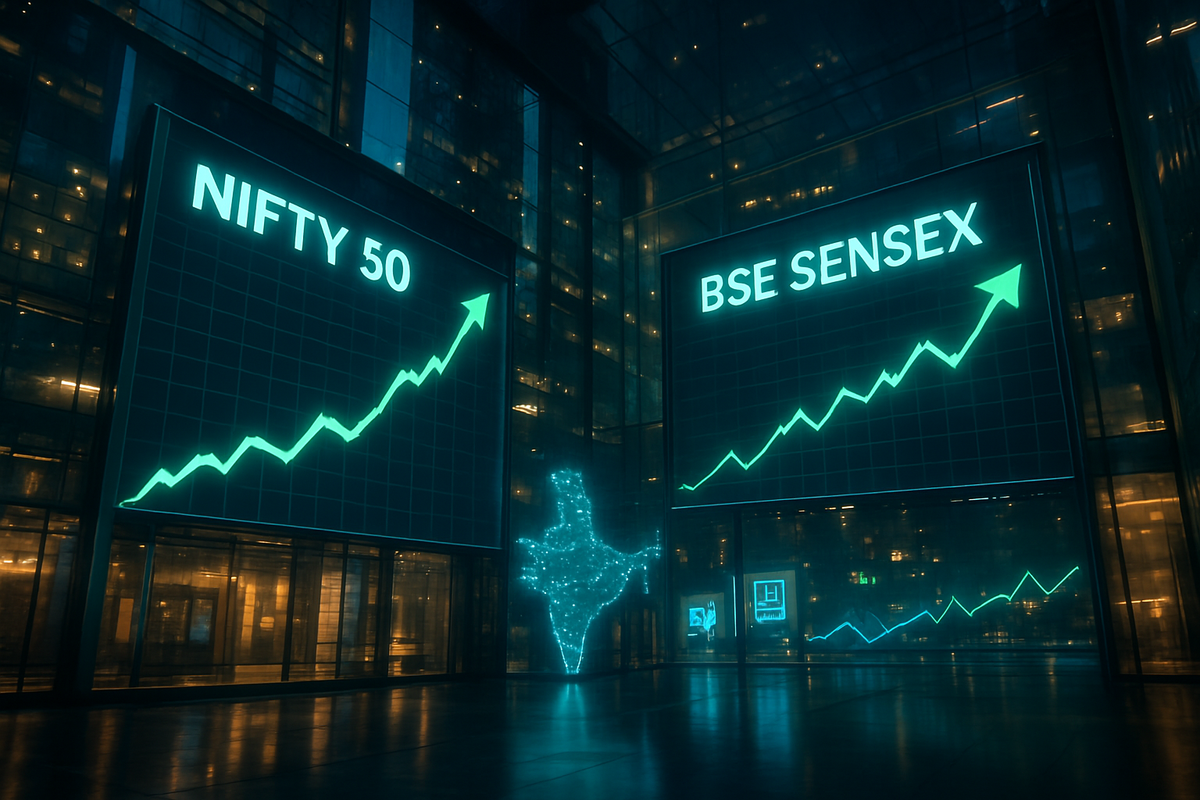
As the final trading sessions of 2025 unfold, the Indian equity markets have staged a dramatic year-end rally, positioning the BSE Sensex and Nifty 50 as the premier performers among major emerging markets (EMs). While much of 2025 was defined by a painful valuation correction and significant foreign fund outflows, the month of December has witnessed a "Great Pivot." Driven by a combination of landmark tax reforms, a stabilizing rupee, and a massive influx of domestic liquidity, Indian indices are ending the year near record highs, effectively decoupling from the volatility seen in other EM peers like China and Brazil.
The immediate implications of this late-year surge are profound. By December 22, 2025, the Nifty 50 has climbed back to the 26,100 level, while the BSE Sensex is hovering near 85,500. This recovery has restored confidence among Foreign Institutional Investors (FIIs), who had largely abandoned the Indian market earlier in the year in favor of cheaper valuations in North Asia. The shift marks a transition from a market driven by speculative fervor to one anchored by structural stability and the most robust GDP growth profile in the G20.
The December Breakout: GST 2.0 and the Return of the FIIs
The primary catalyst for this year-end outperformance was the successful implementation of "GST 2.0" in late September 2025. This overhaul simplified India’s complex tax structure into three streamlined slabs—5%, 18%, and 40%—while introducing AI-driven real-time invoice matching. The reform significantly lowered the tax burden on mass-consumption goods, moving many items from the 28% luxury bracket to the 18% standard rate. This move not only cooled inflation but also provided a massive boost to corporate margins, which had been squeezed by high input costs throughout the first half of the year.
The timeline leading to this moment was fraught with tension. Between October 2024 and mid-2025, the Indian market faced its worst relative underperformance in decades as the "China Stimulus" trade sucked liquidity out of South Asia. However, as the stimulus-led rally in China began to fizzle in Q4 2025 due to persistent deflationary pressures, global fund managers pivoted back to India. The return of FIIs in December—who turned net buyers for the first time in months—coincided with the Indian Rupee stabilizing in the 89.30–89.60 range against the US Dollar, following a record low of 91.14 earlier in the month.
Domestic Institutional Investors (DIIs) remained the unsung heroes of this bull run. Throughout the volatility of 2025, monthly Systematic Investment Plan (SIP) inflows surged past ₹29,000 crore, creating a permanent floor for the market. This domestic "wall of money" allowed the Indian market to absorb over $20 billion in foreign selling earlier in the year, setting the stage for the explosive year-end recovery once global sentiment turned positive.
Corporate Winners: The Dominance of Airtel and the Resilience of Trent
In the corporate arena, Bharti Airtel (NSE: BHARTIARTL) has emerged as a undisputed champion of 2025. The telecom giant’s stock has surged over 30% this year, fueled by a successful ₹157 billion rights issue that brought the company to the brink of "net debt-free" status. Airtel’s strategy of "monetization through quality" bore fruit in late 2025, with 5G traffic accounting for over 40% of its network load. A strategic 15% tariff hike implemented in early December further bolstered its Average Revenue Per User (ARPU) to an industry-leading ₹256, making it a favorite for institutional investors seeking defensive growth.
Meanwhile, Trent Ltd (NSE: TRENT) has provided a masterclass in retail expansion and recovery. Although the stock faced a significant "re-rating" dip mid-year due to high valuations, it has become a top gainer in the December rally. The company’s value-fashion brand, Zudio, officially became a $1 billion revenue brand in 2025, operating over 800 stores across the country. By the close of the year, Trent’s ability to maintain high margins while expanding its footprint has silenced critics, with its "Emerging Categories" like beauty and footwear now contributing more than 20% of its total top line.
Other notable winners include the banking sector, led by HDFC Bank (NYSE: HDB | NSE: HDFCBANK), which saw a revival in credit growth following the festive season. Conversely, the losers in this late-2025 landscape have been companies heavily reliant on low-end exports and those in the traditional IT services sector that failed to pivot quickly enough to generative AI integration, as the market increasingly discriminates between "growth" and "legacy" business models.
Wider Significance: A Structural Decoupling from the EM Pack
India’s performance at the close of 2025 is not merely a technical bounce; it represents a fundamental shift in how the global financial community views the "Emerging Markets" asset class. Historically, India moved in lockstep with the MSCI Emerging Markets Index. However, in 2025, India’s GDP growth of 7.0% stood in stark contrast to the stagnation in Russia and the erratic, stimulus-dependent recovery in China. The "China+1" manufacturing strategy has moved from a boardroom slogan to a tangible reality, with the Production Linked Incentive (PLI) schemes driving a surge in high-tech manufacturing.
The regulatory environment has also played a crucial role. The Securities and Exchange Board of India (SEBI) introduced new measures in 2025 to curb excessive volatility in the derivatives segment, which many analysts believe has funneled more retail capital into long-term cash equities. This shift toward a more "disciplined" market has reduced the "India Premium" to more sustainable levels, making the Sensex and Nifty more attractive to value-oriented global funds that previously viewed the market as overpriced.
Furthermore, the implementation of the "Digital Public Infrastructure" (DPI) 3.0 has further formalized the economy. By late 2025, the seamless integration of credit and digital identity has allowed small and medium enterprises (SMEs) to access capital at unprecedented speeds, feeding into the broader earnings growth of the listed financial and consumer sectors. This structural backbone is a differentiator that other EMs, currently struggling with aging demographics or political instability, have found difficult to replicate.
The Road Ahead: 2026 and the New Normal
Looking toward 2026, the short-term outlook remains bullish but requires a strategic pivot toward "quality at a reasonable price." With the Reserve Bank of India (RBI) expected to maintain a neutral-to-dovish stance as inflation settles into the 4% range, the cost of capital for Indian corporates is likely to remain stable. However, the market will face challenges if global oil prices spike or if trade tensions between the US and its major partners intensify, which could impact the Indian Rupee’s hard-won stability.
The long-term scenario for the Indian market is increasingly viewed through the lens of "The Indian Decade." Analysts expect the Nifty 50 to target the 30,000 milestone by 2027, provided that the current pace of infrastructure spending and tax simplification continues. For investors, the opportunity lies in sectors that are beneficiaries of the "GST 2.0" efficiency gains—specifically logistics, organized retail, and high-end manufacturing. The challenge will be navigating the high P/E ratios that still characterize the Indian market compared to its peers.
Closing Thoughts for the 2025 Investor
As we wrap up 2025, the key takeaway is that the Indian stock market has matured into a resilient, domestic-driven powerhouse that can withstand significant global headwinds. The year-end outperformance of the Sensex and Nifty is a testament to the country's internal consumption story and the success of its digital and tax reforms. While the journey through 2025 was volatile, the destination has been a market that is more structurally sound and less dependent on the whims of global "hot money."
Moving forward, investors should keep a close watch on the quarterly earnings of the retail and telecom sectors to see if the momentum of Trent Ltd (NSE: TRENT) and Bharti Airtel (NSE: BHARTIARTL) can be sustained. The "India Story" is no longer just about potential; it is about the consistent delivery of earnings growth in a world where such growth is increasingly scarce. As the 2026 calendar approaches, the Indian market stands as a beacon of stability in an otherwise uncertain emerging market landscape.
This content is intended for informational purposes only and is not financial advice
More News
View More




Recent Quotes
View MoreQuotes delayed at least 20 minutes.
By accessing this page, you agree to the Privacy Policy and Terms Of Service.