Santa Claus Rally 2025: S&P 500 Defies Volatility to Close Near Record Highs on Institutional Resilience
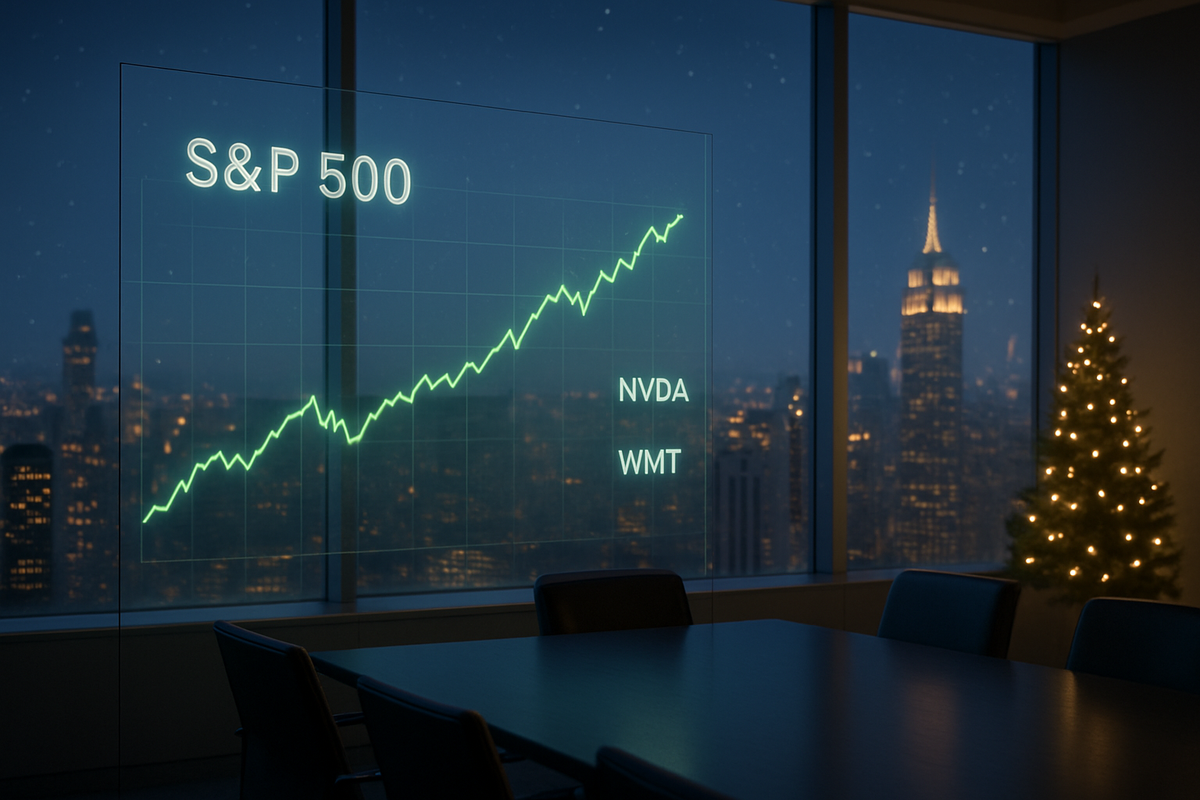
As the sun sets on a tumultuous yet transformative 2025, the financial markets are entering their final trading sessions with a sense of quiet confidence. As of December 22, 2025, the S&P 500 (NYSE: SPY) is navigating the traditional "Santa Claus Rally" period with characteristic low volume, yet it remains remarkably resilient, hovering near the 6,834 mark. This steady climb follows a year defined by a historic 43-day government shutdown and a massive "AI bubble scare" in the spring, signaling that institutional investors are opting for a "risk-on" posture heading into the new year.
The immediate implication of this year-end resilience is a bolstering of the "soft landing" narrative that has dominated Wall Street discourse for months. With the Federal Reserve having delivered its third consecutive interest rate cut on December 10—bringing the federal funds rate to a range of 3.50%–3.75%—the liquidity injection has provided a much-needed safety net. While trading desks are sparsely staffed during this holiday week, the absence of selling pressure suggests that the market has successfully digested the year's geopolitical shocks and is now "priced for perfection" as it eyes the 7,000 milestone for early 2026.
The Final Push: A Year of Recovery and Rate Cuts
The S&P 500’s current trajectory is the culmination of a dramatic recovery that began in mid-November, immediately following the resolution of the longest government shutdown in U.S. history. That 43-day impasse had threatened to derail the economy, but the subsequent "reopening rally" has seamlessly transitioned into the year-end seasonal pattern. Historically, the Santa Claus Rally—comprising the last five trading days of December and the first two of January—sees the market rise about 1.3% on average. This year, the rally appears to have started early, fueled by the Federal Open Market Committee's (FOMC) dovish pivot earlier this month.
Key players in this year-end stability include major institutional asset managers who have been "window dressing" their portfolios by adding exposure to the year’s high-quality winners. Unlike the speculative frenzy of 2023 and 2024, the late 2025 market is characterized by a "quality and infrastructure" rotation. Investors are no longer just betting on software promises; they are rewarding companies that provide the physical backbone of the digital economy. The market's reaction to the December rate cut was one of relief, as Chair Jerome Powell signaled that while the Fed remains vigilant about "sticky" inflation at 2.7%, the priority has shifted toward supporting a cooling labor market.
Winners and Losers of the 2025 Resilience
The 2025 market has been a story of stark contrasts, with a clear divide between those who capitalized on the "AI Infrastructure" boom and those caught in the crosshairs of shifting consumer habits. Nvidia Corp (NASDAQ: NVDA) remains the undisputed heavyweight champion, reaching a historic $5 trillion market cap in October. Despite a massive scare in January, NVDA has surged 62% this year, with CEO Jensen Huang noting that demand for their Blackwell chips remains "off the charts" as the year closes. Joining the winner's circle is the newly independent SanDisk (NASDAQ: SNDK), which, following its spin-off from Western Digital (NASDAQ: WDC) earlier this year, became the S&P 500’s top performer with a staggering 560% year-to-date gain, driven by an insatiable demand for AI server storage.
On the retail front, Walmart Inc. (NYSE: WMT) has emerged as a defensive powerhouse, hitting all-time highs of approximately $114 per share. Walmart’s ability to capture market share from both high- and low-income households has allowed it to outperform the broader index by nearly 30%. Conversely, Amazon.com Inc. (NASDAQ: AMZN) has been a notable laggard, remaining essentially flat for the year. While its AWS division continues to thrive, Amazon’s retail margins were squeezed by 2025's global trade tensions and tariff-driven inflation, leading investors to favor the "purer" retail play of Walmart. Similarly, Costco Wholesale Corp. (NASDAQ: COST) saw its stock dip about 6% as its valuation multiples finally faced a long-awaited "reset" from historical highs.
A Structural Shift in the Market Landscape
The resilience of the S&P 500 at the end of 2025 is more than just a seasonal quirk; it represents a fundamental shift in how the market values growth. The "speculative AI" phase of previous years has evolved into an "AI Power and Storage" phase. This is evident in the performance of energy stocks like Constellation Energy Corp (NASDAQ: CEG), which gained 45% this year after securing massive nuclear power contracts to fuel data centers for the likes of Microsoft and Meta. This trend highlights a broader industry ripple effect: the tech sector is now inextricably linked to the utility and infrastructure sectors, creating a new "Industrial Tech" hybrid asset class.
Historically, this year-end behavior mirrors the "climbing a wall of worry" seen in late 2018 and 2023, where markets shrugged off political instability in favor of fundamental earnings growth. However, the regulatory environment of 2025 adds a new layer of complexity. With ongoing scrutiny of trade policies and the looming transition in Federal Reserve leadership as Jerome Powell’s term nears its 2026 expiration, the current stability is underpinned by a "wait-and-see" approach from policymakers. This has created a goldilocks environment for mid-cap infrastructure firms like MasTec Inc. (NYSE: MTZ), which have thrived as the primary contractors for the nation’s grid modernization.
Looking Ahead: The 2026 Outlook
As we move into the first quarter of 2026, the primary question for investors is whether this resilience can be sustained without the aid of further aggressive rate cuts. The "dot plot" from the Fed suggests a pause may be on the horizon, which could lead to a "digestion phase" for the market in early spring. Strategic pivots will likely be required as the "Magnificent Seven" trade continues to narrow. Investors are expected to shift further into "Value and Quality" names that can withstand a potential uptick in unemployment, which currently sits at a delicate 4.5%.
The most significant challenge for 2026 will be the "priced for perfection" valuations. With the S&P 500's trailing P/E ratio near 26x, there is little room for error in the upcoming Q4 earnings season. However, the projected double-digit earnings growth of 14-15% for 2026 provides a bullish backdrop. Market opportunities may emerge in the "laggards of 2025," such as Amazon or the broader renewable energy sector, should trade tensions ease and the "AI infrastructure" build-out move into its next phase of software implementation.
The Year-End Wrap-Up
The final trading days of 2025 have solidified a narrative of institutional endurance. Despite a year that included a record-breaking government shutdown and persistent "sticky" inflation, the S&P 500 has proven its ability to weather systemic shocks. The key takeaway for investors is the importance of "quality" over "hype." The 2025 rally was not driven by memes or dreams, but by companies like Palantir Technologies (NYSE: PLTR) and Micron Technology (NASDAQ: MU) delivering tangible results in the AI and data sectors.
Moving forward, the market appears to be in a healthy, albeit expensive, position. The resilience seen this December suggests that the "soft landing" has been achieved, even if it remains "fragile." In the coming months, investors should keep a close eye on the Federal Reserve’s leadership transition and the impact of late-2025 tariffs on consumer spending. While the Santa Claus Rally may provide a festive end to the year, the true test will be the market's ability to maintain its momentum as the liquidity-driven tailwinds of 2025 begin to fade in the face of a new economic reality.
This content is intended for informational purposes only and is not financial advice.
More News
View More



Recent Quotes
View MoreQuotes delayed at least 20 minutes.
By accessing this page, you agree to the Privacy Policy and Terms Of Service.