iRobot Just Filed for Bankruptcy. What Does That Mean for IRBT Stock? And Why Have Investors Been Chasing Shares Higher?
By:
Barchart.com
December 18, 2025 at 15:52 PM EST
iRobot’s stock (IRBT) has delivered one of the most dramatic and confusing moves in the market in recent weeks. Shares of the Roomba maker staged a stunning rally in early December, surging several hundred percent in a matter of days as retail traders piled in, betting on a classic short squeeze. For a brief moment, IRBT looked like the latest meme-stock revival, drawing comparisons to GameStop (GME) and other speculative favorites from prior market frenzies. But that rally collided head-on with a harsh reality. Over the weekend, iRobot filed for Chapter 11 bankruptcy protection, confirming just how deeply the company’s business has deteriorated after years of intensifying competition from Chinese rivals and rising costs linked to tariffs. The filing marked a stunning fall for a company that once dominated the global robot vacuum market and helped define an entire consumer electronics category. More Top Stocks Daily: Go behind Wall Street’s hottest headlines with Barchart’s Active Investor newsletter.
So, what does iRobot’s bankruptcy actually mean for IRBT stock? Let’s dive in! About iRobot StockiRobot was founded in 1990 by three engineers from the Massachusetts Institute of Technology (MIT). The company initially focused on defense and space projects before rolling out the Roomba robotic vacuum in 2002. Since then, it has been engaged in designing, building, and selling home robots and other home innovation products. Its product lineup features the Roomba Combo 10 Max, which combines vacuuming and mopping with an AutoWash Dock for automatic maintenance. The company also provides a range of accessories and service plans. Shares of the consumer robotics company have struggled in 2025, weighed down by intense overseas competition and U.S. tariffs. IRBT stock had shed roughly 45% of its value year-to-date (YTD) as of last Friday’s close. And on Monday, the stock cratered more than 72% after the company filed for Chapter 11 bankruptcy protection. The selloff extended into Tuesday, but the stock then spiked over 21% on Wednesday amid speculative retail buying… just to crater double digits again today, Thursday. IRBT currently sits down 92% YTD. 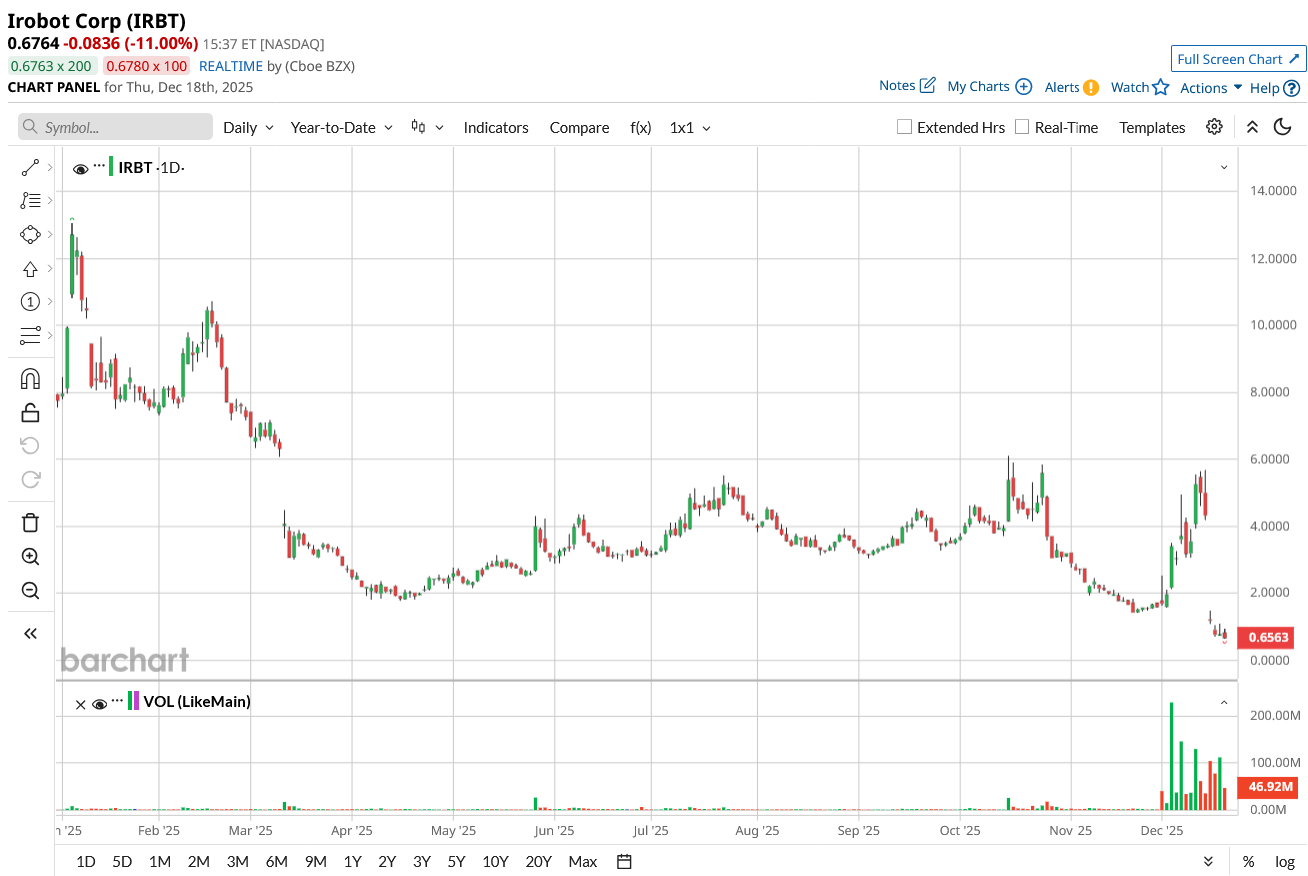
iRobot’s Final Chapter: A Chinese TakeoverOn Sunday, iRobot filed for bankruptcy protection and said it will hand over its business to two Chinese companies and go private, marking the culmination of a years-long fall from grace. The company, which warned in March about its ability to remain a going concern, filed for Chapter 11 protection in Delaware bankruptcy court as it faces intensifying competition from lower-priced rivals and new U.S. tariffs. The company said it had entered into a restructuring agreement under which iRobot will be acquired by its main lender and manufacturing partner, Shenzhen Picea Robotics Co., along with a subsidiary of the Chinese firm. In a filing, iRobot reported between $100 million and $500 million in assets and liabilities. “Today’s announcement marks a pivotal milestone in securing iRobot’s long-term future,” said iRobot’s Chief Executive Officer, Gary Cohen, in a statement. “The transaction will strengthen our financial position and will help deliver continuity for our consumers, customers, and partners.” Under the bankruptcy plan, Picea will acquire 100% of the company’s equity and forgive the remaining $190 million from the 2023 loan, along with an additional $74 million in debt that iRobot owes under the companies’ manufacturing agreement. The company said other creditors and suppliers will be paid in full. The company expects to complete the prepackaged Chapter 11 process by February 2026. iRobot stated that the bankruptcy is not expected to impact its app functionality, customer programs, global partnerships, supply chain relationships, or product support. The Rise and Fall of iRobotiRobot started back in 1990. Some MIT robotic experts, Rodney Brooks, Colin Angle, and Helen Greiner, got it going. At the beginning, they worked on some pretty serious stuff, like building rovers for NASA and robots like the PackBot for the U.S. military. Then, in 2002, they released the Roomba, and that totally changed the game, pioneering a new category, that of consumer robots. Between 2005 and 2012, the company also rolled out products such as the Scooba for floor washing, the Looj for gutter cleaning, and the Verro for pool cleaning. In 2015, the company introduced the Roomba 980, its first robot to feature cloud connectivity and visual mapping (vSLAM). Six years later, it brought out the j7+, which could detect pet waste. By 2021, iRobot had become a global titan. The company’s annual revenue climbed to nearly $1.6 billion because everyone was buying electronics for their homes during the pandemic. They sold over 40 million units worldwide. At its peak, iRobot commanded roughly 60% of the global market share by value, and it seemed like they couldn’t be beat. However, things really started changing around 2021. iRobot began losing ground fast because Chinese companies like Roborock, Dreame, and Ecovacs entered the market with advanced features like LiDAR navigation, technology iRobot did not adopt until its 2025 lineup, at much lower prices. An unofficial beginning of the end arrived in August 2022, when Amazon (AMZN) announced a $1.7 billion deal to acquire the company. For iRobot, the deal was seen as a crucial lifeline to counter fast-follower competitors from China, while for Amazon, it was a key to the smart home ecosystem. However, Amazon abandoned its plans to acquire the company in January 2024, citing regulatory pushback from the European Union. Media reports at the time also indicated that the U.S. Federal Trade Commission was prepared to sue to block the deal. Tariffs were another factor that played a role in iRobot’s downfall. The company anticipated “tariff uncertainty with China” and shifted much of the production of its U.S.-bound robots to Vietnam, according to court filings. However, earlier this year, the country was slapped with a 46% levy under President Donald Trump’s reciprocal tariffs on U.S. trading partners. Although the levy was reduced to 20% after the two countries reached a trade deal, the added costs continued to weigh on the company. iRobot said in court filings that tariffs increased its costs by $23 million in 2025, complicating its ability to plan for the future. What Comes Next for IRBT Stock?IRBT stock staged a massive rally in early December, jumping from about $1.40 to as high as $5.24, a move driven by short-term retail interest as traders viewed the company as an attractive short-squeeze target. The classic short-squeeze playbook is relatively simple: retail traders find a stock with high short interest and begin buying it aggressively, aiming to force short sellers to cover their positions, which in turn fuels further upward momentum. Ideally, this should be reinforced by a compelling narrative or a sense of brand nostalgia to draw in even more buyers. That was precisely the case with IRBT stock. In early December, iRobot’s short interest stood at roughly 40% of the float, which is very high, and combined with signals from the Trump administration supporting the domestic robotics industry, this drew retail traders into the stock. Some retail traders were so bullish on IRBT stock that they even suggested its rally could surpass GameStop’s surge to the $300 level during its frenzy three years ago. However, the bankruptcy announcement abruptly ended the retail-driven rally, with the stock erasing all of its gains since early December. Under the terms of the Restructuring Support Agreement, existing common shareholders will be wiped out. Here’s what the company said in a statement: “The Company expects that holders of the Company’s common stock will not receive any equity of the reorganized Company, and that all issued and outstanding equity interests in the Company will be cancelled and holders of common stock will experience a total loss and not receive recovery on their investment, if the chapter 11 plan is approved by the Court.” With that, there is a high likelihood that Nasdaq will delist iRobot’s stock in the near future. Even so, some retail traders are still speculating and chasing a short squeeze, as yesterday's inexplicable 21% rise showed. On the date of publication, Oleksandr Pylypenko had a position in: AMZN . All information and data in this article is solely for informational purposes. For more information please view the Barchart Disclosure Policy here.
More news from Barchart
More NewsView More
TL;DR: Why Reddit is the New Growth Stock to Beat ↗
Today 10:26 EST
Via MarketBeat
Via MarketBeat
Tickers
RKLB
Recent QuotesView More
Stock Quote API & Stock News API supplied by www.cloudquote.io
Quotes delayed at least 20 minutes. By accessing this page, you agree to the Privacy Policy and Terms Of Service.
© 2025 FinancialContent. All rights reserved.
|