Is Irrational Market Behavior Predictable?
By:
Barchart.com
April 20, 2026 at 09:00 AM EDT
ⓘ This article is third-party content and does not represent the views of this site. We make no guarantees regarding its accuracy or completeness.
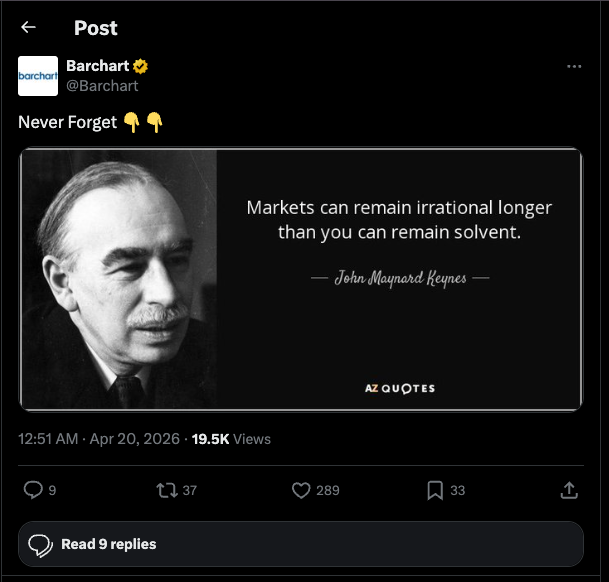
My plan was to put this piece together over the past weekend, but I knew how the time from last Friday’s close through Monday morning’s open in US markets was going to go. Recall the euphoria in global stocks as last week came to an end, with the S&P 500 ($INX) and Nasdaq ($NASX) going to new all-time highs on the weekly social media post from the US president to do just that – rally US stock markets into the weekend. This one proclaimed the Strait of Hormuz (aka Strait of ‘Vermouth’ according to US Treasury Secretary Bessent) was “COMPLETELY OPEN AND READY FOR BUSINESS” (emphasis the US president’s, reportedly, not mine). As I’ve said many times over the past 10 years, a rational human being would realize there was just another not necessarily the Truth Social media post. But algorithms aren’t rational human beings, oddly fitting with what John Maynard Keyes said about many decades ago, “Markets can remain irrational longer than you can remain solvent”. Before global investors had a chance to sober up from Friday night’s celebration, early Saturday morning saw the headlines change to, “Iranian gunboats fire on tanker in Strait of Hormuz as Tehran reimposes restrictions”. Then came Sunday, when the headlines screamed, “U.S. struck seized Iranian-flagged ship in Gulf of Oman”. When the commodity complex opened Sunday night, there were no surprises as Energies quickly rallied and US stock index futures fell. WTI crude oil (CLK26) gained as much as $7.35 (8.8%) while distillates (HOK26) added as much as 30.25 cents (8.9%). Meanwhile, S&P 500 futures (ESM26) fell as much as 76.5 points (1.1%) with Dow Jones Industrial Average futures (YMM26) dropping as much as 551 points (1.1%). Over in the Metals sector, it was also more of the same. June gold (GCM26) opened the week with a quick loss of $127.60 (2.7%), fitting with what I told Kitco News in its weekly poll on expected market activity last Friday. May silver (SIK26) acted like it was in a music video for Tom Petty’s classic song “Free Fallin’”, sliding as much as $3.127 (3.8%). Dr. Copper, the May contract (HGK26) of the economic indicator market, lost as much as 14.2 cents (2.3%) while platinum and palladium both fell as well. Was any of this surprising? “Not remotely.” (Extra points for knowing what this quote references. Think, “Inconceivable!”) As I discussed late last week, Barchart’s Elizabeth Volk sent me an article talking about how predictive market sites are adding commodities to their “traders”, including the dynamic duo of natural gas (aka The Widow Maker) and wheat (aka Poverty Grass). As I concluded my piece on the subject, “Good luck”. More importantly though, we don’t necessarily need predictive market sites to know what is going to happen week to week, or even day to day. While I make no guarantees, the general pattern goes something like this:
While all this is going on, the situation of rising inflation doesn’t change. This past weekend, a couple other news items went nearly unnoticed. I pulled these headlines from CNBC.com Sunday:
While both topics stood out to me, obviously, the latter tied into a question my friend Michele (from Italy) sent me late last week. He asked, “U.S. consumers are spending more than they did a year ago and have not yet slowed down spending across all sectors. Historically, it often takes several months for consumers to reduce spending levels in other categories to adjust to rising oil prices…the same is expected to be seen in the second half of the year. Where will they cut spending to compensate for rising gasoline prices…?” This ties into a piece I worked on with Elizabeth a few weeks ago, one I will be talking about with Stocktwits Tuesday (April 21). I said then I thought one of the first markets to see a shift in US consumer demand would be high-priced beef cuts, possibly leading to the old adage of “The cure for high prices is high prices” playing out again. Though I’m not a proponent of government reports, it will be interesting to see what the Cold Storage report shows us for beef stocks in relation to lower priced poultry stocks as of the end of March, set for release this coming Friday. Over the weekend, I saw a post from an industry leading analyst that read, “While surveys show more Americans view meat as important to their diets, they might be starting to cut back on beef...according to USDA. It projects beef intake will decline 2% this year…trading down from filet mignon to value cuts like sirloin. Some are pivoting to chicken, which is 30% to 40% cheaper than ground beef…” and so on. The bottom line is given the changed dynamics in markets the past decade, most of what happens is predictable. Let’s see what happens. On the date of publication, Darin Newsom did not have (either directly or indirectly) positions in any of the securities mentioned in this article. All information and data in this article is solely for informational purposes. For more information please view the Barchart Disclosure Policy here.
More news from Barchart
Report this content
If you believe this article contains misleading, harmful, or spam content, please let us know. Report this articleMore NewsView More
This 4/20, Wall Street Is Betting on More Than Marijuana ↗
April 20, 2026


5 Stocks Positioned to Win the AI Data Center Buildout ↗
April 20, 2026

Microsoft Targets Trimmed: What It Means for Investors ↗
April 20, 2026
Via MarketBeat
Tickers
MSFT

Via MarketBeat
Recent QuotesView More
Stock Quote API & Stock News API supplied by www.cloudquote.io
Quotes delayed at least 20 minutes. By accessing this page, you agree to the Privacy Policy and Terms Of Service.
© 2025 FinancialContent. All rights reserved.
|