The Intelligence Utility: A Deep Dive into Amazon’s 2026 Transformation
By:
Finterra
January 19, 2026 at 10:10 AM EST
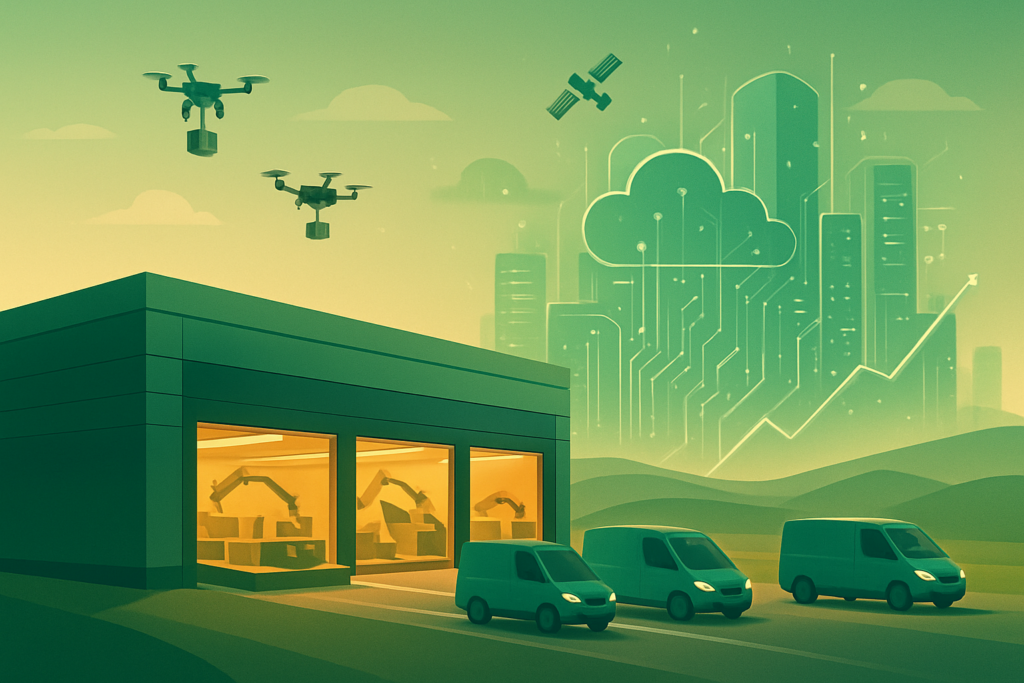
As of January 19, 2026, Amazon.com, Inc. (NASDAQ: AMZN) has effectively transcended its identity as the "Everything Store." In the three decades since its inception, the company has evolved into what analysts now describe as a "planetary utility"—a critical layer of global infrastructure powering everything from the high-performance computing required for generative AI to the physical logistics of daily life. In 2026, Amazon stands at a pivotal junction. After a period of aggressive cost-cutting and organizational flattening led by CEO Andy Jassy, the company has emerged with its highest operating margins in history. With the cloud division, Amazon Web Services (AWS), pivoting toward custom silicon to challenge the dominance of third-party chipmakers, and a retail arm that has finally cracked the code of international profitability, the narrative surrounding AMZN has shifted from "growth at any cost" to "efficiency at massive scale." This research feature explores the levers driving Amazon’s $2.6 trillion valuation and the risks that loom as it faces unprecedented regulatory scrutiny. Historical BackgroundFounded in 1994 by Jeff Bezos as an online bookstore, Amazon’s history is a case study in radical diversification and the "Flywheel Effect." The company’s early years were defined by its survival of the dot-com bubble, a feat achieved by prioritizing long-term market share over short-term profits. Key transformations punctuated its journey: the launch of Amazon Prime in 2005, which weaponized customer loyalty; the 2006 debut of AWS, which pioneered the modern cloud industry; and the 2017 acquisition of Whole Foods, signaling its intent to dominate the physical grocery space. By the time Andy Jassy succeeded Bezos as CEO in 2021, the company was grappling with a post-pandemic "hangover" of overcapacity. The years 2023 through 2025 marked the "Efficiency Era," where the company regionalized its shipping network and integrated advanced robotics, setting the stage for the high-margin powerhouse it is today. Business ModelAmazon’s business model is a multi-layered ecosystem where each segment feeds the others. Its revenue is derived from four primary pillars:
Stock Performance OverviewOver the past decade, AMZN has been a cornerstone of the "Magnificent Seven," though its path has not been linear.
Financial PerformanceAmazon’s fiscal year 2025 results highlight a company firing on all cylinders. Preliminary data shows total annual revenue exceeding $660 billion. The most significant takeaway for analysts has been the expansion of operating margins, which stabilized at 11% in 2025, up from mid-single digits just three years ago. This margin expansion is attributed to the high-margin advertising business and the successful regionalization of the U.S. logistics network. AWS remains the crown jewel of the balance sheet, maintaining 20% year-over-year growth and accounting for more than 60% of the company's total operating income. Free cash flow has rebounded to record levels, allowing the company to self-fund its massive investments in AI and satellite technology. Leadership and ManagementUnder CEO Andy Jassy, Amazon has shifted from the visionary, "big bet" culture of Jeff Bezos to a more disciplined, operationally focused regime. Jassy has famously "flattened" the organization, increasing the ratio of individual contributors to managers by 15% in late 2025 to eliminate "bureaucracy that kills Day 1." The leadership team was bolstered in 2024 by the appointment of Matt Garman as AWS CEO, a move that signaled a return to technical fundamentals in the cloud. The executive suite is currently focused on three mandates: the "AI-ification" of every business unit, the global expansion of the logistics network, and the commercialization of Project Kuiper. Products, Services, and InnovationsInnovation in 2026 is centered on "proprietary independence." Amazon is increasingly building its own technology to avoid the "Nvidia tax" and reliance on third-party providers.
Competitive LandscapeAmazon faces a "three-front war" in 2026:
Industry and Market TrendsThe two dominant trends for 2026 are the automation of physical labor and the regionalization of trade. Amazon has surpassed 1 million robots deployed in its warehouses. The "Proteus" autonomous mobile robot and the "Sparrow" robotic arm now handle approximately 65% of individual item sorting, significantly reducing human error and labor costs. Simultaneously, the global shift toward "near-shoring" has forced Amazon to build more localized supply chains, particularly in North America and India, to mitigate geopolitical risks. Risks and ChallengesThe "bull case" for Amazon is not without significant headwinds:
Opportunities and Catalysts
Investor Sentiment and Analyst CoverageWall Street remains overwhelmingly bullish on AMZN, with over 90% of covering analysts maintaining a "Buy" or "Strong Buy" rating as of January 2026. Institutional ownership remains high, with major funds favoring Amazon as a "defensive growth" play. Retail sentiment is more cautious, often reacting to headlines regarding FTC lawsuits or labor strikes, but the overall market consensus is that Amazon’s "moat" in logistics and cloud is currently impenetrable. Regulatory, Policy, and Geopolitical FactorsGeopolitically, Amazon is navigating a complex landscape. In Europe, the Digital Markets Act (DMA) has designated AWS as a "Gatekeeper," necessitating more interoperability and less "self-preferencing" of its own services. In the U.S., the outcome of the 2024 election has led to a more fragmented regulatory environment, with some states pursuing independent antitrust actions. Furthermore, Amazon’s heavy reliance on Chinese manufacturing for its private-label brands remains a vulnerability should trade tensions escalate. ConclusionAmazon’s transformation in 2026 is a testament to the power of operational discipline when applied to a global-scale network. By regionalizing its logistics and doubling down on custom AI silicon, the company has managed to increase its profitability even as it matures. For investors, the key to the Amazon story is no longer just how many packages it delivers, but how much of the world's digital and physical infrastructure it can own. While regulatory clouds and massive capital requirements offer reasons for caution, Amazon’s ability to reinvent itself—from a bookstore to a cloud giant, and now to an AI and satellite pioneer—suggests that its "Day 1" philosophy remains more than just a corporate slogan. Investors should closely watch the outcome of the October 2026 FTC trial and the Q1 2026 launch of Project Kuiper as the next major catalysts for the stock. This content is intended for informational purposes only and is not financial advice.  More NewsView More
Ollie’s Stock Won’t Stay a Bargain Much Longer ↗
March 15, 2026
Via MarketBeat

3 Stocks That Could Be Next to Announce a Stock Split ↗
March 15, 2026
U.S. Shipbuilding Revival: 3 Stocks to Watch Now ↗
March 15, 2026
Via MarketBeat

Eli Lilly’s Employer Push Could Unlock New GLP-1 Demand ↗
March 15, 2026
Via MarketBeat

Via MarketBeat
Recent QuotesView More
Stock Quote API & Stock News API supplied by www.cloudquote.io
Quotes delayed at least 20 minutes. By accessing this page, you agree to the Privacy Policy and Terms Of Service.
© 2025 FinancialContent. All rights reserved.
|