The $29 Billion Gamble: Analyzing Sysco’s Transformative Pivot and the Jetro Acquisition
By:
Finterra
March 31, 2026 at 09:34 AM EDT
ⓘ This article is third-party content and does not represent the views of this site. We make no guarantees regarding its accuracy or completeness.
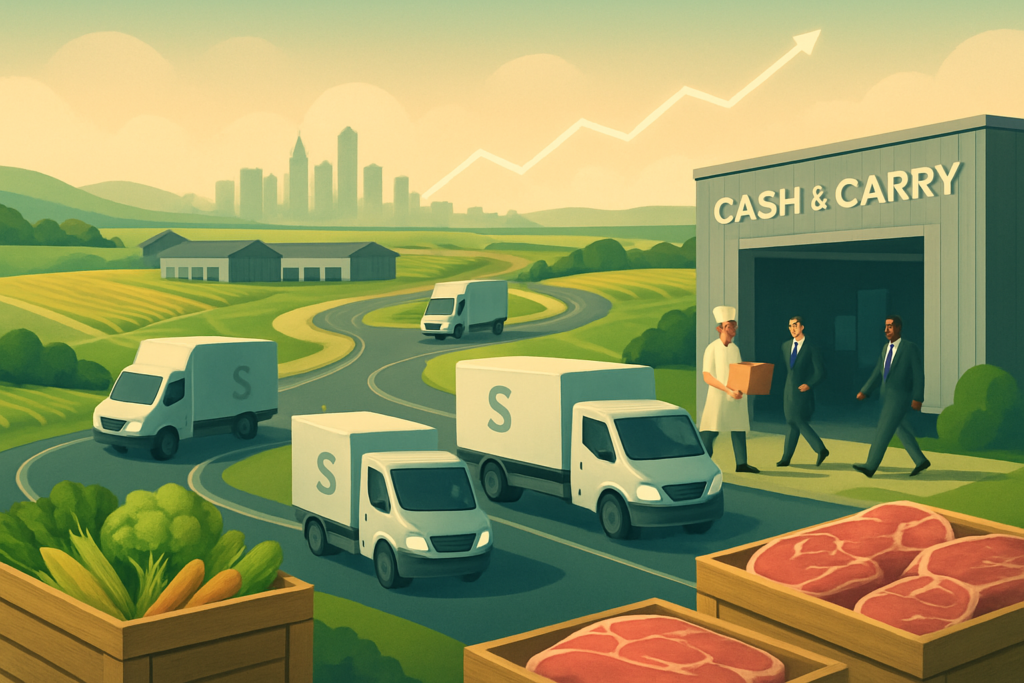
On March 31, 2026, the global foodservice landscape is processing what many analysts are calling the most audacious move in the history of food distribution. Sysco Corp. (NYSE: SYY), the undisputed titan of the industry, recently shocked the markets by announcing a $29.1 billion acquisition of Jetro Restaurant Depot. While Sysco has long been the dominant "push" distributor—delivering food directly to kitchens—this move signals a radical shift toward the "pull" economy of Cash & Carry. However, with the stock tumbling 15% in the wake of the announcement, the market is signaling a deep-seated anxiety: can Sysco manage a massive new debt load while integrating a fundamentally different business culture, or has the giant finally bitten off more than it can chew? Historical BackgroundSysco—an acronym for Systems and Controls—was founded in 1969 by John F. Baugh. His vision was to consolidate a fragmented industry of regional food distributors into a national powerhouse capable of providing consistent service to growing restaurant chains. Since going public in 1970, Sysco has pursued a relentless strategy of inorganic growth, acquiring over 400 companies to build its current empire. The company’s history is defined by its scale. For decades, it was the "boring but beautiful" dividend aristocrat of Wall Street. However, the 2015 failure of its attempted merger with US Foods, blocked by the Federal Trade Commission (FTC) on antitrust grounds, forced Sysco to look elsewhere for growth. This led to international expansions, such as the acquisition of Brakes in Europe, and ultimately, the massive pivot toward Jetro Restaurant Depot in 2026. Business ModelSysco’s business model is a high-volume, low-margin logistics engine. It connects food producers (from massive agricultural firms to local specialty farmers) with the "away-from-home" dining market. The company operates through four primary segments:
The recent Jetro acquisition introduces a fifth, hybrid pillar: Cash & Carry. This allows Sysco to serve the "underserved" small-business segment that prefers to hand-pick their inventory and avoid delivery fees. Stock Performance OverviewAs of March 31, 2026, SYY is trading at approximately $69.30, reflecting a significant "deal-related" correction.
Financial PerformanceSysco’s financials are currently a tale of two realities. In the first half of FY 2026, the company showed operational strength, with an adjusted EPS of $0.99 and gross margins stabilizing at 18.5%. The "Recipe for Growth" efficiency program was successfully offsetting wage inflation. However, the balance sheet has been dramatically reshaped.
Leadership and ManagementCEO Kevin Hourican, formerly of CVS Health, has been the architect of Sysco’s modern transformation. Since taking the helm in 2020, he has shifted the company away from its decentralized roots toward a more digital-first, automated corporate structure. The Jetro deal is Hourican’s "legacy move." By bringing in the Cash & Carry model, he aims to capture the entire restaurant lifecycle. However, the departure of CFO Kenny Cheung shortly before the deal announcement and the appointment of Interim CFO Brandon Sewell have raised questions about the internal consensus regarding the acquisition's price and timing. Products, Services, and InnovationsSysco has moved far beyond just delivering boxes of produce. Its competitive edge now lies in its digital ecosystem:
Competitive LandscapeThe food distribution industry is an oligarchy dominated by the "Big Three":
The Jetro acquisition shifts the competitive battlefield. Sysco is no longer just fighting US Foods for delivery contracts; it is now in direct competition with Costco (COST) and Sam’s Club (WMT) for the "pick-up" business of small restaurant owners. Industry and Market TrendsThree major trends are currently defining the sector in 2026:
Risks and ChallengesThe primary risk facing Sysco is financial overextension. A $21 billion debt pile in an era of "higher-for-longer" interest rates leaves very little margin for error. If a recession hits in late 2026 or 2027, the cost of servicing this debt could eat into the dividend, which is the cornerstone of the stock’s value for many retail investors. Furthermore, there is a cultural integration risk. Jetro is a lean, entrepreneurial "Cash & Carry" operation. Sysco is a massive, process-driven corporate entity. Merging these two cultures without losing Jetro’s efficiency and customer loyalty is a monumental task. Opportunities and CatalystsIf executed correctly, the Jetro deal is a massive catalyst for earnings growth. Management projects the acquisition will add $16 billion in annual revenue and $2 billion in EBITDA.
Investor Sentiment and Analyst CoverageThe current sentiment on Wall Street is "cautious to bearish." While analysts appreciate the strategic logic of the Jetro deal, many have downgraded the stock due to the valuation and debt. Moody’s and S&P have both revised Sysco’s credit outlook to Negative. Institutional investors are currently in a "wait and see" mode, watching for the first two quarters of post-acquisition data to see if the promised synergies begin to materialize. Regulatory, Policy, and Geopolitical FactorsThe elephant in the room is the Federal Trade Commission (FTC). Having blocked the Sysco-US Foods merger a decade ago, regulators are likely to scrutinize the Jetro deal for "market dominance" in local regions. If the FTC demands significant divestitures of Jetro locations in major metro areas like New York or Los Angeles, the financial math of the deal could sour quickly. Additionally, the "Food Supply Chain Task Force" established by the current administration is investigating price transparency in the distribution sector, which could lead to new compliance costs for the combined entity. ConclusionSysco’s $29.1 billion acquisition of Jetro Restaurant Depot is a "bet the farm" move that seeks to redefine the company for the next decade. By bridging the gap between delivery and warehouse shopping, Sysco is attempting to build an impenetrable moat around the foodservice industry. However, the cost of this moat is a mountain of debt and significant share dilution. For investors, Sysco is no longer a "set it and forget it" dividend play; it is now a high-leverage restructuring story. The key metrics to watch over the next 18 months will be the pace of debt repayment, the FTC’s final ruling on the merger, and the company's ability to maintain its gross margins in a increasingly competitive and regulated food supply chain. This content is intended for informational purposes only and is not financial advice.
Report this content
If you believe this article contains misleading, harmful, or spam content, please let us know. Report this articleMore NewsView More
3 Unique ETFs With Strong Momentum for the End of the Year ↗
Today 11:25 EDT

Via MarketBeat

Via MarketBeat
Tickers
DAL
Recent QuotesView More
Stock Quote API & Stock News API supplied by www.cloudquote.io
Quotes delayed at least 20 minutes. By accessing this page, you agree to the Privacy Policy and Terms Of Service.
© 2025 FinancialContent. All rights reserved.
|