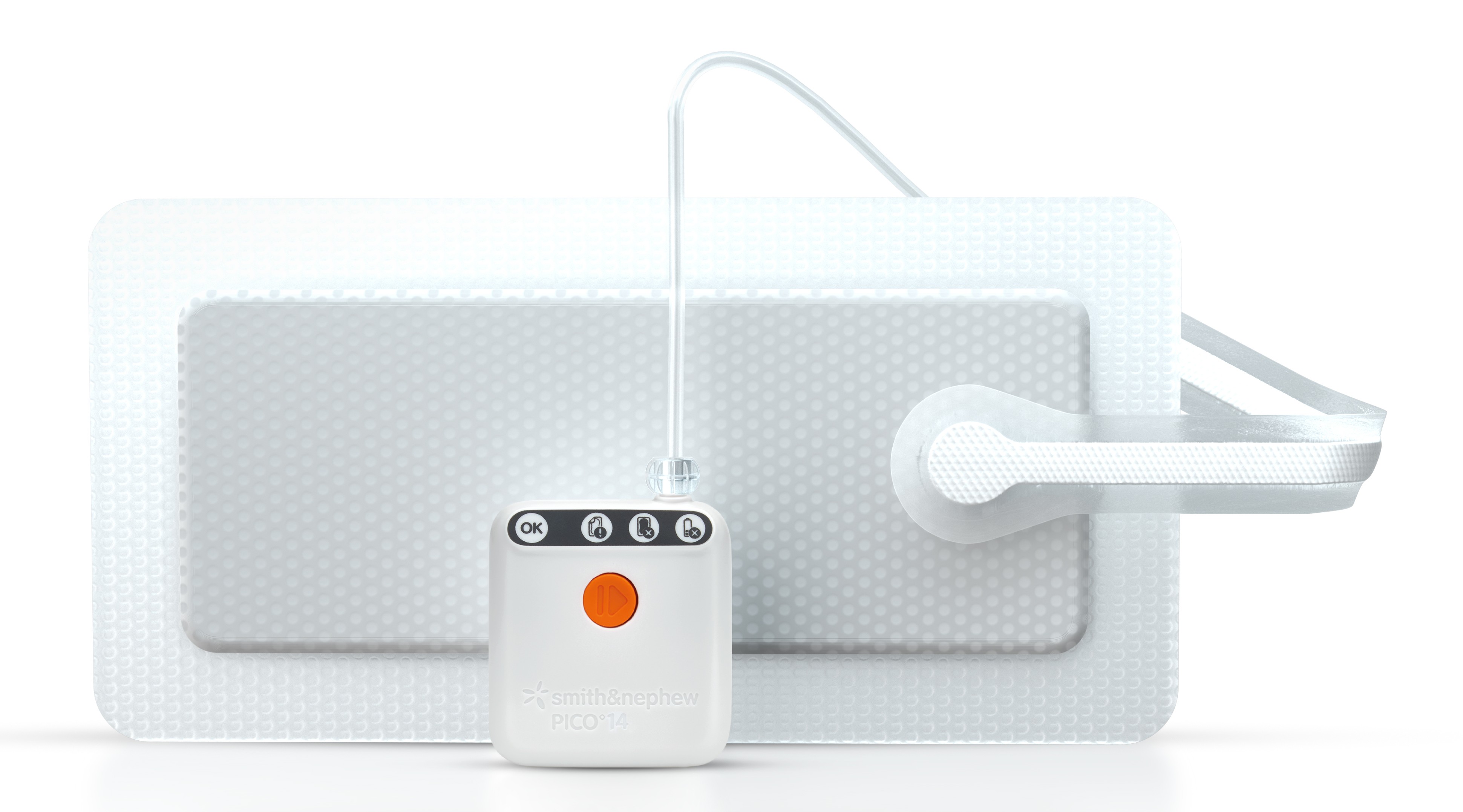
Smith+Nephew comparative study1 shows PICO◊ sNPWT (-80 mmHg) delivers superior performance in relation to wound dehiscence and reduces healthcare costs across cardiovascular and orthopedic surgery versus PrevenaTM -125 mmHg sNPWT
By:
Smith & Nephew UK Ltd via
GlobeNewswire
October 27, 2025 at 11:30 AM EDT
Smith+Nephew (LSE:SN, NYSE: SNN), the global medical technology company, today announces findings from a newly published, first-of-its-kind comparative study of single-use negative pressure wound therapy (sNPWT) devices in orthopedic and cardiovascular surgery. Analyzing real-world data from over 22,000 patients in the Premier PINC AI™ Healthcare Database, the analysis reveals that prophylactic use of PICO sNPWT (-80 mmHg) significantly reduces the risk of wound dehiscence, hospital length of stay (LoS), and overall healthcare costs compared to the PrevenaTM -125 mmHg sNPWT device.
Smith + Nephew's PICO Single Use Negative Pressure Wound Therapy System An estimated 313 million surgical procedures are performed worldwide each year, with the number continuing to rise.2 In the United States, surgical site infections (SSIs) occur in approximately 2% to 4% of patients undergoing inpatient procedures.2,3 In relation to PrevenaTM sNPWT (-125mmHg), use of PICO sNPWT (-80mmHg) resulted in the following key study findings: Cardiovascular Surgery (5,000+ patients)
Orthopedic Surgery (17,000+ patients)
Substantial cost savings with PICO sNPWT “The differences we are seeing likely relate to the PICO system and its dressing design, as well as the associated mechanisms of action that may contribute to improved clinical outcomes.” says Dr. Adam Wright, orthopedic surgeon and study co- author. “Using PICO sNPWT prophylactically on at-risk patients undergoing orthopedic or cardiovascular surgeries helps reduce SSCs, and consequently, strain on healthcare resources.” Growing Body of Evidence These findings are aligned with the global recommendations including NICE4, WHO5 and the ACS/SIS6 guidelines, all of which recommend the use of iNPWT for the purpose of reducing the risk of SSI for at risk patients. For more information about these studies, please visit: https://www.possiblewithpico.com/home -ends- Enquiries Frida Wilhelmsson +46 (738) 499 429 About Smith+Nephew Founded in Hull, UK, in 1856, we now operate in around 100 countries and generated annual sales of $5.8 billion in 2024. Smith+Nephew is a constituent of the FTSE100 (LSE:SN, NYSE: SNN). The terms ‘Group’ and ‘Smith+Nephew’ are used to refer to Smith & Nephew plc and its consolidated subsidiaries, unless the context requires otherwise. For more information about Smith+Nephew, please visit www.smith-nephew.com and follow us on X, LinkedIn, Instagram or Facebook. Forward-looking statements This document may contain forward-looking statements that may or may not prove accurate. For example, statements regarding expected revenue growth and trading profit margins, market trends and our product pipeline are forward-looking statements. Phrases such as "aim", "plan", "intend", "anticipate", "well-placed", "believe", "estimate", "expect", "target", "consider" and similar expressions are generally intended to identify forward-looking statements. Forward-looking statements involve known and unknown risks, uncertainties and other important factors that could cause actual results to differ materially from what is expressed or implied by the statements. For Smith+Nephew, these factors include: conflicts in Europe and the Middle East, economic and financial conditions in the markets we serve, especially those affecting healthcare providers, payers and customers; price levels for established and innovative medical devices; developments in medical technology; regulatory approvals, reimbursement decisions or other government actions; product defects or recalls or other problems with quality management systems or failure to comply with related regulations; litigation relating to patent or other claims; legal and financial compliance risks and related investigative, remedial or enforcement actions; disruption to our supply chain or operations or those of our suppliers; competition for qualified personnel; strategic actions, including acquisitions and disposals, our success in performing due diligence, valuing and integrating acquired businesses; disruption that may result from transactions or other changes we make in our business plans or organisation to adapt to market developments; relationships with healthcare professionals; reliance on information technology and cybersecurity; disruptions due to natural disasters, weather and climate change related events; changes in customer and other stakeholder sustainability expectations; changes in taxation regulations; effects of foreign exchange volatility; and numerous other matters that affect us or our markets, including those of a political, economic, business, competitive or reputational nature. Please refer to the documents that Smith+Nephew has filed with the U.S. Securities and Exchange Commission under the U.S. Securities Exchange Act of 1934, as amended, including Smith+Nephew's most recent annual report on Form 20-F, which is available on the SEC’s website at www. sec.gov, for a discussion of certain of these factors. Any forward-looking statement is based on information available to Smith+Nephew as of the date of the statement. All written or oral forward-looking statements attributable to Smith+Nephew are qualified by this caution. Smith+Nephew does not undertake any obligation to update or revise any forward-looking statement to reflect any change in circumstances or in Smith+Nephew's expectations. ◊ Trademark of Smith+Nephew. Certain marks registered in US Patent and Trademark Office. TM All trademarks acknowledged *Follow up to 30 days post discharge to establish complication levels post-surgery 1. Bashyal RK, Searle R, Nherera LM, Wright A. Effects of single-use negative pressure wound therapy on healthcare use: US analysis of a large claims database. Journal of Wound Care . 2025;34(8):555-562. 2. Meara JG, Leather AJM, Hagander L, et al. Global Surgery 2030: Evidence and solutions for achieving health, welfare, and economic development. The Lancet. Lancet Publishing Group. 2015;386(9993):569-624. doi:10.1016/S0140-6736(15)60160-X 3. CDC, Ncezid, DHQP. Surgical Site Infection Event (SSI). https://www.cdc.gov/nhsn/pdfs/ps-analysis-resources/ImportingProcedureData.pdf. 4. Surgical site infections: prevention and treatment NICE guideline. Published online 2019. Accessed September 9, 2022. www.nice.org.uk/guidance/MTG43. 5. Global Guidelines for the Prevention of Surgical Site Infection. World Health Organization; 2018. 6. Ban K, Minei J, Laronga C, et al. American College of Surgeons and Surgical Infection Society: Surgical Site Infection Guidelines, 2016 Update.; 2017. 7. Ciprandi, G et al. World Union of Wound Healing Societies (WUWHS) Consensus Document. Closed surgical incision management: understanding the role of NPWT. Wounds International, 2016. 8. 3rd Meeting International Consensus Meeting, May 8-10th. Istanbul, Turkey. www.icmortho.org 
More NewsView More
Via MarketBeat
Tickers
MDB

3 Stocks Poised to Benefit From Google’s AI Breakthough ↗
December 03, 2025

Beyond NVIDIA: 5 Semiconductor Stocks Set to Dominate 2026 ↗
December 03, 2025

3 Stocks You’ll Wish You Bought Before 2026 ↗
December 03, 2025
Via MarketBeat

Wall Street Punished CrowdStrike for Beating Earnings? Seriously? ↗
December 03, 2025
Via MarketBeat
Tickers
CRWD
Recent QuotesView More
Stock Quote API & Stock News API supplied by www.cloudquote.io
Quotes delayed at least 20 minutes. By accessing this page, you agree to the Privacy Policy and Terms Of Service.
© 2025 FinancialContent. All rights reserved.
|