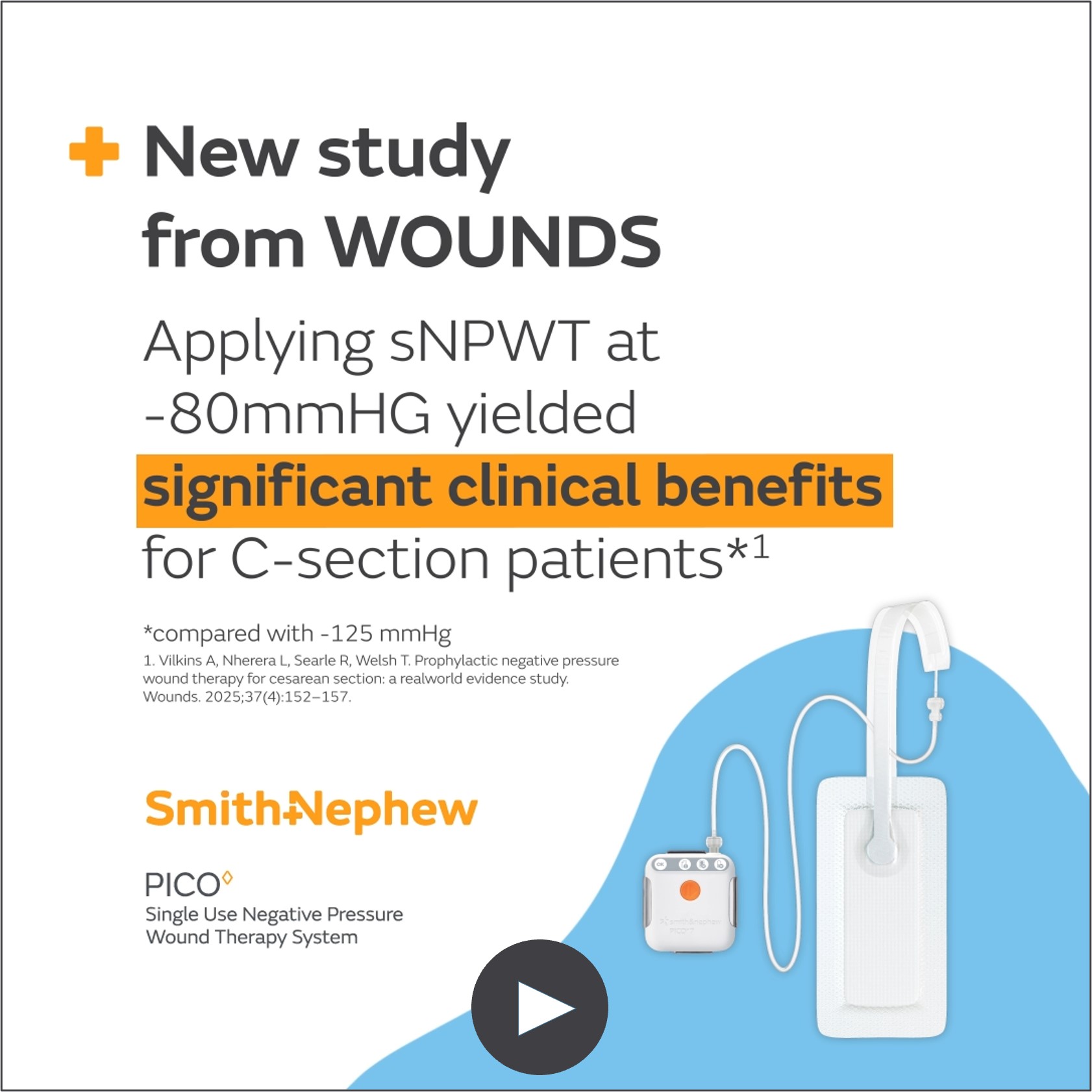
A comparative sNPWT study of 10,000+ C-sections shows PICO™ sNPWT reduces complications and cuts healthcare costs by $728,000 per 1,000 patients
By:
Smith & Nephew UK Ltd via
GlobeNewswire
May 14, 2025 at 08:00 AM EDT
Smith+Nephew (LSE:SN, NYSE: SNN), the global medical technology company, today announces findings from a newly published comparative study of single-use Negative Pressure Wound Therapy (sNPWT) devices in Caesarean section (C-section) recovery has identified significant benefits for postpartum use of Smith+Nephew’s leading PICO sNPWT technology. Analyzing real-world data from over 10,000 C-section patients treated at different pressure levels, the study published in WOUNDS (April 2025) reveals that PICO sNPWT contributes to a significant reduction in surgical site complications (SSCs), including a reduction in the incidence of surgical site infections (SSIs), wound dehiscence and seroma, and overall costs, compared to another sNPWT device (P≤0.05).1 New survey: The real-life burden of C-section complications
Dr. Tia Welsh, M.D. Chair of Obstetrics and Gynecology at Valley Medical Group and co-author of the study added, “Postpartum is already a very vulnerable period for mothers, even without complications. SSCs add physical pain, prolonged recoveries, emotional distress, and disrupt critical early bonding with newborns. These interruptions carry emotional and practical burdens, increasing the risks of postpartum depression, anxiety, and trauma – costs that can’t be captured in dollars alone.” Real-world data shows the clinical and economic benefits of using PICO sNPWT in patients undergoing C-section procedures
“We’ve long understood the benefits of NPWT in surgical recovery, but this is the first large-scale study to directly compare different pressure levels in a real-world setting,” said Dr. Annmarie Vilkins, DO. Director of Obstetrics and Gynaecology at Henry Ford Health, and the study’s lead author.“We found that PICO sNPWT showed significantly improved outcomes through optimizing pressure, fluid management, and skin adhesion. Its unique design helped maintain a high moisture vapor transmission rate supporting an ideal healing environment for recovery, particularly critical for high-risk incisions like C-sections under skin folds, where moisture buildup can lead to infection.”
PICO sNPWT is proven to reduce the odds of surgical site infections (SSIs)3, which could facilitate early mother and baby bonding and positively impacts on the patient’s emotional wellbeing.4 Substantial cost savings with PICO sNPWT High-risk C-section births require improved post-surgical care Complications related to C-sections can lead to increased maternal mortality12, prolonged hospital stays and elevated healthcare costs13, while also impacting a mother’s ability to bond with her newborn.14 Despite this, the Center of Disease Control (CDC) estimates that over 80% of maternal mortalities are preventable.12 For more information, please visit: https://www.possiblewithpico.com/pico-obgyn -ends- Enquiries Dave Snyder +1 (978) 749-1440 About Smith+Nephew Founded in Hull, UK, in 1856, we now operate in around 100 countries, and generated annual sales of $5.8 billion in 2024. Smith+Nephew is a constituent of the FTSE100 (LSE:SN, NYSE: SNN). The terms ‘Group’ and ‘Smith+Nephew’ are used to refer to Smith & Nephew plc and its consolidated subsidiaries, unless the context requires otherwise. For more information about Smith+Nephew, please visit www.smith-nephew.com and follow us on X, LinkedIn, Instagram or Facebook. Forward-looking statements This document may contain forward-looking statements that may or may not prove accurate. For example, statements regarding expected revenue growth and trading profit margins, market trends and our product pipeline are forward-looking statements. Phrases such as "aim", "plan", "intend", "anticipate", "well-placed", "believe", "estimate", "expect", "target", "consider" and similar expressions are generally intended to identify forward-looking statements. Forward-looking statements involve known and unknown risks, uncertainties and other important factors that could cause actual results to differ materially from what is expressed or implied by the statements. For Smith+Nephew, these factors include: conflicts in Europe and the Middle East, economic and financial conditions in the markets we serve, especially those affecting healthcare providers, payers and customers; price levels for established and innovative medical devices; developments in medical technology; regulatory approvals, reimbursement decisions or other government actions; product defects or recalls or other problems with quality management systems or failure to comply with related regulations; litigation relating to patent or other claims; legal and financial compliance risks and related investigative, remedial or enforcement actions; disruption to our supply chain or operations or those of our suppliers; competition for qualified personnel; strategic actions, including acquisitions and disposals, our success in performing due diligence, valuing and integrating acquired businesses; disruption that may result from transactions or other changes we make in our business plans or organisation to adapt to market developments; relationships with healthcare professionals; reliance on information technology and cybersecurity; disruptions due to natural disasters, weather and climate change related events; changes in customer and other stakeholder sustainability expectations; changes in taxation regulations; effects of foreign exchange volatility; and numerous other matters that affect us or our markets, including those of a political, economic, business, competitive or reputational nature. Please refer to the documents that Smith+Nephew has filed with the U.S. Securities and Exchange Commission under the U.S. Securities Exchange Act of 1934, as amended, including Smith+Nephew's most recent annual report on Form 20-F, which is available on the SEC’s website at www. sec.gov, for a discussion of certain of these factors. Any forward-looking statement is based on information available to Smith+Nephew as of the date of the statement. All written or oral forward-looking statements attributable to Smith+Nephew are qualified by this caution. Smith+Nephew does not undertake any obligation to update or revise any forward-looking statement to reflect any change in circumstances or in Smith+Nephew's expectations. ◊ Trademark of Smith+Nephew. Certain marks registered in US Patent and Trademark Office. *Follow up to 30 days post discharge to establish complication levels post-surgery 1 Vilkins, A, Nherera, LM, Searle, R, Welsh, T. Comparing the effectiveness of two prophylactic negative pressure wound therapy devices in reducing surgical site complications after cesarean sections: Insights from a large US claims database. WOUNDS. 2025. 2 Census wide (Research Agency). C-section complications survey with 1001 mothers who had a C-section (50% experienced complications/infections). Data on file. 2025. Data collected March 14-19,2025. 3 Saunders C, Nherera LM, Horner A, Trueman P. Single-Use negative-pressure wound therapy versus conventional dressings for closed surgical incisions: systematic literature review and meta-analysis. BJS Open. 2021;0(0):1 - 8. 4 Bullough L, Burns S, Timmons J, Truman P, Megginson S. Reducing c-section wound complications. The Clinical Services Journal. 2015:2-6. 5 de Lissovoy G, Fraeman K, Hutchins V, Murphy D, Song D, Vaughn BB. Surgical site infection: Incidence and impact on hospital utilization and treatment costs. Am J Infect Control. 2009;37(5):387-397. doi:10.1016/j.ajic.2008.12.010 6 Centers for Disease Control and Prevention (CDC) website. Births - method of delivery. Last reviewed April 9, 2024. Accessed March 2025. https://www.cdc.gov/nchs/fastats/delivery.htm 7 Erritty M, Hale J, Thomas J, Thompson A, Wright R, Low A, Carr M, George R, Williams L, Dumitrescu A, Rees J, Irukulla S, Fry CH, Fluck D, Han TS. Reduction of adverse outcomes from cesarean section by surgical-site infection prevention care bundles in maternity. Int J Gynaecol Obstet. 2023;1;161(3):963-968. doi:10.1002/ijgo.14605. PMID: 36452991. 8 Barber, EL. Contributions to Rising Cesarean Delivery Rate. Obstet Gynecol. 2011;118(1):29-38 9 Choban PS, Heckler R, Burge JC, Flancbaum L. Increased incidence of nosocomial infections in obese surgical patients. Am Surg. 1995;61(11):1001–1005. 10 Nagachinta T, Stephens M, Reitz B, Polk BF. Risk factors for surgical-wound infection following cardiac surgery. J Infect Dis. 1987;156(6):967–973. 11 Friedman ND, Sexton DJ, Connelly SM, Kaye KS. Risk factors for surgical site infection complicating laminectomy. Infect Control Hosp Epidemiol. 2007;28(9):1060–1065. 12 Centers for Disease Control and Prevention (CDC) website. Preventing pregnancy-related deaths. Published September 25, 2024. Accessed March 2025. 13 Olsen MA, Butler AM, Willers DM, Gross GA, Hamilton BH, Fraser VJ. Attributable costs of surgical site infection and endometritis after low transverse cesarean delivery. Infect Control Hosp Epidemiol. 2010;31(3):276-236 82. doi:10.1086/650755 14 Hoff CE, Movva N, Rosen Vollmar AK, Pérez-Escamilla R. Impact of maternal anxiety on breastfeeding outcomes: a systematic review. Adv Nutr. 2019;10(5):816-826. doi:10.1093/advances/nmy132. PMID: 31079143. 
More NewsView More
3 Stocks Poised to Benefit From Google’s AI Breakthough ↗
December 03, 2025

Beyond NVIDIA: 5 Semiconductor Stocks Set to Dominate 2026 ↗
December 03, 2025

3 Stocks You’ll Wish You Bought Before 2026 ↗
December 03, 2025
Via MarketBeat

Wall Street Punished CrowdStrike for Beating Earnings? Seriously? ↗
December 03, 2025
Via MarketBeat
Tickers
CRWD

Okta: Excuses to Sell Vs. Reasons to Buy ↗
December 03, 2025
Via MarketBeat
Recent QuotesView More
Stock Quote API & Stock News API supplied by www.cloudquote.io
Quotes delayed at least 20 minutes. By accessing this page, you agree to the Privacy Policy and Terms Of Service.
© 2025 FinancialContent. All rights reserved.
|