Nvidia: The Unquestioned Architect of the AI Revolution and its Market Ripple
By:
MarketMinute
December 10, 2025 at 14:12 PM EST
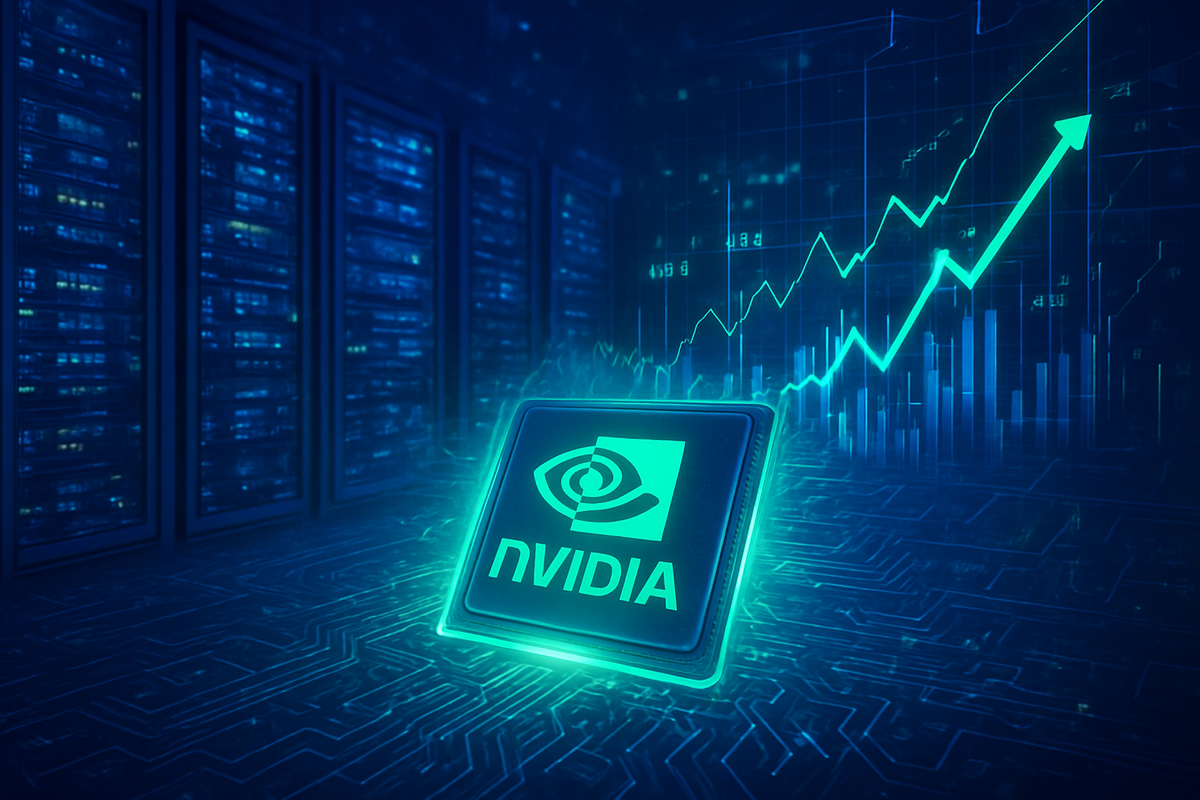
Nvidia's (NASDAQ: NVDA) influence on the broader stock market and the artificial intelligence (AI) sector has reached unprecedented levels as of December 2025. The company, which briefly touched a staggering $5 trillion market capitalization in October 2025, stands as the indispensable infrastructure provider for the global AI build-out. Its dominance in high-performance Graphics Processing Units (GPUs) and the proprietary CUDA software ecosystem has not only driven its own stratospheric growth but has also become a critical determinant of success for countless other technology firms and the pace of AI innovation worldwide. The immediate implications of Nvidia's reign are profound. Its record-breaking financial performance, with revenues consistently exceeding expectations—driven primarily by its Data Center segment—continues to fuel investor confidence and positions the company as a leading indicator for the health and trajectory of the tech sector. This pervasive influence, however, also presents a complex landscape of opportunities and challenges, from intensifying competition and geopolitical pressures to the urgent need for strategic pivots across the industry. Nvidia's Unyielding Ascent: A Timeline of Dominance and Strategic ManeuversNvidia's journey to its current market zenith has been marked by relentless innovation, strategic partnerships, and a keen understanding of the burgeoning AI landscape. The period from late 2024 through late 2025 has been particularly instrumental in cementing its indispensable role. A Trajectory of Innovation and Financial Milestones:
These events highlight Nvidia's multi-pronged strategy: continuous hardware innovation, aggressive software ecosystem development, strategic investments in leading AI startups, and proactive engagement with policymakers to shape market access. The company's financial results consistently underscore its indispensable role, with its data center segment driving the bulk of its growth, demonstrating that Nvidia is not just participating in the AI revolution but actively architecting it. The Shifting Sands: Companies Poised to Win or Lose in Nvidia's ShadowNvidia's (NASDAQ: NVDA) market dominance creates a complex ecosystem where various companies find themselves either riding the wave of AI demand or struggling to carve out their own niche. The Beneficiaries:
The Challengers and Those Facing Headwinds:
Nvidia's (NASDAQ: NVDA) influence ensures that even its closest partners and customers are constantly evaluating their reliance, driving a strategic diversification across the industry. Wider Significance: Nvidia as a Bellwether for the Future of AINvidia's (NASDAQ: NVDA) dominant influence transcends market capitalization; it serves as a critical bellwether for the broader trajectory of the AI industry, national technological competitiveness, and the evolving dynamics of global trade. Broader Industry Trends: Nvidia's (NASDAQ: NVDA) sustained innovation in GPU architecture, exemplified by its H100, A100, and the newer Grace Blackwell and Rubin CPX series, continues to power complex AI computations, from deep learning model training to real-time inference. The company's success is deeply intertwined with the burgeoning AI market, which is projected for substantial growth, particularly in the generative AI segment. The industry is now shifting from the experimental phase of large foundation models to prioritizing large-scale, cost-effective inference. This transition presents both opportunities and challenges for Nvidia (NASDAQ: NVDA), as major cloud providers are increasingly investing in their own specialized chips for high-volume inference, seeking to reduce their reliance on Nvidia's CUDA ecosystem for certain tasks. Ripple Effects on Competitors and Partners: Nvidia's (NASDAQ: NVDA) dominance is showing "cracks" as key customers like OpenAI (privately held) diversify their chip supply through multi-billion dollar deals with competitors such as Broadcom (NASDAQ: AVGO) and AMD (NASDAQ: AMD). Hyperscalers like Alphabet's (NASDAQ: GOOGL) Google, Amazon (NASDAQ: AMZN), and Microsoft (NASDAQ: MSFT) are developing in-house AI chips to optimize costs and performance. While Nvidia's (NASDAQ: NVDA) CUDA platform remains a formidable barrier, competitors are actively working to close the hardware performance gap and develop alternative software stacks. For partners like TSMC (NYSE: TSM), Nvidia's immense demand for advanced packaging capacity (CoWoS) creates both significant revenue but also potential capacity constraints for other customers. Regulatory and Policy Implications (US-China Tech Tensions): Nvidia (NASDAQ: NVDA) is at the epicenter of escalating US-China tech tensions. China's State Administration for Market Regulation (SAMR) has launched an antitrust investigation into Nvidia, alleging anti-monopoly violations, widely seen as a retaliatory measure against US export controls. Concurrently, China is accelerating its indigenous semiconductor development to reduce reliance on foreign technology. On the US side, while previous strict export controls prevented sales of Nvidia's most powerful processors to China, President Trump's December 2025 approval for H200 AI chip sales to "approved customers" in China, with a 25% revenue share to the US, marks a "managed competition" approach. However, this approval does not extend to Nvidia's latest Blackwell or Rubin chips, highlighting the ongoing strategic competition and the risk of fragmented global semiconductor supply chains. Historical Precedents: Nvidia's (NASDAQ: NVDA) current market position draws parallels to historical tech monopolies, particularly Intel's (NASDAQ: INTC) long-standing dominance in the x86 CPU market. Similar to how Intel once dictated processor standards, Nvidia has established an industry benchmark for AI accelerators. Its "first-mover advantage" in AI computing and the robust, proprietary CUDA software ecosystem create significant developer lock-in, echoing how companies like Microsoft (NASDAQ: MSFT) leveraged operating system dominance. However, history also shows that even the most dominant tech companies eventually face significant challenges from evolving technologies and determined competitors, suggesting that Nvidia (NASDAQ: NVDA) must continuously innovate and adapt to maintain its lead. What Comes Next: Navigating the AI FrontierThe future for Nvidia (NASDAQ: NVDA) and the broader AI market is one of accelerated growth, intense competition, and strategic evolution. Both short-term and long-term possibilities point to a dynamic landscape demanding constant adaptation. Short-Term Possibilities (2026-2027): The immediate outlook for Nvidia (NASDAQ: NVDA) remains exceptionally strong, driven by insatiable demand for AI infrastructure. The entire 2025 production of its Blackwell architecture is already sold out, and the company anticipates significant revenue growth. The emergence of sophisticated AI models, including reasoning models and autonomous AI agents, will continue to drive the need for more powerful processing capabilities, benefiting Nvidia's advanced chip offerings like the Rubin CPX, purpose-built for inference. However, intensifying competition from AMD (NASDAQ: AMD), Intel (NASDAQ: INTC), and hyperscalers' in-house chips will challenge Nvidia's (NASDAQ: NVDA) "monopoly," especially in the inference market. Geopolitical tensions, particularly US-China tech policies, will continue to influence market access and supply chain stability. Long-Term Possibilities (2028 and Beyond): In the long term, AI will infuse every industry, becoming a basis for competition and growth. Nvidia (NASDAQ: NVDA) is well-positioned for expansion into Edge AI (projected to reach $157 billion by 2030), sovereign AI initiatives, and new applications in healthcare, scientific discovery, and robotics. Nvidia's (NASDAQ: NVDA) active development of CUDA-Q for hybrid classical-quantum applications also signals a strategic move into future computing paradigms. However, sustained competition will likely lead to a more diversified AI chip supply chain, potentially moderating Nvidia's (NASDAQ: NVDA) market share from its current highs. Challenges related to power consumption and the widespread adoption of liquid cooling systems in data centers will also necessitate further innovation in energy efficiency. Strategic Pivots and Adaptations: To maintain its leadership, Nvidia (NASDAQ: NVDA) will need several strategic pivots. This includes continued hardware innovation with tailored architectures for diverse AI workloads, aggressive investment in power-efficient designs, and expansion of its software platform beyond strict CUDA lock-in to enhance interoperability. Further ecosystem development through strategic alliances with cloud providers and enterprises, coupled with potential acquisitions in key AI software and networking companies, will be crucial. Flexible business models, including tiered offerings and expanded GPU-as-a-Service models, will cater to different market segments. Finally, navigating geopolitical headwinds will require nuanced regional strategies and continued advocacy with policymakers. Potential Scenarios and Outcomes:
Comprehensive Wrap-up: Nvidia's Enduring Legacy and the Road AheadNvidia's (NASDAQ: NVDA) position as of December 2025 is that of an undisputed titan, having architected the foundational infrastructure for the global AI revolution. Its unparalleled market share in AI accelerators, coupled with the formidable "CUDA moat" of its software ecosystem, has propelled it to record financial performance and a market capitalization that few companies have ever achieved. The company is not merely a chip designer; it provides a complete, full-stack ecosystem of hardware, software, and networking that underpins the vast majority of AI applications today. The market moving forward is characterized by continued explosive growth in AI capital expenditure, with projections indicating hundreds of billions of dollars in investment in the coming years. Nvidia's (NASDAQ: NVDA) Blackwell and future Rubin platforms are designed to meet this escalating demand, ensuring multi-year profit expansion. However, this growth will occur within an increasingly competitive landscape, where AMD (NASDAQ: AMD), Intel (NASDAQ: INTC), and hyperscalers' custom ASICs will vie for market share, particularly in the inference segment. Geopolitical factors, especially US-China tech relations, will also continue to shape market dynamics, requiring Nvidia (NASDAQ: NVDA) to navigate a complex and potentially volatile international environment. The lasting impact of Nvidia (NASDAQ: NVDA) lies in its role as an "AI utility." It enables the "compute economy" where every dollar of AI capital expenditure translates into demand for advanced silicon, power infrastructure, and cooling systems. Its products are critical for both AI training (model development) and inference (running AI models), with inference becoming a major growth area. Nvidia's (NASDAQ: NVDA) early and aggressive investment in AI, combined with its continuous innovation, has created a fundamental infrastructure that will continue to drive technological progress and economic transformation for decades to come. Investor Outlook: What to Watch in the Coming Months Investor sentiment around Nvidia (NASDAQ: NVDA) remains overwhelmingly positive, with a consensus "Strong Buy" rating and significant upside potential. However, vigilance is key in this rapidly evolving market. Investors should closely monitor:
This content is intended for informational purposes only and is not financial advice More NewsView More
Post 35% Surge, Analysts Eye More Upside in Copper Giant Freeport ↗
December 17, 2025
Via MarketBeat
Why a SpaceX IPO Could Be a Major Catalyst for GOOGL Stock ↗
December 17, 2025

Can Upwork Maintain Its Comeback? Reasons to Be Bullish and Bearish ↗
December 17, 2025
Via MarketBeat

Is Tesla Overvalued? 2 Reasons It Might Be a Bargain ↗
December 17, 2025
Via MarketBeat
Tickers
TSLA
How These 2 Stocks Won 2025's AI Race—And What's In Store for 2026 ↗
December 17, 2025
Recent QuotesView More
Stock Quote API & Stock News API supplied by www.cloudquote.io
Quotes delayed at least 20 minutes. By accessing this page, you agree to the Privacy Policy and Terms Of Service.
© 2025 FinancialContent. All rights reserved.
|