Precious Metals Surge: Gold, Silver, Platinum, and Palladium Flash Bullish Signals
By:
MarketMinute
December 16, 2025 at 09:45 AM EST
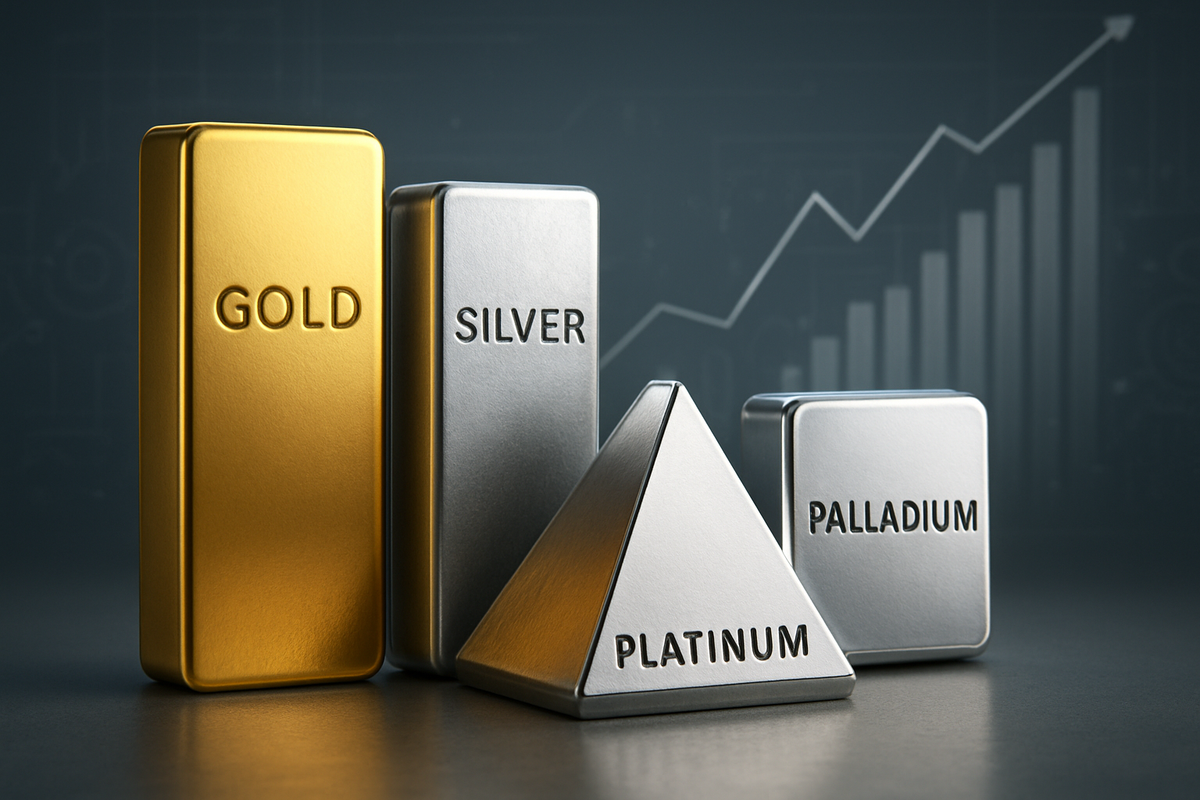
The precious metals market is currently experiencing a robust uptrend, with gold, silver, platinum, and palladium all exhibiting significant bullish momentum as of December 16, 2025. This widespread rally is driven by a confluence of factors, including persistent industrial demand, strategic shifts in monetary policy from global central banks, and growing investor confidence in hard assets amidst a dynamic economic landscape. While some profit-taking has been observed in recent sessions, the overarching technical analysis points to a continuation of upward trajectories for these key commodities, signaling potential for further gains in the near to medium term. This surge in precious metals prices carries immediate implications for global financial markets, hinting at a potential rotation into safe-haven and inflation-hedge assets. Investors are closely monitoring key support and resistance levels across the board, as well as upcoming economic indicators, particularly the US Nonfarm Payrolls report, which could further influence the dollar's strength and, consequently, the appeal of these metals. The remarkable performance, especially from silver and platinum, underscores a broader re-evaluation of their industrial and investment utility, setting the stage for an intriguing period in commodity trading. Technical Deep Dive: Unpacking the Momentum in Precious MetalsThe recent performance of gold, silver, platinum, and palladium provides a compelling narrative of market strength, with each metal carving out its distinct path within the broader bullish trend. A detailed technical analysis reveals critical price levels, established trends, and potential future movements that investors are closely watching. Gold (XAU/USD) has entered a consolidation phase following a powerful ascent that commenced in late November. Currently trading around $4285 to $4294.17 per troy ounce, gold experienced a slight dip on December 16, attributed primarily to profit-taking after reaching $4350 earlier in the week—nearing its all-time high of $4381.58 recorded in October 2025. Despite this minor pullback, gold remains firmly entrenched in a rising trend channel on the 2-hour chart, consistently printing higher lows above the critical $4250-$4260 range. The 50-day and 100-day moving averages at $4280 and $4250 respectively, provide robust support. As long as gold maintains above $4250, any retracements are likely corrective, suggesting continued upward potential with key resistance at $4320, $4345, and $4385. A break below $4218 would signal a bearish shift. Silver (XAG/USD) has been a standout performer, rocketing to a record high of $64.65 per ounce this week. On December 16, it traded around $63.00-$63.64, experiencing a modest 1.45% decline due to profit-taking. This minor dip does little to overshadow silver's phenomenal 25.71% rise over the past month and an astounding 106.89% increase year-on-year, marking its best annual performance since 1979. The rally is fueled by robust industrial demand from the solar, electric vehicle, and data center sectors, coupled with tightening inventories and strong ETF inflows. Technically, silver maintains a clear uptrend channel, with moving averages signaling a strong bullish trend despite overbought conditions. Key support levels are identified between $62.80-$61.80, with targets extending towards $64.50, $65.85, and potentially above $69.25. A break below $60.15 could indicate a negative shift. Platinum (PL/USD) has also demonstrated significant bullish momentum, reaching $1831.30 USD/t.oz on December 16, a 1.49% increase from the previous day and a 19.62% rise over the past month. Its 95.11% surge year-on-year brings it to its strongest levels since 2011, driven by the US Federal Reserve's rate cut, a less hawkish policy outlook, and optimism surrounding Chinese demand recovery. Platinum is forming strong bullish waves within its main bullish channel, with critical support at $1740.00. Technical indicators remain positive, pointing to further upside towards immediate targets of $1847.00 and $1865.00. A sustained monthly close above $1700 could pave the way for a push towards the psychological $1900-$2000 zone. The anticipated 2025 deficit of 69,200 ounces is expected to provide additional price support. Palladium (PA/USD) has also seen a positive trend, climbing to $1592.50 USD/t.oz on December 16, a 0.47% increase from the previous day. Over the past month, its price has increased by 13.91%, and it is up 72.82% year-on-year. Palladium futures are nearing their mid-October highs, supported by the Federal Reserve's monetary policy and improving global vehicle demand, particularly from China. Despite a recent retracement, analysis suggests this pullback might be a "false move" as non-commercial traders are increasing their positions, and a major bullish divergence trigger has been noted. While some indicators suggest a neutral technical stance, the underlying sentiment from the Commitment of Traders (COT) report points to potential resilience. Palladium is expected to trade around $1522.86 by the end of the quarter, with a 12-month estimate of $1720.13. Long opportunities are eyed if a clear upward trend emerges, while improving automotive demand and South African production remain key factors to monitor. Corporate Beneficiaries and Potential HeadwindsThe robust performance of precious metals translates directly into potential gains and strategic shifts for companies operating within the mining, refining, and investment sectors. Mining giants with significant exposure to gold, silver, platinum, and palladium are poised to be primary beneficiaries. Companies like Barrick Gold Corp. (NYSE: GOLD) and Newmont Corporation (NYSE: NEM), as leading gold producers, stand to see increased revenue and profitability from higher gold prices. Similarly, diversified miners such as Sibanye-Stillwater Ltd. (NYSE: SBSW), which has substantial platinum group metals (PGM) operations, including platinum and palladium, will likely experience improved financial performance. Higher metal prices enhance their profit margins on extracted ore, potentially leading to increased capital expenditure on exploration and development, or higher returns for shareholders through dividends or buybacks. Conversely, companies that rely on these precious metals as industrial inputs might face increased costs, potentially impacting their profitability. For instance, manufacturers in the automotive sector, which heavily utilize platinum and palladium in catalytic converters, could see their production costs rise. While the demand from the electric vehicle sector is a tailwind for silver, traditional internal combustion engine manufacturers might feel the pinch from higher PGM prices. Jewelry retailers and manufacturers, especially those specializing in platinum and gold, might also experience fluctuating demand as higher raw material costs could translate to higher consumer prices, potentially dampening sales volumes. However, the prestige and investment appeal of these metals can often offset some of these cost pressures. Investment vehicles such as iShares Silver Trust (NYSEARCA: SLV) and SPDR Gold Shares (NYSEARCA: GLD), which track the prices of silver and gold respectively, will directly reflect the upward price movements, benefiting investors holding these ETFs. The increased volatility and strong upward trends also present opportunities and challenges for commodity traders and financial institutions. Investment banks and brokerages involved in precious metals trading will likely see increased activity, generating higher commissions and trading revenues. However, managing exposure to rapidly appreciating assets also requires sophisticated risk management strategies to mitigate potential pullbacks or sudden market shifts. For smaller exploration and development companies, the higher metal prices can make it easier to attract investment and fund projects that might have been uneconomical at lower price points, potentially leading to a resurgence in mining sector M&A activity. Broader Implications: A Shifting Global Economic CompassThe current surge in precious metals prices is not merely a sectoral event; it reflects and contributes to broader industry trends, economic shifts, and potential policy implications that resonate across the global financial landscape. This widespread bullishness in precious metals aligns with a growing sentiment of uncertainty and a search for tangible value amidst global economic recalibrations. The Federal Reserve's recent rate cuts and a less hawkish monetary policy outlook have historically been supportive of gold and other precious metals, as lower interest rates reduce the opportunity cost of holding non-yielding assets. This policy shift suggests a broader trend among central banks globally, potentially signaling a more accommodative stance to stimulate economic growth, which can inadvertently fuel inflationary pressures and enhance the appeal of precious metals as a hedge. The robust industrial demand, particularly for silver in solar, electric vehicles, and data centers, and for platinum and palladium in automotive catalysts, underscores a fundamental shift in their utility beyond traditional investment vehicles, integrating them deeply into the fabric of the green energy transition and technological advancement. The potential ripple effects on competitors and partners are significant. For instance, the strong performance of silver, which has now surpassed crude oil in price for the first time in decades, highlights a reordering of commodity valuations. This could prompt investors to reallocate capital from traditional energy commodities to industrial metals with strong growth narratives. Regulatory bodies might also begin to pay closer attention to these markets, particularly given the strategic importance of metals like silver on the US critical minerals list. This designation could lead to policy support for domestic mining and refining, aiming to secure supply chains and reduce reliance on foreign sources, potentially impacting international trade dynamics and pricing. Historically, periods of significant precious metals appreciation often coincide with heightened geopolitical tensions or economic instability, as investors flock to safe havens. While the current environment is primarily driven by industrial demand and monetary policy, the underlying appeal of these metals as a store of value during turbulent times remains a crucial factor. Comparisons can be drawn to past commodity supercycles, where a combination of strong demand, limited supply, and accommodative monetary policy led to sustained price increases across various raw materials. The Road Ahead: Navigating Opportunities and ChallengesAs precious metals continue their upward trajectory, the coming months are poised to present a blend of opportunities and challenges for investors, industry players, and policymakers alike. In the short term, the market will be keenly watching for further economic data, particularly the US Nonfarm Payrolls report, which could provide fresh cues on the Federal Reserve's future policy path. A softer jobs report, for instance, could weaken the dollar and further bolster precious metal prices. Continued strong industrial demand, especially from the burgeoning green technology sectors, will be crucial in sustaining the momentum for silver and platinum. Traders will focus on maintaining current support levels for gold ($4250-$4270), silver ($62.80-$61.80), platinum ($1740.00), and palladium (around $1522.86) as indicators of continued strength. Any decisive breaks below these levels could trigger profit-taking and temporary pullbacks. Looking further out, the long-term outlook for precious metals appears robust, contingent on several factors. The ongoing global push towards decarbonization and electrification will continue to drive demand for industrial metals like silver and platinum. The anticipated 2025 deficit in platinum supply, for example, is a significant long-term bullish factor. For gold, its traditional role as a safe haven and inflation hedge is likely to remain prominent amidst potential geopolitical uncertainties and persistent inflationary pressures. Strategic pivots may be required from companies in the automotive sector to adapt to higher PGM costs, possibly accelerating the transition to alternative materials or technologies. Market opportunities may emerge in the form of increased investment in exploration and mining of these metals, particularly in regions with stable regulatory environments. Conversely, challenges could arise from potential market saturation if supply significantly increases, or from a sudden shift in global economic sentiment towards risk-on assets, which might divert capital away from precious metals. Potential scenarios include a sustained bull market if industrial demand remains strong and monetary policies remain supportive, or periods of consolidation and moderate corrections as markets digest significant gains. Comprehensive Wrap-Up: Enduring Significance and Investor VigilanceThe current rally in gold, silver, platinum, and palladium marks a pivotal moment in the commodity markets, underscoring the enduring significance of precious metals in a rapidly evolving global economy. The key takeaways from this event are clear: precious metals are experiencing a broad-based bullish surge driven by a potent mix of industrial demand, accommodative monetary policies, and their inherent appeal as stores of value. Silver and platinum, in particular, have demonstrated exceptional performance, highlighting their critical role in the green energy transition and technological advancements. Gold continues its traditional role as a safe haven, while palladium shows signs of a strong recovery. This collective momentum suggests a market moving forward with conviction, albeit with the usual periods of profit-taking and consolidation. The lasting impact of this event is likely to be a re-evaluation of precious metals within investment portfolios, potentially leading to increased allocations as investors seek diversification and hedges against inflation and economic uncertainty. The strong industrial demand also solidifies their fundamental value beyond speculative trading. Investors should closely watch for key economic indicators, particularly central bank policies and manufacturing data, which will continue to influence price movements. Monitoring geopolitical developments and supply-demand dynamics within the mining sector will also be crucial. Furthermore, keeping an eye on technical support and resistance levels for each metal will provide valuable insights into potential entry and exit points in the coming months. The narrative of precious metals as both essential industrial components and reliable investment assets is stronger than ever. This content is intended for informational purposes only and is not financial advice More NewsView More
RTX Surges to Record Highs as Defense Orders Explode ↗
Today 17:42 EST
Via MarketBeat
Tickers
RTX

Smart Money Is Buying Auto Suppliers, Not Car Brands ↗
Today 16:49 EST

Higher Beef Prices Are Here: Best Steakhouse Stocks for 2026 ↗
Today 15:07 EST
Via MarketBeat

AI Runs on Power—And Constellation Energy Controls the Switch ↗
Today 14:16 EST

3 Insider Moves You Shouldn’t Ignore Heading Into 2026 ↗
Today 13:33 EST
Recent QuotesView More
Stock Quote API & Stock News API supplied by www.cloudquote.io
Quotes delayed at least 20 minutes. By accessing this page, you agree to the Privacy Policy and Terms Of Service.
© 2025 FinancialContent. All rights reserved.
|