Deep Dive: Tesla (TSLA) – Navigating the Future of AI, Autonomy, and Energy
By:
PredictStreet
December 17, 2025 at 10:33 AM EST
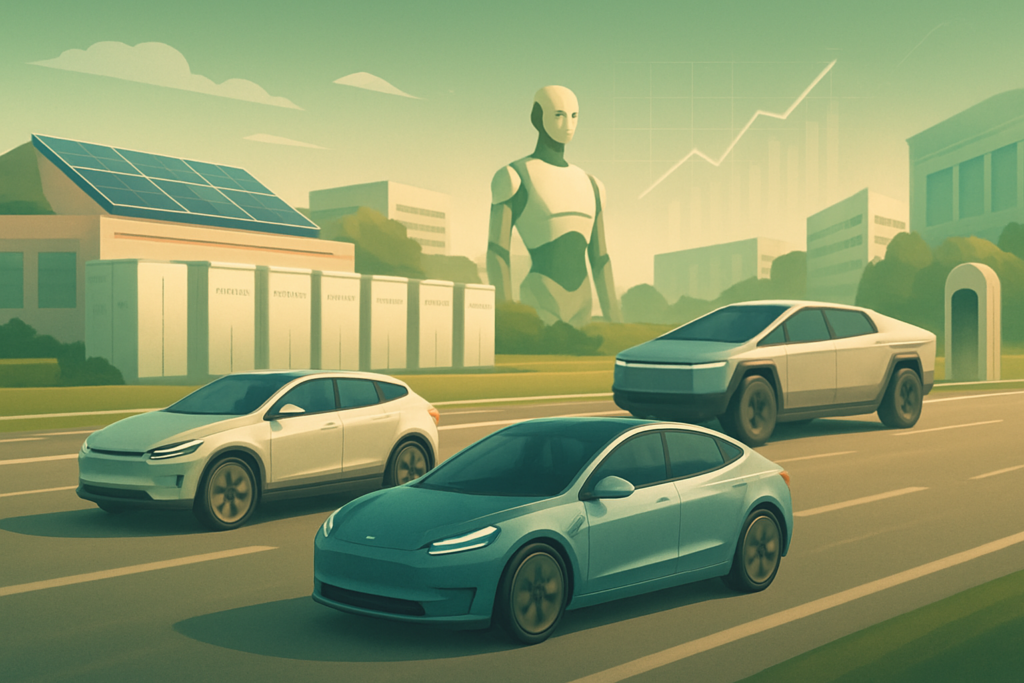
As of December 17, 2025, Tesla, Inc. (TSLA/NASDAQ) continues to command significant attention in the global markets, operating at the nexus of electric vehicles (EVs), clean energy, and cutting-edge artificial intelligence (AI). Co-founded in 2003, with Elon Musk taking the helm as CEO in 2008, Tesla’s mission to accelerate the world's transition to sustainable energy remains its guiding principle. In late 2025, Tesla is intensely focused on several transformative initiatives. A primary driver of current market interest is its rapid progress in autonomous driving, with Elon Musk confirming the commencement of fully driverless robotaxi testing in Austin, Texas. This development is pivotal to the company's long-term vision, shifting its valuation beyond traditional automotive metrics towards an AI-driven mobility platform. Concurrently, Tesla is making significant strides in humanoid robotics, with its Optimus robot poised for a production ramp-up in 2025, signaling an official entry into the commercial robotics market. To counter increasing competition and stabilize sales, Tesla is also strategically introducing more affordable EV models, such as the anticipated "Model Q" or "Model 2," slated for launch in the first half of 2025. This move aims to broaden its market appeal, particularly in the face of a general downturn in the U.S. EV market and the expiration of federal tax credits. Beyond automotive, Tesla's energy division, encompassing Powerwall and Megapack storage systems, is experiencing robust growth, with a new Megafactory in Shanghai commencing production in Q1 2025. This segment is increasingly recognized as a critical pillar for future revenue and profitability, contributing to grid stability and renewable energy integration. Tesla's continued relevance stems from its pioneering role in EV adoption, its relentless pursuit of AI and autonomy, and its expanding footprint in the global energy sector, even as it navigates intense competition and regulatory scrutiny. 2. Historical BackgroundTesla, Inc. (originally Tesla Motors) has profoundly impacted the automotive and energy industries since its inception, marked by a dynamic founding story, rapid product development, and strategic evolution. Named after the inventor Nikola Tesla, the company's journey highlights a consistent drive towards sustainable energy and technological innovation. Founding StoryTesla Motors was incorporated on July 1, 2003, by American engineers Martin Eberhard and Marc Tarpenning in San Carlos, California. Eberhard served as the CEO and Tarpenning as CFO, with their initial vision being to build a high-performance electric sports car, inspired by the positive reception to General Motors' EV1 experiment. They aimed to create a car manufacturer that was also a technology company, focusing on core technologies like batteries, software, and proprietary motors. Ian Wright joined them a few months later. In February 2004, Elon Musk led Tesla's Series A funding round, investing $6.5 million of the $7.5 million raised, becoming the company's chairman and largest shareholder. J.B. Straubel joined in May 2004 as chief technical officer. While Musk is widely recognized, a lawsuit settlement in 2009 allowed Eberhard, Tarpenning, Wright, Musk, and Straubel to all be recognized as co-founders. Early MilestonesTesla's early years were characterized by ambitious development and significant financial challenges:
Key Transformations and Strategic ShiftsTesla's evolution has been marked by several significant transformations:
Significant Product LaunchesTesla's product roadmap has expanded from niche sports cars to a diversified lineup:
3. Business ModelTesla's business model as of December 17, 2025, is characterized by its vertical integration and a strategic evolution beyond solely automotive manufacturing to encompass energy solutions and advanced AI/robotics. The company operates on a "full vehicle sales + self-charging network" model, with a layered approach to its long-term vision. Primary Revenue SourcesTesla's revenue streams are diverse, though automotive sales remain the largest contributor:
Product Lines1. Vehicles:
2. Energy Products:
ServicesTesla's service offerings are integral to its ecosystem:
Market Segments and Customer BaseTesla's target market is evolving, moving from a niche luxury segment to a broader consumer base.
Tesla's business model is increasingly framed as a "layered company." The electric vehicle business forms the foundational layer, generating cash flow and providing a platform for software-driven services. The middle layer is the autonomous driving business, envisioned as a high-margin mobility platform. The top layer, representing the long-term future, is the robotics business, particularly with the Optimus humanoid robot, which is expected to see external deliveries begin in late 2025. This strategic shift emphasizes Tesla as an "AI-driven platform company with physical products." 4. Stock Performance OverviewTesla (TSLA/NASDAQ) has demonstrated a highly dynamic and often volatile stock performance over the past decade, characterized by periods of exponential growth, significant pullbacks, and a consistent outperformance of broader market benchmarks over the longer term. As of December 17, 2025, the company's trajectory reflects its evolution from an electric vehicle (EV) pioneer to a broader artificial intelligence and robotics powerhouse. Past 1 Year Performance (December 2024 – December 2025)The past year for Tesla stock has been a rollercoaster, culminating in a new record high. On December 17, 2025, TSLA closed at $489.88. This marked its first record close since December 17, 2024, after trading above $490 intraday for the first time. The stock's 52-week low was $214.25, reached in early April 2025. Through December 11, 2025, Tesla's share price rose 8.8%. The year-to-date (YTD) total return for TSLA in 2025 is 21.31%.
Past 5 Years Performance (December 2020 – December 2025)Over the past five years, Tesla has experienced "explosive growth," solidifying its position as a global leader in the EV segment. The 5-year total return for TSLA stock is 135.99%. An investment of $1,000 in TSLA stock five years ago would be worth $2,359.85 today.
Past 10 Years Performance (December 2015 – December 2025)Over the last decade, Tesla has undergone a fundamental transformation, evolving from a niche EV manufacturer to a global leader in clean energy, autonomous driving, and electric vehicles. The 10-year total return for TSLA stock is a remarkable 3,033.43%. This represents an annualized return of 40.94%.
In summary, Tesla's stock performance over the past one, five, and ten years highlights its position as a disruptive force in multiple industries. While experiencing significant volatility, particularly in response to macroeconomic conditions, competitive pressures, and controversies surrounding its CEO, Elon Musk, its long-term growth has been driven by continuous innovation in EVs, autonomous driving, robotics, and energy solutions, consistently outperforming the broader market over extended periods. The company's future valuation is increasingly tied to its AI and robotics initiatives rather than solely its automotive sales. 5. Financial PerformanceTesla's Q3 2025 Financial Performance Reflects Record Revenue and Deliveries Amidst Significant Margin Compression and Strategic Investments Tesla (TSLA/NASDAQ) reported its Q3 2025 financial results on October 22, 2025, showcasing record revenue and vehicle deliveries. However, profitability metrics experienced a notable decline due to aggressive pricing strategies, increased operating expenses, and reduced regulatory credit income. The company's focus on future growth through AI and energy solutions remains a key theme. Key Financial Metrics (Q3 2025):
Valuation Metrics (as of December 17, 2025):
Significant Trends and Concerns:
6. Leadership and ManagementAs of December 17, 2025, Tesla's leadership and management are characterized by the influential role of CEO Elon Musk, a team of key executives, a board of directors facing scrutiny over compensation and independence, a strategic pivot towards artificial intelligence and robotics, and a corporate governance reputation marked by significant controversies and recent leadership changes. CEO: Elon MuskElon Musk serves as Tesla's Chief Executive Officer and Director, spearheading the company's overarching vision, product innovation, and strategic direction across electric vehicles (EVs), AI, robotics, and energy solutions. Strategic Approach: In 2025, Tesla's strategic focus underwent a significant clarification, repositioning the company less as an automaker and more as an AI-driven platform company with physical products. While electric vehicles remain foundational, the future emphasis is heavily placed on autonomy and robotics, particularly the development of driverless Robotaxis and the Optimus humanoid robot. Tesla has launched a limited, geofenced robotaxi pilot in Austin, Texas, and by December 2025, confirmed testing truly unsupervised rides, aiming for commercial operation and mass production of purpose-built autonomous vehicles like the Cybercab by April 2026. Musk envisions a future where vehicle owners can integrate their cars into a decentralized robotaxi network. The Optimus robot project also continues to show improvements in movement, balance, and task execution, with a bold vision for general-purpose robots in various sectors. Recent Changes/Controversies: A major development in November 2025 saw Tesla shareholders approve a new, performance-linked pay package for Elon Musk, potentially worth up to $1 trillion in Tesla stock over the next decade, tied to ambitious market capitalization and operational milestones. This package had previously faced rejection by a Delaware judge in January 2024 due to significant governance flaws, raising questions about conflicts of interest and compromising the board's independence in negotiations. Key ExecutivesTesla's executive leadership team is designed to be lean yet impactful, overseeing various critical functions. Key executives as of December 2025 include:
Recent Changes/Controversies: Tesla has experienced significant leadership changes and departures throughout 2025. Key figures responsible for the Model Y and Cybertruck projects, Siddhant Awasthi and Emmanuel Lamacchia, resigned on the same day in November 2025. Other high-level exits since mid-2024 and throughout 2025 include the director of the battery team, the head of Tesla's "Dojo" supercomputer team, the vice president of North American sales and service (Omead Afshar was fired in June 2025), the head of HR (Jenna Ferrua), and Milan Kovac, the lead engineer for the Optimus robot program. Some departures have been attributed to internal tensions, Musk's micromanagement, and his divided attention across multiple ventures like xAI and the Department of Government Efficiency (DOGE). These departures have raised concerns about leadership instability and technical depth, particularly in powertrain engineering (with the exit of Andrew Baglino, an 18-year veteran) and battery architecture (Vineet Mehta). Board of DirectorsRobyn Denholm serves as the Chair of Tesla's Board of Directors since 2018. Other notable members of the board include:
Recent Changes/Controversies: Tesla's board compensation has been a major source of controversy. Since 2004, the board has reaped over $3 billion in stock awards, an amount significantly exceeding that of directors at other major U.S. technology firms. Much of this compensation has come from stock options rather than shares, a practice criticized by corporate governance experts for magnifying upside potential with limited downside risk and potentially compromising directors' objectivity. Kimbal Musk alone has earned nearly $1 billion, and director Ira Ehrenpreis $869 million, from these stock options. A shareholder lawsuit in 2021 led to the suspension of new stock grants, and a Delaware court ruled that excessive pay and personal ties had compromised CEO-pay negotiations. In 2025, despite a four-year suspension of pay for some directors, average annual compensation for Tesla board members between 2018 and 2024 remained more than double that of Meta directors, the next highest-paid among "Magnificent Seven" tech companies. Company's Governance ReputationTesla's governance reputation as of December 2025 is a contentious issue, frequently drawing criticism from corporate governance experts and shareholders.
7. Products, Services, and InnovationsTesla, as of December 17, 2025, continues to be a prominent force in the automotive and energy sectors, driven by its diverse product and service offerings and an ambitious innovation pipeline. The company's strategy focuses on electric vehicles, energy solutions, and cutting-edge artificial intelligence and robotics to maintain its competitive edge. Tesla's Current Product and Service Offerings1. Vehicle Lineup:
2. Energy Products:
3. Software Services:
Innovation Pipeline and R&D FocusTesla's R&D efforts are strategically concentrated on several high-impact areas, aiming to push boundaries in AI, robotics, and manufacturing:
Key Patents:
Contribution to Competitive EdgeTesla's product, service, and innovation strategies collectively contribute to its competitive edge in several ways:
Despite intensifying competition from legacy automakers and nimble Chinese EV manufacturers, which has led to some market share erosion and margin pressures, Tesla's relentless focus on technological innovation, vertical integration, and ecosystem expansion, particularly in AI and robotics, continues to be its core strategy for long-term growth and competitive differentiation. 8. Competitive LandscapeAs of December 17, 2025, Tesla (TSLA/NASDAQ) faces a rapidly evolving and intensely competitive electric vehicle (EV) landscape. While still a prominent player, its market dominance is being challenged by traditional automakers, a surge of EV startups, and, most notably, aggressive Chinese manufacturers. Tesla's market share is showing signs of decline in key regions, despite an overall increase in global EV adoption. Tesla's Market Share and ShiftsTesla's global market share in Battery Electric Vehicles (BEVs) was approximately 13-13.4% in Q3 2025, ranking second globally. However, some estimates for Q1-Q3 2025 place it around 9%. Global EV sales saw robust growth in Q3 2025, surging 32-48% year-on-year. Regional Breakdown and Shifts:
Key Industry Rivals1. Traditional Automakers (Legacy Manufacturers):
2. EV Startups:
3. Chinese Manufacturers:
Tesla's Competitive StrengthsDespite increasing competition, Tesla retains several significant competitive advantages:
Tesla's Competitive WeaknessesTesla faces several challenges that could impact its long-term competitive position:
In conclusion, while Tesla maintains significant technological and brand strengths, its competitive landscape has become far more challenging by December 2025. The company is experiencing market share erosion across crucial global markets, primarily driven by the aggressive expansion and cost-competitiveness of Chinese EV manufacturers and the accelerated electrification efforts of traditional automakers. Tesla's ability to introduce more affordable models, refine its manufacturing processes, and continue innovating will be critical to navigating this evolving environment. 9. Industry and Market TrendsAs of December 17, 2025, Tesla (TSLA/NASDAQ) navigates a dynamic landscape shaped by evolving trends across the EV and renewable energy sectors, macroeconomic shifts, and intricate supply chain dynamics. Consumer demand, while generally robust for EVs, is also subject to cyclical economic effects and shifting sentiment. Sector-Level Trends: EVs and Renewable EnergyElectric Vehicles (EVs):
Renewable Energy:
Macro DriversEconomic Growth:
Interest Rates:
Supply Chain DynamicsBattery Materials:
Chips (Semiconductors):
Cyclical Effects on Consumer DemandConsumer demand for EVs shows a complex picture. While global EV sales are growing, there are regional variations and shifts in sentiment.
10. Risks and ChallengesAs of December 17, 2025, Tesla (TSLA/NASDAQ) navigates a complex landscape marked by significant operational, regulatory, controversial, and market-related challenges. While the company continues its pivot towards becoming an AI-driven platform focused on autonomy and robotics, its traditional automotive business faces considerable headwinds. Operational Risks Tesla faces several operational hurdles that impact its production capabilities and supply chain efficiency:
Regulatory Risks Tesla is under intense regulatory scrutiny across multiple jurisdictions, particularly concerning its advanced driver-assistance systems and environmental practices:
Controversies Controversies surrounding Tesla's CEO, Elon Musk, and product quality continue to pose challenges:
Market Risks Tesla faces a more challenging market environment characterized by increasing competition, softening demand, and macroeconomic pressures:
11. Opportunities and CatalystsAs of December 17, 2025, Tesla (TSLA/NASDAQ) stands at a pivotal juncture, with a range of opportunities and catalysts poised to drive its growth across diverse sectors. The company is strategically redefining itself beyond just an electric vehicle (EV) manufacturer, increasingly emphasizing its role as an AI-driven platform company with significant advancements in autonomy, robotics, and energy solutions. Key Opportunities and Catalysts: 1. Growth Levers (New Products & Market Expansion)
2. New Technologies
3. M&A Potential While specific M&A targets or rumors for Tesla are not prominently highlighted in the provided information as of December 2025, the company's strong cash position ($33 billion in Q3 2024) and low debt could provide the flexibility for strategic acquisitions if opportunities arise that align with its AI, robotics, or energy ambitions. 4. Near-Term Events
Other Catalysts:
12. Investor Sentiment and Analyst CoverageAs of December 17, 2025, investor sentiment for Tesla (TSLA/NASDAQ) presents a complex picture, characterized by a prevailing "Hold" consensus among Wall Street analysts, highly divergent price targets, significant institutional activity, and a retail investor base heavily influenced by the company's long-term artificial intelligence (AI) and robotaxi ambitions, often outweighing near-term fundamental concerns. Wall Street Analyst Coverage and Price Targets The consensus among Wall Street analysts for Tesla (TSLA) is currently a "Hold" rating. Across various reports, the number of analysts covering TSLA ranges from 26 to 56, but the overall sentiment leans neutral. For instance, out of 33 analysts, 12 recommend "Buy," 12 suggest "Hold," and 9 advise "Sell." Another perspective from 26 analysts indicates 23% Strong Buy, 23% Buy, 31% Hold, 12% Sell, and 12% Strong Sell ratings. Similarly, an average recommendation of 2.7 (on a scale of 1=Strong Buy to 5=Sell) from 54 brokerage firms also points to a "Hold" status. Price targets for TSLA vary significantly, reflecting the wide range of opinions on the company's future. The median one-year price target is $386.42, implying a potential downside of 18.70% from recent trading prices. The average target price across 42 analysts is $377.50, with estimates ranging from a bearish $19.05 to a highly bullish $600.00. This average also suggests a downside of approximately 17.75% from the December 15, 2025, price of $458.96. Other average price targets reported include $379.08 and $400.86. Recent notable analyst price targets and ratings include:
Hedge Fund Movements and Institutional Investor Positions Hedge fund activity and institutional ownership in TSLA have shown dynamic shifts throughout 2025. In Q2 2025, institutional ownership surged as prominent players like Vanguard Group and Goldman Sachs significantly increased their holdings, positioning Tesla as a top addition to hedge fund portfolios, often alongside other AI-driven tech giants like Amazon and Microsoft. By the end of Q3 2025, 99 hedge funds reported holding TSLA in their portfolios, an increase from 85 in the previous quarter. Overall, hedge funds are reported to hold approximately 66.2% of the stock. However, the institutional landscape is not uniform. As of December 8, 2025, institutional owners held 48.12% of the company's float, with 117 institutions having entirely liquidated their positions over the past year. Despite some selling, major institutional holders like Vanguard Group Inc, BlackRock, Inc., State Street Corp, and JPMorgan Chase & Co. remain significant shareholders. Notably, Norges Bank and Vanguard increased their positions recently. Insider trading activity reveals a mixed signal: while Director Kimbal Musk and CFO Vaibhav Taneja engaged in selling shares, CEO Elon Musk made 25 purchases totaling over 2.5 million shares, valued at nearly $1 billion, within the last six months, with no reported sales. Retail Investor Chatter and Trends Retail investor sentiment appears largely bullish, driven primarily by Tesla's long-term vision in AI, robotics, and robotaxi technology, often overshadowing concerns about its core electric vehicle (EV) business fundamentals. Tesla shares saw a significant surge on December 17, 2025, in pre-market trading, signaling renewed investor confidence specifically in its robotaxi ambitions. Analysts highlighted Morgan Stanley's projection of scaling an autonomous vehicle fleet to a million units by 2035, fueling optimism. Investors seem to be betting on Tesla's ability to monetize its existing EV fleet through autonomous features, moving focus from long-term R&D to potential tangible revenue streams. Despite this optimism, some retail chatter reflects skepticism regarding the timeline and efficacy of Full Self-Driving (FSD), with comments noting delays since 2016. Significant Shifts in Sentiment or Consensus Tesla's sentiment has undergone significant shifts throughout 2025. The stock experienced a challenging start to the year, sliding over 30% in the first three months. This downturn was attributed to weakening sales in key markets like Europe and China, intensified competition from rivals such as BYD, and investor unease over CEO Elon Musk's increasing involvement in politics, which was perceived to divert his attention from the company. However, sentiment began to rebound, with shares more than doubling from an April low. This recovery was largely fueled by renewed investor enthusiasm for Musk's vision in AI and robotics, a narrative that has increasingly become a dominant factor in Tesla's valuation, often overshadowing concerns about its core EV business. The third quarter of 2025 saw record vehicle deliveries, partially boosted by a rush of buyers ahead of the expiration of the $7,500 U.S. federal EV tax credit. However, analysts anticipate a weaker Q4, citing intensifying competition, diminishing impact of price cuts, the absence of tax credit incentives, and potential brand backlash due to Musk's political activities. Despite these near-term headwinds and fundamental concerns, the stock surged to a new all-time high in mid-December 2025. This indicates a clear divergence: while short-term fundamental outlooks raise caution, long-term speculative optimism, particularly around Tesla's AI and robotaxi potential, continues to drive investor confidence and stock performance. This trend highlights that Tesla's valuation is heavily influenced by future technological leadership rather than solely current vehicle performance. Short interest in TSLA has fluctuated, with 78.30 million shares shorted as of November 28, 2025, representing 3.28% of the public float. This indicates a slight increase from 71.19 million shares on November 14, 2025, but a decrease from earlier levels in 2025 where it reached 81 million shares, reflecting a mixed but generally significant level of bearish bets earlier in the year. 13. Regulatory, Policy, and Geopolitical FactorsAs of December 17, 2025, Tesla (TSLA/NASDAQ) operates within a dynamic and complex global landscape shaped by evolving regulatory frameworks, significant policy shifts, and persistent geopolitical tensions. These factors present both substantial challenges and strategic opportunities for the electric vehicle (EV) and clean energy giant. Regulatory and Compliance FactorsTesla faces increasing scrutiny across multiple regulatory domains, particularly concerning its advanced driver-assistance systems and overall vehicle safety.
Policy Factors: Government Incentives for EVs and Renewable EnergyGovernment policies continue to play a crucial role in shaping the EV market and supporting renewable energy adoption, directly impacting Tesla's automotive and energy divisions.
Geopolitical FactorsGeopolitical dynamics, particularly U.S.-China relations and broader supply chain vulnerabilities, pose significant risks and opportunities for Tesla's global operations.
14. Outlook and ScenariosAs of December 17, 2025, Tesla (TSLA/NASDAQ) stands at a pivotal juncture, actively transitioning its core identity from primarily an electric vehicle (EV) manufacturer to a full-stack artificial intelligence (AI) and robotics enterprise. This strategic pivot, coupled with evolving market dynamics and technological advancements, defines its future outlook. The company's stock is currently trading near its all-time high, reflecting significant investor expectations tied to its ambitious long-term projects despite some near-term challenges in its automotive segment. Short-Term Outlook (Next 1-2 years: 2026-2027)Current Landscape (Late 2025): However, Tesla's energy storage segment (Megapack, Powerwall) is a bright spot, posting record gross profits in Q3 2025, fueled by demand from AI data centers, and is projected to double its revenue to $18 billion by 2026. Bull Case (2026-2027):
Bear Case (2026-2027):
Long-Term Outlook (3-5+ years: 2028-2030 and beyond)Bull Case (2028-2030+):
Bear Case (2028-2030+):
Potential Strategic Pivots or Key Inflection Points:
In conclusion, Tesla is at an "asymmetric future", where its valuation is increasingly tied to its long-term AI and robotics aspirations, potentially unlocking unprecedented growth if successful. However, the journey is fraught with significant execution risks, regulatory hurdles, and intense competition, making for a highly volatile and uncertain, yet potentially transformative, outlook. 15. ConclusionTesla (TSLA/NASDAQ) has navigated a challenging yet transformative 2025, marked by fluctuating financial performance, intensifying competition in its core electric vehicle (EV) business, and significant strides in its ambitious AI, robotics, and energy sectors. As of December 17, 2025, a balanced perspective for investors highlights both substantial opportunities and considerable risks. Key Findings from 2025: 1. Mixed Financial Performance and Shifting Revenue Drivers: 2. Intensified Competition and Declining EV Market Share (Especially in Europe): 3. Accelerated Progress in AI, Autonomy, and Energy Storage:
4. Leadership Scrutiny and Strategic Refocus: Investor Watchpoints (as of 12/17/2025): Short-Term (Next 6-12 Months):
Long-Term (1-5 Years and Beyond):
Conclusion: Tesla remains a high-risk, high-reward investment. While its core EV business faces significant near-term pressure from increased competition and slowing demand in key markets, its ambitious long-term vision in AI, autonomous driving, robotics, and advanced energy solutions offers substantial growth potential. For investors, Tesla's future is increasingly tied to the successful execution and commercialization of these emergent technologies. The stock's current high valuation (P/E ratio around 300) reflects significant future growth expectations, making it particularly sensitive to progress in these areas and susceptible to volatility. A discerning investor will monitor not just vehicle delivery numbers, but more importantly, the tangible advancements and monetization strategies in Tesla's AI-driven initiatives and energy solutions. This content is intended for informational purposes only and is not financial advice More NewsView More
Via MarketBeat
2 Stocks to Avoid as Crypto Momentum Wanes ↗
December 21, 2025
Via MarketBeat

3 Dividend Growth Stocks Analysts Are Upgrading for 2026 ↗
December 21, 2025
Via MarketBeat
These 3 Banks Are Rallying Into Year-End, But Will It Continue? ↗
December 20, 2025
Via MarketBeat

Recent QuotesView More
Stock Quote API & Stock News API supplied by www.cloudquote.io
Quotes delayed at least 20 minutes. By accessing this page, you agree to the Privacy Policy and Terms Of Service.
© 2025 FinancialContent. All rights reserved.
|