Ola Electric (OLAELECTRIC) Deep Dive: Navigating the 2025 Crossroads Amidst Founder Share Sales and Market Shifts
By:
PredictStreet
December 18, 2025 at 10:41 AM EST
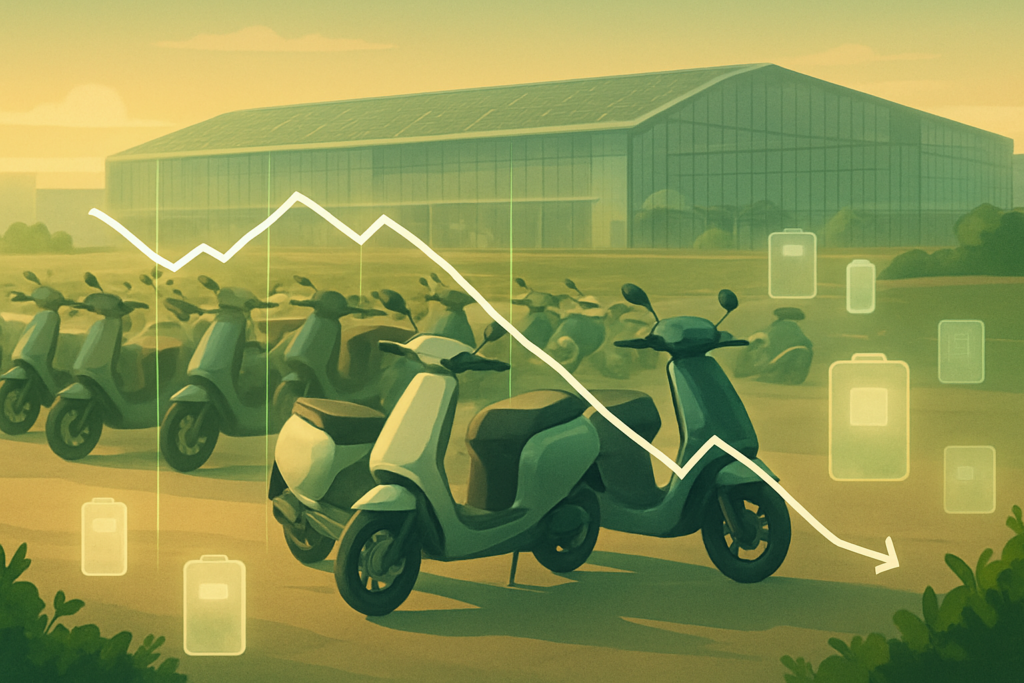
As of December 18, 2025, Ola Electric Mobility Ltd. (NSE: OLAELECTRIC; BSE: 544230) finds itself at a critical crossroads. Once the poster child of India’s electric vehicle (EV) revolution, the company has transitioned from a market-dominating disruptor to a embattled player fighting for its place in an increasingly crowded arena. The stock, which debuted with much fanfare in August 2024, has faced a grueling 2025, characterized by a sharp erosion in market share and persistent service-quality concerns. This week, the narrative took another dramatic turn as founder and CEO Bhavish Aggarwal executed a substantial share sale through open market transactions. This move, intended to clear promoter-level debt and eliminate share pledges, has sparked intense debate among institutional investors and retail traders alike. With the stock trading at a significant discount to its IPO price and legacy manufacturers gaining ground, this deep-dive examines whether Ola Electric is a falling knife or a generational value opportunity. Historical BackgroundOla Electric was born out of the ride-hailing giant Ola (ANI Technologies) in 2017, initially as a pilot project for electric mobility. By 2019, it was spun off into a separate entity with a bold mission: to end the era of internal combustion engine (ICE) two-wheelers in India. The company’s rise was meteoric. In 2021, it launched the S1 and S1 Pro scooters, backed by a massive marketing campaign and a "Futurefactory" in Tamil Nadu designed to be the world's largest two-wheeler plant. Despite early hiccups with delivery timelines and software glitches, Ola Electric successfully captured over 50% of the Indian electric two-wheeler (E2W) market by early 2024. Its initial public offering (IPO) in August 2024 was seen as a litmus test for the Indian tech ecosystem, raising ₹6,145 crore and valuing the company at roughly $5 billion. However, the post-IPO period has been marked by operational growing pains and a resurgent challenge from India’s traditional automotive giants. Business ModelOla Electric operates an uniquely integrated business model that distinguishes it from traditional OEMs:
Stock Performance OverviewThe stock’s journey since its August 2024 IPO at ₹76 per share has been a volatile descent.
Financial PerformanceOla Electric’s financials for the fiscal year ending March 2025 (FY25) and the first half of FY26 reflect a company in a difficult transition.
Leadership and ManagementBhavish Aggarwal, the visionary founder, remains the central figure and primary driver of the company’s strategy. Known for his aggressive timelines and "first-principles" thinking, Aggarwal is both Ola's greatest asset and a point of scrutiny for governance experts. The management team has seen some turnover in 2025, as the company pivoted from a "growth-at-all-costs" phase to a "service-and-cell" focus. The recent share sale by Aggarwal was officially characterized as a strategic move to clean up the promoter balance sheet. However, analysts note that the optics of the founder selling a large stake while the share price is at record lows has hurt retail investor confidence. Governance reputation remains a "work in progress," with the board recently adding more automotive veterans to provide a steady hand during the production ramp-up. Products, Services, and InnovationsInnovation is the pillar upon which Ola Electric’s bull case rests.
Competitive LandscapeThe competitive environment has shifted drastically. In 2023, Ola was the clear leader. In late 2025, it has fallen to 5th place in market share.
Industry and Market Trends
Risks and Challenges
Opportunities and Catalysts
Investor Sentiment and Analyst CoverageSentiment is currently Bearish to Neutral.
Regulatory, Policy, and Geopolitical FactorsThe Indian government remains committed to its 2030 EV targets, providing a strong tailwind. Ola is a major beneficiary of the Production Linked Incentive (PLI) scheme for both Advanced Chemistry Cell (ACC) battery storage and automobile manufacturing. These incentives are expected to start hitting the income statement in late 2025 and 2026, providing a much-needed buffer for the bottom line. ConclusionOla Electric’s story in late 2025 is one of "disruption interrupted." The company’s bold vision of vertical integration and market dominance has been tempered by the harsh realities of automotive manufacturing and a fierce counter-attack from legacy players. The founder’s recent share sale, while logically aimed at cleaning up the balance sheet, serves as a poignant symbol of the company's current struggle for stability. Investors should watch two key metrics in 2026: the yield and cost-benefit of the Bharat Cell and the market reception of their electric motorcycles. If Ola can fix its service reputation and leverage its Gigafactory to win the price war, it may yet reclaim its crown. For now, it remains a high-beta, high-risk bet on the future of Indian mobility. This content is intended for informational purposes only and is not financial advice. Today's date: 12/18/2025. More NewsView More
Via MarketBeat
Forget the Chips: 4 Industrial Plays for the AI Rebound ↗
Today 15:49 EST

MongoDB Could Hit Record Highs—But You’ll Need to Move Fast ↗
Today 14:36 EST
Via MarketBeat
Tickers
MDB

Via MarketBeat
Tickers
DG
Don’t Bet Against AppLovin: The Case Against the Shorts ↗
Today 12:36 EST
Via MarketBeat
Tickers
APP
Recent QuotesView More
Stock Quote API & Stock News API supplied by www.cloudquote.io
Quotes delayed at least 20 minutes. By accessing this page, you agree to the Privacy Policy and Terms Of Service.
© 2025 FinancialContent. All rights reserved.
|